
How to Remove Hard Water Stains From Glass Shower Doors
A clear glass shower can make a bathroom feel larger and brighter, but it also shows every water spot. If you’re trying to figure out how to remove hard water stains from glass shower doors, the first step is understanding what caused the cloudy buildup in the first place.
That film is usually more than dirt.
When water evaporates from the glass, dissolved minerals are left behind. Repeated cycles of wetting and drying allow those deposits to build on the surface. Soap residue, shampoo, body oils, and cleaning products can make the buildup even more noticeable.
The good news is that many hard water stains can be removed at home. The important part is knowing what you are looking at and using a cleaning method that is appropriate for your particular glass.
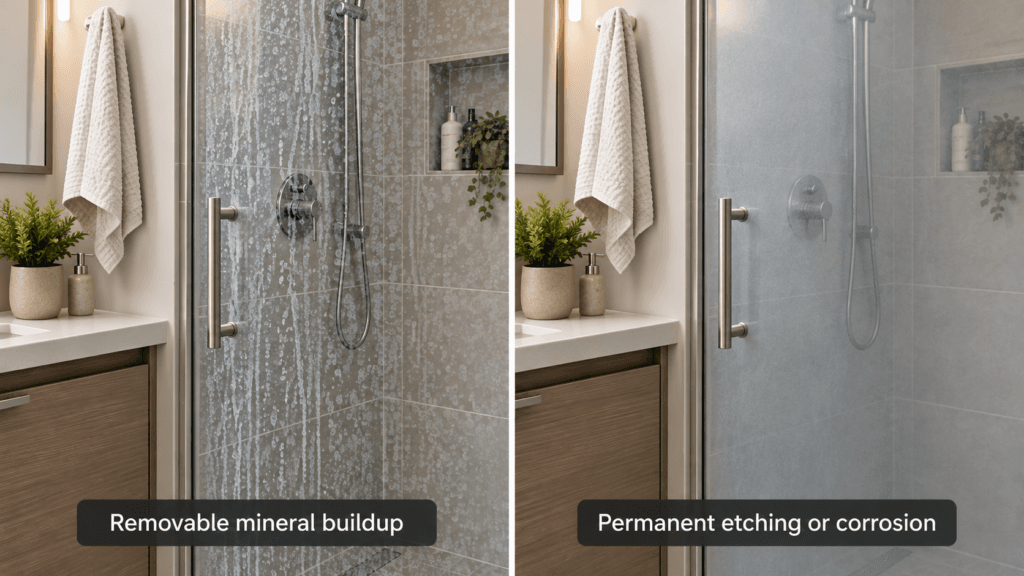
If the stains have been neglected for years, however, some of the cloudy appearance may no longer be removable mineral buildup. The glass itself may have become permanently stained or corroded.
What Is Actually on Your Shower Glass?
Not every cloudy shower door has the same problem.
| What you see | Likely cause | Typical approach |
|---|---|---|
| Light water spots | Fresh mineral deposits | Mild cleaner and microfiber cloth |
| White or chalky film | Hard water scale | Manufacturer-approved mineral removal method |
| Greasy or streaky haze | Soap scum and body oils | Mild detergent before mineral treatment |
| Spots that resist mild acidic cleaning | Heavy buildup, silica, or surface damage | More cautious cleaning or professional assessment |
| Permanent cloudy or etched appearance | Glass corrosion or etching | Cleaning may not fully restore it |
This distinction matters because homeowners often begin scrubbing harder when a stain does not come off.
That can make things worse.
If the problem is mineral buildup, the goal is to dissolve or loosen the deposits. If the surface has already been damaged, aggressive scrubbing will not restore the glass and may add scratches on top of the existing problem.
Check Whether Your Shower Glass Has a Protective Coating
Before using vinegar, mineral remover, abrasive cleanser, razor blades, or polishing products, find out whether the glass has a protective surface treatment.
Modern shower enclosures may use factory-applied protective glass such as ShowerGuard or HydroClear, or an aftermarket hydrophobic coating such as EnduroShield. These products do not necessarily have the same care instructions.
For example, Guardian recommends a 50/50 mixture of white vinegar and water for hard-water buildup on ShowerGuard glass, and Cardinal permits the same mixture on HydroClear. At the same time, manufacturers place specific restrictions on abrasives, strong chemicals, razor blades, and polishing products.
If you know the manufacturer, check its cleaning instructions first.
If you do not know what is on the glass, start with the gentlest cleaning method rather than assuming the strongest product is better.
Start by Removing Soap and Surface Grime
Mineral deposits are often mixed with soap scum, so jumping directly to a hard-water treatment can make the job more difficult.
Rinse the glass with warm water and clean it first with a mild detergent or a cleaner approved for your enclosure.
Use a soft microfiber cloth or non-abrasive sponge.
The purpose of this first pass is not necessarily to remove the mineral staining. You are removing the oils and soap sitting on top of it so the next cleaning step can reach the deposits underneath.
Rinse the glass thoroughly afterward.
At this point, look at the surface again. Sometimes a large part of what appeared to be hard-water staining was actually soap residue.
How to Remove Hard Water Stains From Glass Shower Doors Safely
The safest way to remove hard water stains from glass shower doors is to start with the mildest cleaning method recommended for your specific glass or protective coating.
For glass where the manufacturer permits it, a common approach is a mixture of equal parts white vinegar and water. Guardian specifically recommends this concentration for hard-water deposits on ShowerGuard glass, while Cardinal lists it as acceptable for HydroClear.
Apply the solution with a soft cloth or non-abrasive sponge and give it a little time to work on the deposit rather than immediately scrubbing aggressively.
Keep the cleaner from sitting unnecessarily on metal hinges, handles, brackets, or decorative finishes. The glass and the hardware around it may have completely different cleaning requirements.
Work the surface gently, then rinse thoroughly with clean water and dry it.
If the deposits are relatively recent, you may see a dramatic improvement after one cleaning.
Older buildup may require more than one treatment.
Repeated gentle cleaning is usually preferable to attacking the glass with an aggressive abrasive.
Be Careful With Commercial Hard-Water Removers
A product labeled for calcium, lime, or rust does not automatically mean it is safe for every shower enclosure.
Some specialty shower-glass manufacturers specifically prohibit certain mineral-removal chemicals on their coated surfaces. Cardinal, for example, lists several strong cleaners, abrasive products, polishing compounds, and products containing hydrofluoric or phosphoric acid among items that should not be used on HydroClear-coated glass.
This is one of the most important practical rules when cleaning shower glass:
Choose the cleaner based on the glass you actually own, not simply on how stubborn the stain looks.
The same applies to aftermarket protective coatings. A cleaner that is harmless to ordinary untreated glass may shorten the life of a surface treatment.
If you cannot identify the coating, test any new cleaner in a small, inconspicuous area first.
Do Not Reach for a Razor Blade Too Quickly
Razor blades are sometimes recommended online for removing deposits from glass.
They can also scratch glass, damage coatings, catch on surface imperfections, and damage nearby seals or hardware.
The National Glass Association’s shower-enclosure guidance recommends non-abrasive care and advises against tools and cleaning agents that can scratch glass or damage enclosure finishes.
The same caution applies to steel wool, abrasive pads, powdered cleansers, and aggressive polishing.
There are professional restoration methods that intentionally polish damaged glass, but that is different from casually scrubbing a shower door with whatever abrasive happens to be available.
What If Vinegar Does Not Remove the Spots?
This is where shower-glass cleaning becomes more interesting than most online advice suggests.
Not all water spotting is simply calcium scale.
Guardian separates typical hard-water staining from high-silica conditions. Its care guidance notes that hard-water spots may respond to diluted vinegar, while high-silica deposits can require a different cleaning approach.
That means a stain that does not respond to vinegar does not automatically need stronger acid.
You may be dealing with a different mineral deposit, heavy long-term buildup, or actual deterioration of the glass surface.
If several careful cleaning attempts make little difference, continuing to increase the strength of the cleaner can do more harm than good.
Hard Water Stains vs. Permanently Damaged Glass
Fresh mineral deposits sit on the surface and can often be removed.
Long-term exposure is different.
Shower glass is repeatedly exposed to water, heat, humidity, soaps, cleaners, and dissolved minerals. Over time, untreated glass can develop surface corrosion that leaves it cloudy even after deposits have been removed. Manufacturers of protective shower glass specifically design their products to resist this type of deterioration.
One clue is what happens when the glass is wet.
If the cloudy appearance almost disappears while the glass is wet but returns as soon as it dries, there may still be surface deposits that can potentially be improved.
If the haze remains essentially unchanged after proper cleaning, the surface itself may be damaged.
At that stage, normal household cleaning has reached its limit.
Professional glass-restoration companies may be able to improve some damaged surfaces through controlled polishing, but severely etched or corroded shower glass sometimes needs to be replaced.
Preventing the Stains From Coming Back
Once the glass is clean, prevention is much easier than another major restoration.
The simplest habit is also one of the most effective: remove water before it dries.
The National Glass Association recommends frequently squeegeeing shower glass and drying it with a soft cloth to reduce spotting and scale buildup. Guardian likewise recommends using a squeegee or towel after showering to reduce mineral and soap deposits.
You do not have to make the enclosure perfectly dry after every shower.
The goal is simply to prevent hundreds of droplets from repeatedly evaporating on the same surface.
Regular light cleaning also works better than waiting until the glass turns cloudy.
In especially hard-water areas, you may need to clean more frequently because every shower leaves another small amount of mineral behind.
Does a Water Softener Solve the Problem?
A water softener can reduce some of the minerals responsible for traditional hard-water scale, but that does not necessarily mean your shower glass will stop spotting.
Water can contain other dissolved materials, including silica, that are not eliminated in the same way. Guardian specifically notes that homeowners with water softeners can still experience spotting from silica.
A softener can make maintenance easier in some homes, but it is not a substitute for keeping the glass clean and dry.
Are Protective Glass Coatings Worth It?
If you are replacing a shower enclosure or installing one as part of a bathroom remodel, glass protection is worth understanding before the glass is ordered.
There are two broad approaches.
Some glass products receive a permanent protective surface during manufacturing. Others use an aftermarket hydrophobic coating applied to the finished glass.
Both are intended to make contamination harder to bond to the surface, but maintenance requirements and durability vary by product.
They also do not make the shower maintenance-free.
Even protected glass can develop water spots if mineral-rich droplets are repeatedly allowed to dry. The advantage is that contaminants generally become easier to remove and the glass receives additional protection against long-term staining or corrosion.
If you are already comparing shower enclosures, Builzee’s 3/8 vs. 1/2 Shower Glass: Which Thickness Is Better? explains how glass thickness affects feel, weight, hardware, cost, and the overall design of a frameless shower.
Be Just as Careful With the Hardware
The glass may be the largest surface, but the most vulnerable parts of a shower enclosure can be the hinges, clamps, handles, channels, and decorative finishes around it.
A cleaner that is acceptable on the glass can damage plated or coated hardware.
Strong chemicals can discolor finishes, while abrasives can permanently change their appearance.
Avoid spraying aggressive cleaners over the entire enclosure and assuming every material can tolerate the same treatment.
Apply cleaners carefully to the glass and rinse surrounding areas when you are finished.
This is especially important with matte black, brushed, plated, or specialty hardware finishes.
When Cleaning Is No Longer Enough
There is a point where more cleaning stops being useful.
If the glass remains cloudy after the appropriate deposits have been removed, professional restoration may be worth investigating before replacing the enclosure.
Replacement becomes more reasonable when the surface is heavily etched, scratched, chipped, or permanently discolored, particularly if the enclosure is already older or the hardware is approaching the end of its useful life.
You should also stop if you are uncertain what coating is on the glass and increasingly aggressive cleaners are producing no improvement.
A damaged coating plus damaged glass is harder to correct than the original water spots.
Bottom Line
Most hard water stains on glass shower doors begin as mineral deposits left behind when water evaporates.
The safest way to remove them is to start gently. Clean away soap and surface grime first, identify whether the glass has a protective coating, and then use a mineral-removal method approved for that particular surface.
Do not assume stronger chemicals or harder scrubbing will produce a better result.
If mineral deposits sit on the glass for long periods, some staining can eventually become permanent surface damage. At that point, ordinary cleaning may no longer restore the original clarity.
Once the glass is clean, regular light cleaning and a quick squeegee after showering are far easier than removing years of accumulated hard-water scale.
Planning Your Next Bathroom Project?
Explore Builzee’s guides for showers, bathroom remodeling, materials, costs and other bathroom projects before you start.