Kitchen Backsplash Ideas: Tile, Slab, Peel-and-Stick & More
A backsplash does more than fill the wall between the countertop and upper cabinets. It protects a hard-working part of the kitchen from splashes, grease and everyday cleaning, but it also has a big effect on how the room looks.
The best kitchen backsplash ideas balance those two jobs. A dramatic slab can make the backsplash the focal point of the room, while a simple tile can quietly support the cabinets and countertops. In some kitchens, keeping the backsplash understated is the better choice.
If you are choosing countertops at the same time, start with Builzee’s Kitchen Countertops & Surfaces Guide. The countertop and backsplash are usually seen together, so it helps to make those decisions as a pair rather than choosing each one separately.
Start With the Countertop
Before getting too deep into backsplash colors and patterns, look at the countertop.
If the countertop already has strong veining, movement or color variation, a quieter backsplash usually keeps the kitchen from feeling too busy. A more subdued quartz, solid-color surface or butcher block gives you more freedom to make the backsplash a focal point.
A useful rule is to decide which surface should lead.
If the countertop is the feature, let the backsplash support it. If the countertop is simple, the backsplash can carry more pattern, texture or color.
Trying to make both surfaces compete for attention is one of the easiest ways to make a kitchen feel visually crowded.
Tile Backsplashes
Tile remains one of the most flexible backsplash choices because there are so many materials, sizes, colors and installation patterns available.
It can work in almost any style of kitchen, from traditional to contemporary, and it is usually easier to repair than a large slab if one area becomes damaged.
The tradeoff is grout.
Even when the tile itself is easy to clean, grout lines add joints that can collect residue and require more maintenance than a continuous surface.
Ceramic Tile
Ceramic tile is a practical choice for many kitchens.
It is available in an enormous range of colors and shapes, from plain white rectangles to handmade-looking decorative tiles. It can also be one of the more affordable ways to cover a large backsplash area.
For homeowners who want a classic backsplash without making the kitchen feel trendy, simple ceramic tile is difficult to go wrong with.
Porcelain Tile
Porcelain is generally denser and less porous than standard ceramic tile.
It works well in kitchens where durability and easy cleaning are priorities, and it can imitate stone, concrete and other materials surprisingly well.
Large-format porcelain tile can also reduce the number of grout joints compared with smaller tile.
Subway Tile
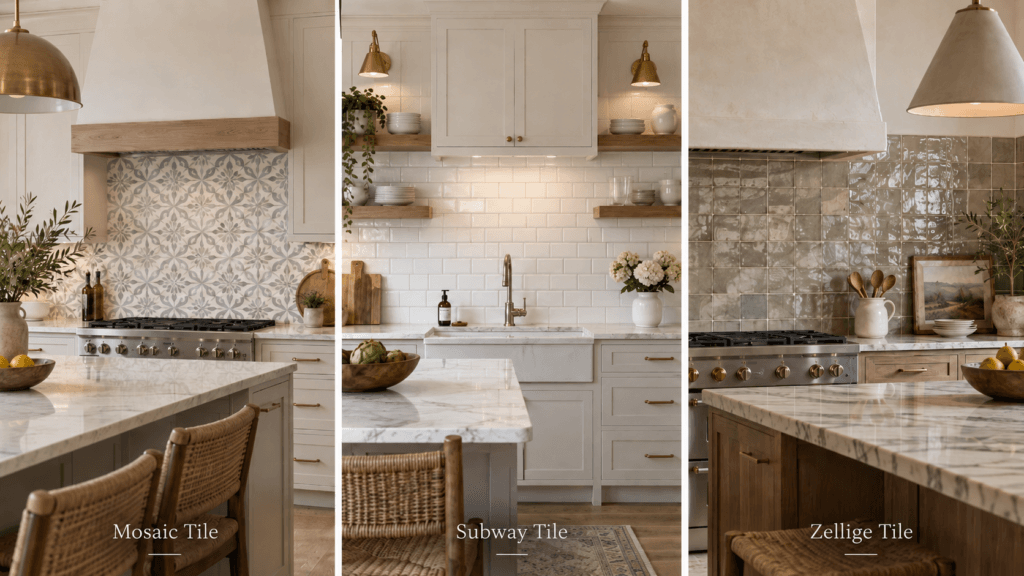
Subway tile is still common because it is simple, flexible and works with many cabinet styles.
The traditional version is a white rectangular tile installed in a running-bond pattern, but that is only one option.
You can change the look considerably by using:
- A longer or narrower tile
- A vertical stack
- A straight horizontal stack
- A contrasting grout
- A handmade or irregular surface
- A colored or glossy glaze
If the kitchen already has a lot happening visually, a simple subway tile can be a good way to keep the backsplash from competing with everything else.
Zellige and Handmade-Look Tile
Zellige and other handmade-look tiles have become popular because of their imperfect edges, glossy surfaces and variation from piece to piece.
They can add depth to an otherwise simple kitchen without relying on a busy pattern.
The variation is part of the look. If you want perfectly straight lines and a uniform surface, this may not be the right direction.
These tiles also tend to create more visible grout and surface variation than a flat, machine-made tile, so installation quality matters.
Natural Stone Tile
Marble, limestone and other natural stone tiles can give a backsplash a more traditional or high-end appearance.
Because stone is a natural material, expect variation in color, pattern and texture.
Some natural stones are also more porous than ceramic or porcelain and may need sealing or more careful cleaning. Before choosing one, think about how much cooking actually happens in the kitchen and how willing you are to maintain the material.
A beautiful material that makes you nervous every time tomato sauce splashes on it may not be the best fit for your household.
Full-Height Slab Backsplashes
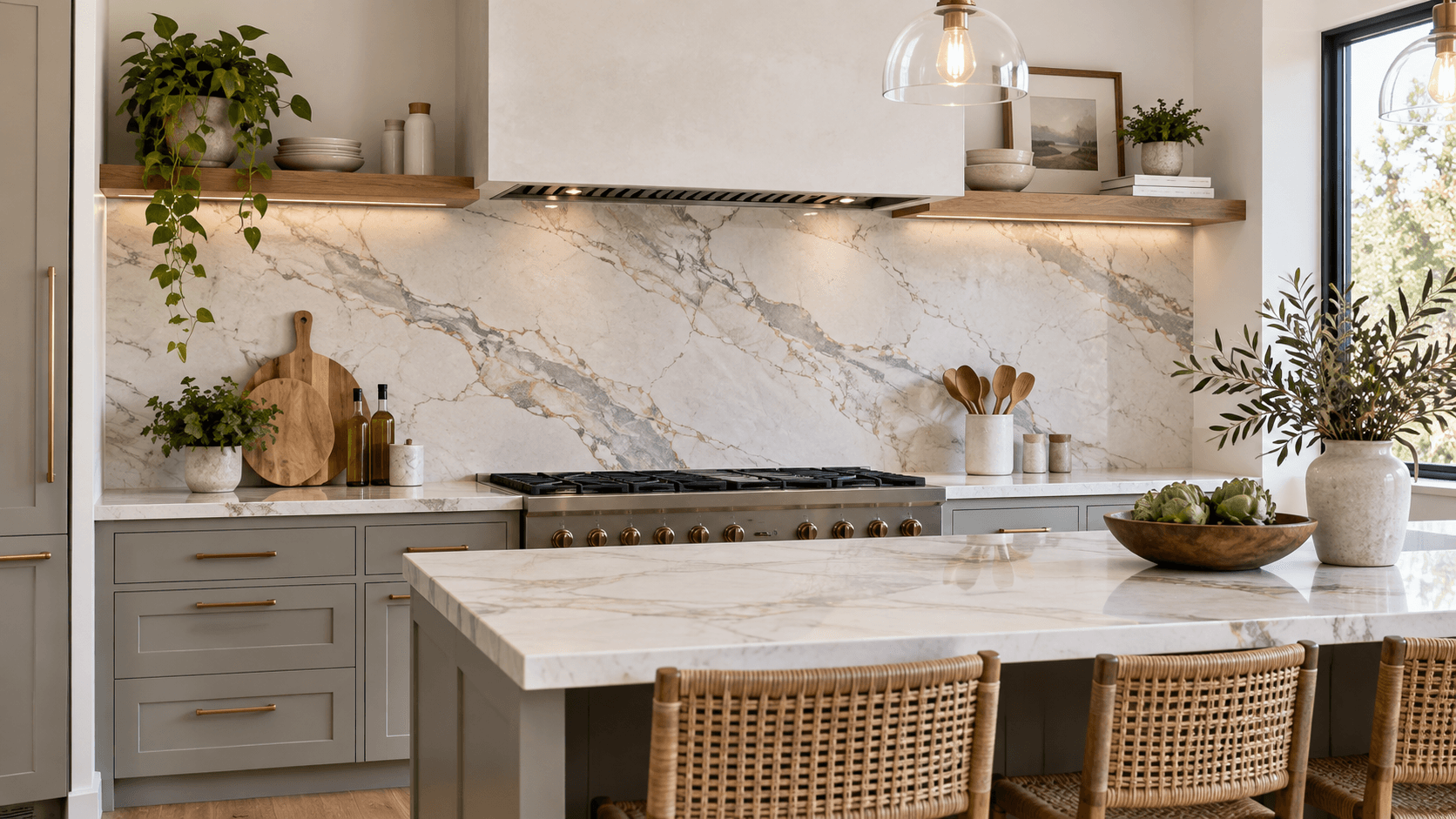
A slab backsplash uses a large continuous piece of stone, quartz, porcelain or another sheet material rather than individual tiles.
This creates a very clean look with fewer joints.
It is especially effective when the same or a coordinating material is used on both the countertop and backsplash.
A full-height slab can run from the countertop all the way to the underside of the upper cabinets or range hood.
The biggest advantages are visual continuity and easier cleaning. There are fewer grout lines, and veining can sometimes be laid out intentionally across the wall.
The disadvantages are cost, fabrication and installation complexity.
Large slabs can be heavy and difficult to handle, and outlets, corners, windows and other penetrations need to be measured carefully.
If you are considering a slab backsplash as part of a larger remodel, review the Kitchen Remodeling & Installation Guide before ordering material. Backsplash installation often depends on when countertops, cabinets, electrical devices and appliances are installed.
Quartz Backsplash
Quartz can create a very clean look when the same surface continues from the countertop up the wall.
It works particularly well in modern kitchens where the goal is fewer joints and less visual clutter.
Using the exact same quartz on both surfaces can make a smaller kitchen feel more continuous because there is less visual interruption.
It can also become expensive quickly because the backsplash adds a significant amount of slab material.
Porcelain Slab Backsplash
Large-format porcelain slabs can create a similar appearance to natural stone while offering a different range of colors, patterns and performance characteristics.
Some products imitate marble or other stone very convincingly.
Because the material is available in large sheets, it can provide the clean appearance of a slab with very few joints.
Fabrication and installation should be handled carefully, particularly around cutouts and edges.
Natural Stone Slab
Marble, quartzite, granite and other natural stones can make a dramatic backsplash.
When the veining is strong, the slab becomes part of the architecture of the kitchen rather than simply a protective wall surface.
Natural stone can also vary considerably from slab to slab.
If you are using it for both countertop and backsplash, look at the actual slabs and consider how the veining will continue through the space. A small sample does not show enough of the pattern to make that decision well.
Peel-and-Stick Backsplash
Peel-and-stick backsplash products can make sense when budget, speed or reversibility matters more than creating a permanent finish.
They are especially useful for:
- Rentals
- Temporary updates
- Laundry rooms or kitchenettes
- Cosmetic refreshes before a larger remodel
Quality varies significantly.
Some products are thin vinyl sheets, while others have more substantial surfaces designed to imitate tile or stone.
Surface preparation is important. A peel-and-stick product will not hide a rough, greasy or damaged wall particularly well.
Also check the manufacturer’s installation restrictions before using one near a cooktop or range. Not every peel-and-stick product is intended for areas exposed to higher temperatures.
Painted Wall or Short Backsplash
Not every kitchen needs tile or slab over every inch of wall.
A painted wall can work well in lower-splash areas, especially when paired with a short countertop backsplash.
This is often seen in kitchens where there are open walls instead of upper cabinets.
The downside is that painted drywall does not offer the same protection as tile or slab in areas that regularly get wet or greasy.
A more protective surface is usually worth considering behind sinks and cooking areas, even if other portions of the kitchen remain painted.
How High Should a Kitchen Backsplash Go?
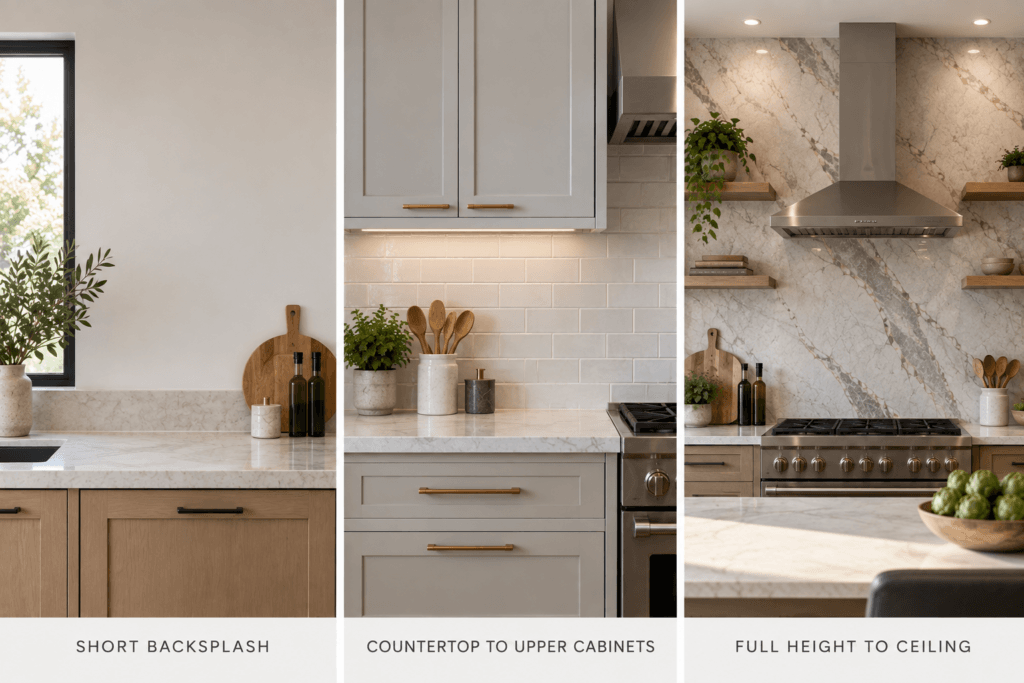
There is no single backsplash height that works for every kitchen.
Common approaches include:
Short Backsplash
A short backsplash may be only a few inches high and is often made from the same material as the countertop.
It provides basic protection while leaving most of the wall painted.
This can work well in simple kitchens or areas where splashing is limited.
Countertop to Upper Cabinets
This is the most common full backsplash arrangement.
Tile or slab runs from the countertop up to the bottom of the upper cabinets.
It offers good wall protection without covering unnecessary areas.
Full Height to the Ceiling
In kitchens with open shelving, a range hood or no upper cabinets, backsplash material can continue much higher.
Taking tile or slab to the ceiling can create a dramatic effect, especially behind a range.
It also costs more and makes the surface a much larger part of the room, so material choice becomes more important.
What Should You Use Behind the Stove?
The area behind the range typically receives more grease, heat and cleaning than other backsplash areas.
Choose a surface that is easy to clean and suitable for the appliance location.
Tile, porcelain and many slab materials are commonly used because they provide durable, washable surfaces.
Avoid assuming that every decorative wall covering or peel-and-stick product is appropriate behind cooking equipment. Check the product manufacturer’s instructions along with the range manufacturer’s clearance and installation requirements.
The backsplash should complement the range area without creating a maintenance problem every time you cook.
Should the Backsplash Match the Countertop?
It can, but it does not have to.
There are three common approaches.
Match the Countertop
Using the same material on both surfaces creates a seamless, high-end look.
This works particularly well with quartz, quartzite, marble and porcelain slabs.
Coordinate Without Matching
A backsplash can repeat one of the colors in the countertop without copying it exactly.
For example, a warm off-white tile can work with a countertop that has beige or gold veining.
This often gives the kitchen more depth while keeping the surfaces connected.
Create Contrast
A simple countertop can handle a stronger backsplash color or pattern.
This works best when the rest of the kitchen is relatively restrained.
If the cabinets, countertop, flooring and backsplash are all making separate statements, the room can become overwhelming quickly.
Grout Color Matters More Than It Seems
Grout changes the way tile reads from across the room.
A grout color close to the tile color makes the surface feel more continuous.
Contrasting grout emphasizes every tile.
That can look great when the tile pattern is intentionally part of the design, but it also makes uneven spacing and installation imperfections more noticeable.
Very light grout can show staining more easily in cooking areas, while very dark grout can make a simple wall much more graphic.
Before committing, look at the actual tile and grout sample together.
Think About Outlets Before Installation
Electrical outlets can interrupt an otherwise clean backsplash quickly.
Before installation, consider their location, orientation and cover plates.
In some remodels, outlets can be relocated or placed more discreetly, but those decisions should happen before the wall is finished.
Do not wait until an expensive slab has been fabricated to start thinking about outlet locations.
Electrical work should also be coordinated with the rest of the remodel rather than treated as an afterthought.
Backsplash Ideas for Small Kitchens
In a smaller kitchen, the backsplash can either make the room feel more continuous or break it into too many visual pieces.
Simple materials often work especially well.
A few approaches worth considering include:
- Using the same countertop material as the backsplash
- Choosing tile with a low-contrast grout
- Running the backsplash continuously across the main work area
- Using larger-format tile to reduce grout lines
- Keeping patterns simple when cabinets and countertops already have detail
This does not mean a small kitchen has to be boring.
A strong backsplash can still work, especially when the rest of the kitchen is fairly restrained. For more ideas on getting more function from limited space, see Small Kitchen Remodel Ideas That Actually Improve Storage and Workflow.
Modern Kitchen Backsplash Ideas
Modern kitchens tend to look best when the backsplash supports clean lines rather than adding unnecessary detail.
Popular approaches include large porcelain tile, continuous slab backsplashes, stacked rectangular tile and simple textured surfaces.
The materials do not have to be cold or minimalist.
Warm stone, handmade tile and subtle veining can still work in a modern kitchen as long as the overall composition remains controlled.
A backsplash does not need to be the loudest part of the room to make the kitchen look finished.
Common Kitchen Backsplash Mistakes
Choosing the Backsplash Before the Countertop
It is usually easier to coordinate a backsplash with a countertop than to find a countertop that works with a very specific tile.
Using Too Many Patterns
Strong cabinet grain, heavily veined countertops and patterned tile can become overwhelming when used together.
Ignoring Grout
Grout color and joint size can change the finished appearance dramatically.
Forgetting About Cleaning
Intricate textures may look great in a showroom but can be frustrating directly behind a range.
Selecting Material From a Small Sample
Natural stone and patterned slabs can vary significantly across a full piece.
Not Planning Outlets and Terminations
Where the backsplash starts, stops and meets windows or cabinets matters almost as much as the material itself.
Choosing a Trend You Do Not Actually Like
A backsplash is relatively visible and can be expensive to replace. Choose something you would still want even if it stopped appearing in design photos next year.
How Much Should You Spend on a Backsplash?
Backsplash costs can range from a relatively inexpensive tile project to a custom slab installation that becomes a meaningful part of the overall kitchen budget.
Material is only part of the cost.
Also consider:
- Wall preparation
- Removal of an existing backsplash
- Labor
- Grout and setting materials
- Slab fabrication
- Outlet and switch modifications
- Specialty trim or edge pieces
If you are budgeting an entire remodel, Builzee’s Kitchen Remodeling Cost & Buying Guide explains how backsplash work fits alongside cabinets, countertops, appliances and other major kitchen expenses.
How to Choose the Right Kitchen Backsplash
Start with the parts of the kitchen that are hardest or most expensive to change.
That usually means cabinets and countertops.
Then choose a backsplash that works with those surfaces and fits the way the kitchen is actually used.
If you cook frequently, ease of cleaning may matter more than an intricate texture. If the kitchen is mostly used for light cooking and entertaining, you may have more freedom to choose a delicate or decorative material.
Look at samples in the actual kitchen if possible.
Natural light, under-cabinet lighting and surrounding colors can make a material look very different from how it appeared in a showroom.
Most importantly, do not feel obligated to make the backsplash a focal point.
Sometimes the best backsplash is the one that quietly connects the cabinets, countertops and walls and makes the whole kitchen feel more finished.
For more planning help, browse Builzee’s complete Kitchen Guides covering layouts, cabinets, countertops, appliances, installation and remodeling costs.
Planning a Kitchen Remodel?
Explore Builzee’s complete Kitchen Guides for practical help with layouts, cabinets, countertops, appliances, installation and project costs.