How Much Does a Kitchen Remodel Cost? A Practical Budget Guide
Kitchen remodel costs can vary dramatically.
One homeowner might update an existing kitchen for $15,000 by keeping the layout and working with the cabinets they already have. Another homeowner can spend $60,000 or more replacing everything, moving plumbing and electrical, installing custom cabinetry and upgrading appliances.
Recent national project data from Angi puts the average professional kitchen remodel at about $27,000, with many projects falling between roughly $14,500 and $41,500. Houzz data shows an even wider difference once project scope is considered, with median spending around $20,000 for minor kitchen remodels and $55,000 for major remodels.
Those numbers are useful starting points, but they don’t tell you what your kitchen will cost.
The biggest factors are the scope of work, cabinet selection, appliances, finish level and, perhaps most importantly, whether you keep the existing kitchen layout.
Kitchen Remodel Cost by Project Scope
It helps to think about a kitchen remodel in three general levels rather than starting with one national average.
| Remodel Level | Rough Planning Range | Typical Scope |
|---|---|---|
| Minor update | $10,000–$20,000 | Paint, cabinet refinishing, hardware, backsplash, fixtures and limited appliance or flooring upgrades |
| Major remodel | $20,000–$65,000 | New cabinets, countertops, flooring, appliances, lighting and other substantial upgrades |
| Complete remodel | $65,000–$130,000+ | Major layout changes, custom cabinetry, premium appliances and extensive plumbing, electrical or structural work |
These are planning ranges, not contractor quotes. Material selections and labor costs can move a project substantially higher or lower. Current Angi data uses similar ranges when separating minor, major and complete kitchen remodels.
The important distinction is what you are actually changing.
Replacing cabinet doors and installing a backsplash is a very different project from removing walls and relocating the sink, range and refrigerator.
If you’re still trying to determine the overall scope, start with How to Budget for a Home Renovation Without Getting Surprised before choosing finishes.
What Makes a Kitchen Remodel Expensive?
Kitchen remodels are expensive because several different trades and material categories come together in a relatively small space.
A typical project can involve:
- Cabinets
- Countertops
- Appliances
- Flooring
- Plumbing
- Electrical
- Lighting
- Painting and drywall
- Backsplash
- Demolition and disposal
- Permits
- Contractor labor
Changing one item can also affect several others.
For example, replacing a standard range with a larger professional-style range may require cabinet changes, a new electrical or gas connection and a larger ventilation system.
Moving a kitchen island might affect flooring, electrical outlets and lighting locations.
That is why seemingly simple design changes can have a much bigger effect on the final budget than homeowners initially expect.
Cabinets Are Usually One of the Biggest Expenses
Cabinetry is often one of the largest individual costs in a kitchen remodel.
There are generally three paths:
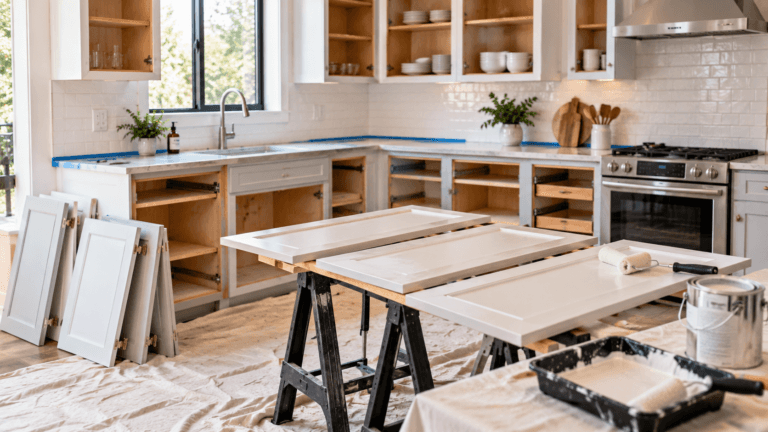
Keep and update the existing cabinets.
If the cabinet boxes are in good condition and the layout still works, painting them and replacing hardware can produce a major visual change at a fraction of the cost of replacement.
Replace them with stock or semi-custom cabinets.
This gives you a new layout and more storage options while keeping costs below most fully custom systems.
Install custom cabinets.
Custom cabinetry provides the most flexibility in dimensions, materials, finishes and storage features, but it can also consume a large portion of the remodeling budget.
Before replacing cabinets simply because they look dated, inspect the boxes themselves.
If they’re structurally sound, How to Paint Kitchen Cabinets: A Step-by-Step Guide shows another option worth considering.
Small Kitchens Aren’t Always Cheap Kitchens
It’s easy to assume that half the kitchen means half the cost.
That isn’t necessarily true.
A small kitchen still needs a refrigerator, sink, faucet, range, lighting and often a dishwasher. There are fixed costs that don’t disappear simply because the room has fewer square feet.
Where smaller kitchens can save money is in quantities.
You’ll generally need fewer cabinets, less countertop material and less flooring.
If space is the bigger problem than appearance, see Small Kitchen Remodel Ideas That Actually Improve Storage and Workflow before deciding that the entire kitchen needs to be rebuilt.
Countertops Can Change the Budget Quickly
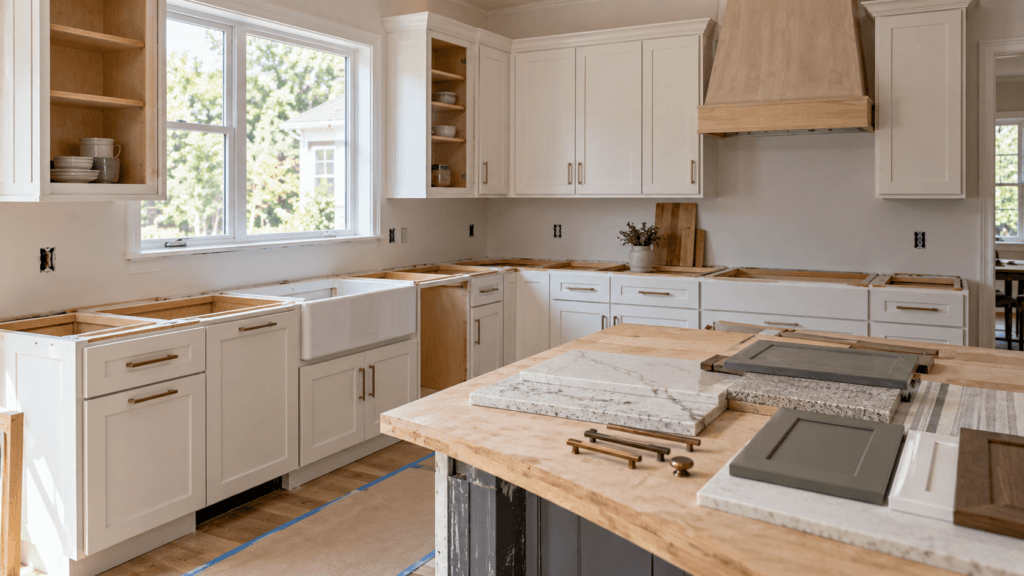
Countertop pricing depends on more than the advertised material price.
You also have to consider:
- Total countertop area
- Number of slabs required
- Sink and cooktop cutouts
- Edge profiles
- Waterfall ends
- Backsplash material
- Fabrication
- Installation
A relatively simple perimeter countertop can be much less expensive than a large island requiring oversized slabs, multiple cutouts and waterfall edges.
Quartz and granite remain common choices, but porcelain, butcher block, laminate and other surfaces can make sense depending on the budget and how the kitchen will be used.
One useful strategy is to select cabinets and countertops together rather than treating them as completely separate decisions. They’re two of the largest visual surfaces in the kitchen and two areas where small specification changes can have large budget consequences.
Don’t Overlook the Backsplash
Compared with cabinets and countertops, the backsplash is usually a relatively small part of the overall kitchen budget.
That makes it one of the better places to add character.
Material options range from inexpensive ceramic tile to large-format porcelain, natural stone and full-height countertop slabs.
Installation complexity matters too.
A simple stacked tile layout is generally easier to install than intricate mosaics, specialty patterns or materials requiring a lot of cutting.
For a breakdown of the different options, see Kitchen Backsplash Ideas: Tile, Slab, Peel-and-Stick & More.
Appliances Can Cost Almost Anything
Appliance budgets can range from a few thousand dollars for a basic package to tens of thousands for premium equipment.
More important than the brand name is selecting the appliances early enough.
Major appliances affect:
- Cabinet dimensions
- Countertop openings
- Electrical requirements
- Gas connections
- Plumbing
- Ventilation
- Clearances
You don’t want to finish designing the cabinets and then discover that the refrigerator or range you selected doesn’t fit.
For most remodels, major appliance selections should be made before cabinet drawings are finalized.
Flooring Costs Depend on What’s Underneath It
Flooring is another area where the visible material isn’t necessarily the whole cost.
Once the existing floor is removed, you may discover:
- Uneven subflooring
- Water damage
- Multiple layers of old flooring
- Cracked concrete
- Height differences between adjacent rooms
- Areas requiring patching or leveling
Those repairs need to happen before the new flooring goes down.
Luxury vinyl plank, laminate, porcelain tile, engineered wood and hardwood are all commonly used in kitchens, but installation requirements vary significantly.
If you’re replacing the floor as part of the remodel, the Builzee Flooring Quantity Calculator can help estimate how much material you’ll need after accounting for room dimensions and waste.
Keeping the Existing Layout Can Save a Lot of Money
One of the most effective ways to control kitchen remodel costs is to leave the major components roughly where they already are.
Moving cabinets isn’t necessarily expensive by itself.
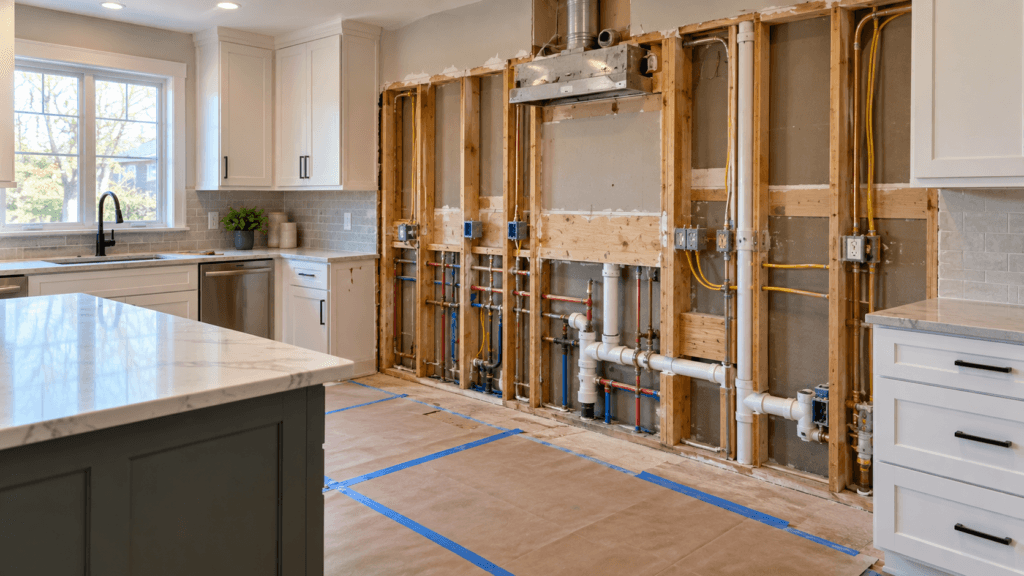
Moving everything behind them can be.
Relocating a sink may mean changing water and drain lines.
Moving a range can require electrical or gas work.
Relocating a refrigerator with a water supply requires plumbing.
Removing a wall can introduce structural work, framing, drywall, electrical relocation and engineering.
Sometimes those changes are absolutely worth doing because the original layout doesn’t function well.
But they should solve a real problem.
If the layout already works reasonably well, keeping the sink, range and major appliances in roughly the same locations can leave much more of the budget available for the things you’ll actually see and use every day.
Labor Is More Than Installation
Homeowners sometimes compare the price of the visible materials with the contractor’s total proposal and wonder where the rest of the money goes.
A kitchen remodel involves much more than installing cabinets and countertops.
Depending on the project, contractors may need to coordinate:
- Demolition
- Framing
- Plumbing
- Electrical
- Drywall
- Painting
- Flooring
- Cabinet installation
- Countertop templating and installation
- Tile work
- Appliance installation
- Inspections
The more trades involved, the more important coordination becomes.
This is also why the cheapest proposal is not automatically the least expensive project in the long run.
When comparing bids, make sure each contractor is pricing the same scope, materials and responsibilities.
Our guide How to Compare Contractor Quotes Before Starting a Home Renovation explains what to look for when proposals appear thousands of dollars apart.
Don’t Forget Permits and Existing Conditions
The most frustrating remodeling costs are usually the ones nobody can see before work begins.
Opening walls and removing cabinets can expose problems that weren’t visible during planning.
Common examples include:
- Water-damaged subflooring
- Old or inadequate electrical wiring
- Plumbing problems
- Improper previous renovations
- Wall damage
- Mold or moisture problems
- Unlevel floors
- Structural conditions
Not every kitchen will uncover a surprise.
But budgeting every dollar toward cabinets, countertops and appliances leaves no room if something does appear.
A 10% to 20% contingency is a reasonable planning range for many renovation projects, particularly when substantial demolition is involved. Older houses or projects involving major layout changes may justify more.
Think of contingency as money reserved for the project, not money that has to be spent.
Where Should You Spend and Where Can You Save?
There isn’t one right answer because homeowners use kitchens differently.
Someone who cooks every day may get more value from good appliances, durable countertops and an efficient work area.
Someone with a small kitchen may benefit more from improved cabinetry and storage.
A homeowner preparing to sell might focus on broad visual appeal rather than highly personalized premium features.
In general, some of the best opportunities to control costs are:
Keep a functional layout.
Moving fewer utilities can eliminate a surprising amount of work.
Reuse good components.
Cabinets don’t necessarily need replacement simply because their color is dated.
Mix premium and affordable finishes.
Not every surface needs to be the most expensive option available.
Avoid changing selections during construction.
Changes made after materials have been ordered or work has started can be disproportionately expensive.
Spend money on problems you actually need to solve.
Better storage or lighting may improve the kitchen more than replacing something simply because it’s old.
Build the Budget Around the Scope, Not the Other Way Around
It can be tempting to start with a number such as “$30,000 kitchen remodel” and then try to make every decision fit inside it.
A better approach is to first define what the kitchen actually needs.
Ask yourself:
What doesn’t work about the existing kitchen?
What needs to be replaced?
What would simply be nice to have?
Does the layout need to change?
Which existing components can stay?
Once those questions are answered, you can start assigning money to the project intelligently.
A $20,000 remodel that solves the right problems can be far more successful than a $60,000 remodel filled with expensive finishes but poor planning.
Recent national data makes the size of that range clear. Angi’s verified-project data places many professional kitchen remodels between roughly $14,500 and $41,500, while Houzz reports median spending of $20,000 for minor projects and $55,000 for major kitchen renovations.
The goal isn’t to hit somebody else’s average.
It’s to understand where your money is going before construction starts.
Final Takeaway
So, how much does a kitchen remodel cost?
For many homeowners, $15,000 to $40,000 is a useful broad starting range, but the real answer depends heavily on what you’re changing.
A cosmetic refresh that keeps the cabinets and layout may cost considerably less. A full renovation with new cabinetry, premium appliances and relocated utilities can climb past $60,000 quickly.
Start with the scope.
Decide what needs to change, what can stay and which improvements will actually make the kitchen work better.
Then compare realistic contractor pricing, choose materials that fit the project and keep some contingency available for the things you can’t see yet.
That creates a much more useful kitchen remodel budget than starting with a national average and hoping your project fits it.
Planning a Kitchen Remodel?
Explore Builzee’s Kitchen Guides for practical help with layouts, cabinets, countertops, backsplashes, remodeling costs and project planning.