
How to Compare Window Replacement Quotes: Why Prices Can Be Thousands Apart
You get three quotes to replace the same 12 windows.
One contractor wants $14,000. Another wants $21,000. A third comes in at $34,000.
Same house. Same number of windows. Why are the prices so different?
It is easy to assume the lowest contractor is cutting corners or the highest contractor is overcharging. Either could be true, but there is another common explanation: the contractors may not actually be quoting the same project.
One proposal might cover replacement windows installed within the existing frames. Another might include complete removal of the old assemblies, new flashing, repairs around the openings and finished interior and exterior trim.
The products may also be different even when the proposals use similar descriptions such as “premium vinyl,” “Low-E glass” or simply the name of a manufacturer.
That is why comparing window replacement quotes should start with the scope of work rather than the total at the bottom of the page.
The goal is to get the proposals onto reasonably equal ground before deciding which one offers the best value.
Start With the Scope, Not the Price
A good window quote should tell you more than how many windows will be replaced and what the project costs.
You should be able to identify the window being provided, how it will be installed, what surrounding work is included and what the contractor expects to happen if existing conditions create additional work.
Think of the total proposal as several costs combined:
Window product + installation + surrounding work + contractor costs
The first two are easy to recognize. The surrounding work is where many apparent price differences begin.
Removal, flashing, trim, stucco or siding repair, painting, permits, disposal and repairs to damaged framing can all be included in one proposal and excluded from another.
Before deciding that one contractor is $5,000 cheaper, determine whether that contractor is actually providing $5,000 less work.
Make Sure the Window Products Are Comparable
A manufacturer name alone is not enough to compare two window proposals.
Most major manufacturers offer multiple product lines with different frame materials, hardware, glass packages, finishes and performance levels.
A quote that simply says “12 vinyl replacement windows” leaves a lot unanswered.
Ideally, the proposal identifies enough information to determine what is actually being purchased.
| Product Detail | What to Look For |
|---|---|
| Manufacturer | Who makes the window |
| Product series | The specific line or model |
| Window type | Slider, casement, single-hung, picture window, etc. |
| Frame material | Vinyl, fiberglass, aluminum, wood, composite |
| Color / finish | Interior and exterior finish |
| Glass package | Insulated glass, Low-E coatings, laminated or tempered glass where applicable |
| Screens / grids | Included or additional |
| Performance | NFRC-rated U-factor, SHGC and other relevant ratings |
Two different products do not need to be identical to be comparable.
One contractor may propose a premium vinyl system while another proposes fiberglass. The point is to understand whether part of the price difference is coming from the product rather than the installation.
Confirm How the Windows Will Be Replaced
Installation method can create a major difference between two proposals.
An insert or retrofit replacement generally leaves more of the existing window frame and surrounding finishes in place. The new window is installed within the existing opening.
A full-frame replacement removes more of the original window assembly and exposes more of the opening around it.
Once that opening is exposed, additional work may be required for waterproofing, flashing, insulation, trim and repairs to surrounding finishes.
Neither method is automatically right for every home.
If the existing frame and surrounding construction are in good condition, a retrofit installation may be appropriate and can reduce disturbance to the building.
If there is water damage, deterioration or a need to substantially change the opening, a more extensive replacement may make sense.
The important point when comparing bids is simple: make sure each contractor is pricing the same installation approach.
A useful question is:
What parts of my existing window and frame will still be there when the installation is complete?
The answer usually makes the scope much easier to understand.
For a deeper look at when each installation method makes sense, see Builzee’s Window Replacement Guide.
Look Beyond the Window Itself
The actual window unit may be only part of the work happening at each opening.
When an existing window is removed or modified, the surrounding construction may also need attention.
That can include flashing, sealants, insulation, interior trim, exterior trim, drywall, stucco, siding and paint.
One contractor may include all of that work. Another may intentionally limit the proposal to supplying and installing the windows.
Neither proposal is necessarily wrong.
Problems arise when homeowners compare the two totals without noticing that one contractor has left several portions of the finished project to someone else.
Here is a simple example:
| Scope Item | Contractor A | Contractor B |
|---|---|---|
| Window installation | Included | Included |
| Existing window removal | Included | Included |
| Exterior trim | Excluded | Included |
| Stucco patching | By owner | Included |
| Interior touch-up | Excluded | Included |
| Disposal | Included | Included |
| Permit | By owner | Included |
Contractor A may appear considerably less expensive at first.
But the homeowner still needs to pay for the excluded work somewhere.
That is why the most useful comparison is not simply quote versus quote. It is completed project versus completed project.
Waterproofing Deserves Its Own Line on the Comparison
Windows are openings through the exterior wall, which makes water management part of the installation rather than an optional detail.
The exact flashing approach depends on the existing wall, window type and installation method. A retrofit project that leaves most of the existing frame intact will not necessarily use the same flashing details as a full-frame installation.
The proposal does not need to contain pages of technical specifications, but the contractor should be able to explain how the new window will be sealed and integrated with the existing wall.
If the scope only says “install and caulk,” it is worth asking for more detail.
Find out what happens at the sill, how the perimeter of the window is sealed and what the contractor will do if existing flashing or water damage becomes visible during removal.
This is particularly important because water problems around windows can remain hidden behind finishes long before they become obvious inside the home.
Read the Exclusions as Carefully as the Inclusions
The exclusions section can sometimes tell you more about a window quote than the first page.
Contractors often need exclusions because some conditions cannot be confirmed until the existing windows are removed.
For example, the contractor may reasonably exclude concealed wood rot because nobody knows whether it exists yet.
That is different from leaving the subject out entirely.
Common items worth checking include framing repair, dry rot, termite damage, stucco or siding repair, painting, permits, difficult access, scaffolding and work involving hazardous materials.
An exclusion is not automatically a warning sign.
A vague exclusion is more concerning.
If a proposal says:
“Unforeseen conditions extra.”
you still do not know how those extras will be handled.
A better proposal explains what is outside the base price and how additional work will be authorized and priced.
Hidden Damage Is Where Quote Comparisons Can Fall Apart
Windows can hide problems.
Once the old assembly comes out, the contractor may find deteriorated framing, water damage, damaged sheathing, failed flashing or evidence of a previous poor installation.
Some repairs may be minor. Others can expand the scope significantly.
The best time to discuss that possibility is before the project begins.
The contractor should be able to explain how unforeseen repairs are handled. Depending on the company, that might be a predetermined unit price, an hourly labor rate, time and materials or a separate change order.
There is no single correct pricing method.
What matters is knowing the process before demolition begins.
For example:
| Hidden Condition | Proposal A | Proposal B |
|---|---|---|
| Minor wood repair | Not stated | Unit price provided |
| Larger framing repair | Change order | Change order |
| Additional work requires owner approval | Not stated | Yes |
| Material markup | Not stated | Defined in contract |
The two base prices may be close, but Proposal B gives the homeowner considerably more information about the risk of additional cost.
That has value.
Check Who Is Responsible for Finish Work
A window can be installed correctly and still leave unfinished work around the opening.
Interior casing may need replacement. Drywall may need patching. Exterior stucco or siding may be disturbed. Painted surfaces may need touch-up.
A homeowner can easily assume those items are part of “window replacement” even when the contractor views them as separate work.
Look specifically for language such as:
“By owner.”
“Excluded.”
“Patch only. Paint by others.”
“Existing trim to remain.”
“Stucco repair not included.”
Those statements are not necessarily problems. They simply tell you where one contractor’s responsibility ends.
If additional trades will be needed after the window installer leaves, include that cost when comparing the proposals.
Compare Glass Performance Without Getting Lost in Marketing
“Energy-efficient glass” is not a precise specification.
Neither is “Low-E dual pane.”
If energy performance is an important reason for replacing the windows, compare the actual ratings of the products being proposed.
Two of the most useful numbers are U-factor and Solar Heat Gain Coefficient, or SHGC.
U-factor relates to how readily heat transfers through the window. Lower values generally indicate better resistance to heat flow.
SHGC relates to how much solar heat enters through the window. The appropriate value depends on climate, orientation and the amount of sun exposure.
| Rating | What It Describes | General Rule |
|---|---|---|
| U-factor | Heat transfer through the window | Lower is generally better |
| SHGC | Solar heat entering through the window | Best value depends on climate and exposure |
| Visible Transmittance | Amount of visible light passing through | Higher generally means more daylight |
A more expensive glass package may provide better performance, but that does not automatically make it the right upgrade for every home.
If one contractor is significantly more expensive because of glass upgrades, make sure you understand what those upgrades actually provide.
Permits and Code Requirements Can Also Change the Scope
Permit requirements vary by location and by the type of work being performed.
One contractor may include permit costs while another expects the homeowner to obtain and pay for them separately.
That difference should be visible when the proposals are compared.
Certain openings may also require safety glazing or need to maintain emergency escape and rescue requirements depending on their location and local code.
Older homes can add another layer.
Renovation work that disturbs painted surfaces in qualifying pre-1978 housing may fall under federal lead-safe renovation requirements. That can affect the procedures used during removal, containment and cleanup.
Again, the goal is not to make every homeowner become a code expert.
It is simply to make sure the contractors are pricing the project using the same assumptions.
Separate the Window Warranty From the Installation Warranty
A long window warranty sounds reassuring, but it may cover only the manufactured product.
Installation responsibility is a separate issue.
If an insulated glass unit fails, the manufacturer may cover the glass.
If water enters because of the way the window was installed, that may fall under the contractor’s workmanship warranty instead.
A complete comparison should therefore look at both.
| Warranty Area | Questions to Answer |
|---|---|
| Frame | How long is it covered? |
| Insulated glass | What happens if the seal fails? |
| Hardware | Are operating components covered? |
| Finish | Does the warranty cover fading or finish failure? |
| Installation | How long does the contractor warranty the workmanship? |
| Water intrusion | Who determines whether the problem is product- or installation-related? |
| Service | Are labor or service-call charges included? |
| Transfer | Does coverage change if the home is sold? |
The longest warranty on paper is not necessarily the best warranty.
What matters is what is covered, for how long and who is responsible for solving the problem.
Know Who Will Actually Install the Windows
The person selling the project may never be part of the installation crew.
Some contractors use employees. Others use subcontracted installation crews. Some companies use both.
None of those arrangements automatically tells you whether the installation will be good.
A more useful comparison is how the contractor manages the installation.
Who supervises the work?
What installation standards are crews expected to follow?
Who performs quality control?
Who returns if something needs adjustment?
Who is responsible for warranty service?
A good window installed poorly can still create air leakage, water problems and operational issues.
Product quality and installation quality need to be considered together.
Normalize the Quotes Before Comparing the Final Price
Once the major differences are identified, you can begin comparing the proposals on more equal terms.
Consider this simplified example.
Original Quotes
| Contractor | Quoted Price |
|---|---|
| Contractor A | $18,500 |
| Contractor B | $22,500 |
| Contractor C | $26,000 |
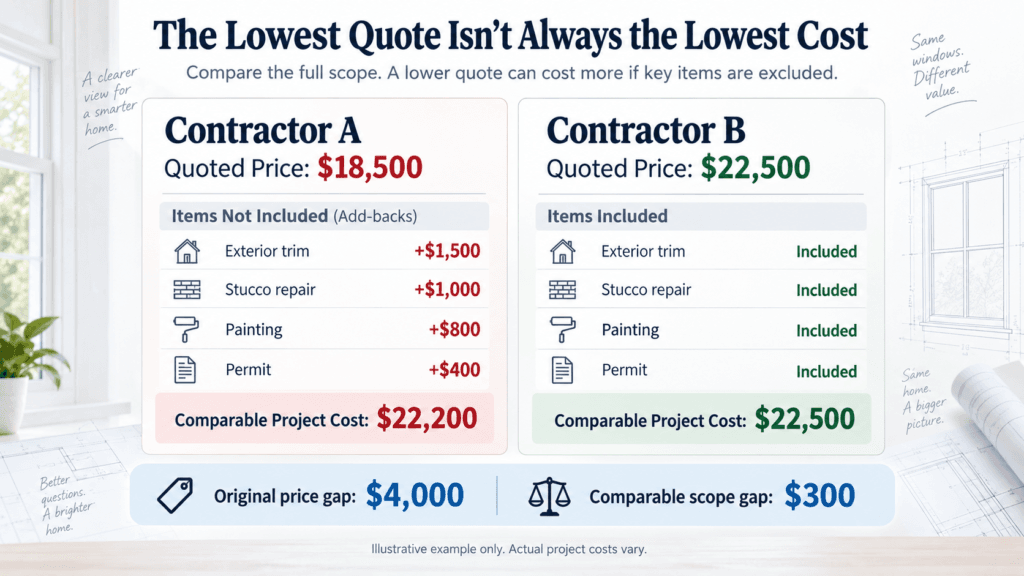
At first glance, Contractor A appears to save $4,000 compared with Contractor B.
Now look at the missing scope.
After Reviewing the Proposals
| Item | Contractor A | Contractor B |
|---|---|---|
| Base quote | $18,500 | $22,500 |
| Exterior trim not included | + $1,500 estimated | Included |
| Stucco repairs | + $1,000 estimated | Included |
| Painting | + $800 estimated | Included |
| Permit | + $400 estimated | Included |
| Comparable project total | $22,200 | $22,500 |
The original $4,000 price gap has almost disappeared.
These numbers are only an illustration, but the estimating principle is important.
Add back the work that still needs to be performed before deciding which contractor is actually cheaper.
This is one of the easiest ways to avoid choosing a low proposal that becomes an expensive project later.
A Simple Window Quote Comparison Sheet
You do not need estimating software to compare three window proposals.
A spreadsheet or even a piece of paper works.
Put the contractors across the top and compare the major scope items line by line.
| Comparison Item | Quote A | Quote B | Quote C |
|---|---|---|---|
| Manufacturer / series | |||
| Window configuration | |||
| Frame material | |||
| Glass package | |||
| Installation method | |||
| Existing window removal | |||
| Flashing / waterproofing | |||
| Perimeter sealing / insulation | |||
| Interior trim | |||
| Exterior trim | |||
| Stucco / siding repair | |||
| Painting / finishing | |||
| Disposal | |||
| Permit | |||
| Hidden-damage pricing | |||
| Product warranty | |||
| Workmanship warranty | |||
| Total price |
If something is not addressed in the proposal, write:
Not specified.
Do not assume it is included.
A few “not specified” entries often explain why one quote seems unusually inexpensive.
What Should Concern You in a Window Quote?
Price alone is not a red flag.
Neither is being the lowest bidder.
What should make you slow down is uncertainty.
A proposal deserves more questions when the product is not identified, the installation method is unclear, large portions of finish work are never mentioned or nearly every potential problem falls under a vague “extra work” clause.
Pressure to sign immediately should also be separated from the actual value of the proposal.
A discount does not make an unclear scope clearer.
The strongest proposal is usually the one that allows you to understand what will be installed, what work is included, what is excluded and what happens if the project changes.
The Lowest Quote Can Still Be the Best Quote
After all of this, the lowest proposal may still be the right one.
A smaller contractor may have lower overhead. One installer may be more efficient. Another company may have better supplier pricing.
There is nothing wrong with paying less for comparable work.
The same logic applies to an expensive proposal.
Higher price alone does not prove better craftsmanship, better installation or better windows.
When one quote is significantly higher than the others, you should be able to identify where the additional value is coming from.
Maybe it is a different window system.
Maybe it includes full-frame replacement instead of retrofit work.
Maybe it covers extensive exterior finishes that the other contractors excluded.
Or maybe the price really is simply higher.
Once the scopes are normalized, that distinction becomes much easier to see.
Bottom Line
Do not compare window replacement quotes by looking only at the total price.
Compare the project each contractor is actually proposing.
Start with the window product and installation method, then look at flashing, repairs, trim, finish work, permits, disposal, hidden-condition procedures and warranties.
Pay particular attention to exclusions and items that are not specified.
Once the proposals cover reasonably comparable scopes, the price at the bottom of the page finally becomes useful.
If you are still determining how much to budget before requesting estimates, see Builzee’s How Much Does Window Replacement Cost in 2026? guide.
Planning a Window Project?
Explore Builzee’s complete Windows guide for window types, frame materials, glass performance, replacement, installation and buying guidance.