Home Window Tinting: Pros, Cons, Warranty Risks & Smart Glass Alternatives
Window tinting is one of those home upgrades that looks simple at first. A room gets too hot in the afternoon, glare makes the television difficult to see, or a large window feels too exposed, so adding film seems like an easy solution.
And in many cases, it can be.
Modern residential window films can reduce glare, reject solar heat, filter ultraviolet light and provide additional privacy without replacing the existing windows. Installation is relatively quick, and the cost is usually far below replacing an entire window system.
The complication is that modern windows are no longer just pieces of clear glass in a frame. Many contain insulated glass units, Low-E coatings, tempered or laminated glass, specialized spacers and factory-designed coatings that already manage solar energy and heat transfer.
Adding another layer to that system can change how the glass behaves.
That is why homeowners should look beyond the color or darkness of a film before installing it. Compatibility with the existing glass, thermal stress and the window manufacturer’s warranty can be just as important as glare reduction or appearance.
There are also newer technologies to consider. Electrochromic glass, switchable privacy glass and other smart glazing systems offer capabilities that traditional window film cannot, although they come with very different costs and installation requirements.
Why Homeowners Consider Window Tinting
The most common reason for adding residential window film is comfort.
A west-facing living room may be comfortable all morning and then become noticeably hotter as afternoon sunlight hits the glass. Large windows can create glare on televisions and computer screens, while rooms with valuable furniture or flooring may receive hours of direct sunlight every day.
Window film can help address several of these conditions without changing the window itself.
Solar-control films are designed to reduce part of the solar energy passing through the glass. Depending on the product, they may also reduce visible glare and ultraviolet exposure. Privacy films can make certain windows less exposed, while decorative films can obscure views into bathrooms, entry sidelights or other areas where full transparency is not desirable.
The important part is identifying the actual problem first.
A homeowner dealing primarily with glare may need a different film than someone trying to reduce heat. A bathroom that needs privacy may not need solar-control film at all. And a room that feels cold in winter because of an old, inefficient window may not be meaningfully improved by tinting.
Window film is a tool, not a cure for every window problem.
Not All Window Film Is the Same
Residential films vary considerably in how they look and what they are designed to accomplish.
Traditional solar-control films may have a noticeable tint or reflective appearance. Some are relatively dark, while others are designed to maintain more natural daylight. Reflective films can provide strong daytime glare reduction and change the exterior appearance of the glass, sometimes creating a mirror-like look.
Ceramic films are another option. These products are generally designed to provide solar and UV control without relying on a highly reflective metallic appearance. They can be useful when homeowners want performance while keeping the glass relatively neutral in appearance.
Privacy and decorative films are different again. Frosted, patterned or translucent products are generally used to obscure views rather than significantly improve energy performance. They are common on bathroom windows, entry doors and sidelights.
There are also thicker safety and security films intended to help retain broken glass after impact. These products should not be confused with simply making a window “unbreakable.” A true security glazing system may depend not only on the film itself, but also on how the film is attached at the perimeter and how the surrounding frame is constructed.
The marketing term “window tint” can therefore describe products serving very different purposes.
The Benefits Can Be Noticeable
When film is matched correctly to the window and the problem being addressed, the improvement can be significant.
Glare reduction is often the most immediately noticeable benefit. Rooms that receive strong direct sunlight can become more comfortable for television viewing, computer work and everyday use.
Solar-control film may also reduce some of the heat entering through sun-exposed glass. This can be especially useful on large west- and south-facing windows where direct sunlight creates uncomfortable afternoon conditions.
UV filtering is another common benefit. Reducing ultraviolet exposure can help protect furniture, artwork, flooring and other interior materials from one contributor to fading. It will not eliminate fading entirely because visible light, heat and the materials themselves also play a role, but reducing UV exposure can still be worthwhile.
Privacy can also improve, although homeowners need to understand how reflective films behave.
A highly reflective window may provide substantial privacy during the day when it is brighter outside than inside. At night, that relationship reverses. If the lights are on inside the home and it is dark outside, the glass may no longer provide the same privacy.
There is no simple film that creates perfect one-way glass under every lighting condition.
The Tradeoffs Are Worth Understanding
Window film changes both the performance and appearance of the glass.
A darker film may solve an afternoon glare problem but make the room feel unnecessarily dim during the rest of the day. Reflective products can noticeably change the exterior appearance of a home, and some films introduce subtle changes in color when looking through the glass.
This is why seeing an actual sample on the window is more useful than choosing from a small printed swatch.
Installation quality matters as well. Bubbles, contamination, scratched surfaces, visible seams and lifting edges are much easier to notice across large residential windows than they might be on smaller pieces of glass.
Film also does not repair a failing window.
If there is condensation between panes, a failed insulated-glass seal, deteriorated framing, air leakage or water intrusion around the opening, tinting the glass does not address the underlying problem.
In those situations, money may be better spent correcting the window or replacing it.
Can Window Film Affect Your Window Warranty?
Potentially, yes, and this is one of the most important things to check before installation.
There is no universal rule that adding aftermarket film automatically cancels every part of every window warranty. Warranty language varies by manufacturer and product.
The concern is usually more specific.
If an aftermarket film changes the thermal behavior of the glass and contributes to a failure, the manufacturer may exclude that particular failure from warranty coverage. Other manufacturers may place broader restrictions on aftermarket modifications.
The issue comes down largely to heat.
When sunlight reaches a window, part of that energy is transmitted through the glass, part is reflected and part is absorbed. Adding film changes that balance. Certain film-and-glass combinations can increase the amount of heat absorbed by one pane.
As glass temperatures increase, the temperature difference between the center of the glass and cooler areas around the perimeter can also increase. Under the wrong conditions, that can contribute to thermal stress.
That does not mean residential film is inherently dangerous or that it should never be installed on modern windows. It means the film needs to be compatible with the actual glazing system.
Before tinting a window that is still under warranty, find out who manufactured it and review the written warranty. If possible, confirm whether the proposed film is permitted and whether glass breakage or insulated-glass failure associated with aftermarket film would remain covered.
It is also worth asking the film installer whether the film manufacturer offers separate glass-breakage coverage for the product being proposed.
Low-E Glass Makes Compatibility More Important
Low-E glass is now common in modern residential windows.
Low-E, short for low emissivity, refers to an extremely thin coating incorporated into the glazing system to control radiant heat transfer. Different Low-E coatings are designed to achieve different combinations of visible light, solar heat gain and thermal performance.
The coating is generally protected within an insulated glass unit rather than simply exposed on the room-side surface.
Because a Low-E window already manages solar energy in a specific way, adding aftermarket film should not be viewed as simply adding “more efficiency.”
The combination can change where solar energy is absorbed within the glass.
In some configurations, a compatible film may work perfectly well. In others, the additional heat absorption may make a particular product inappropriate.
This is especially why a professional installer should know more than the dimensions of the window. Ideally, the existing glass construction should be identified before a film is recommended.
The Type of Glass Matters Too
A window that looks like ordinary clear glass may actually contain several layers and treatments.
Most newer residential windows use insulated glass units, commonly called IGUs. Two or more panes are separated by a sealed space that may contain air or an insulating gas. Low-E coatings are often incorporated within that assembly.
Tempered glass has been heat-treated to increase strength and to change the way it breaks. It is commonly required in locations where safety glazing is needed, such as certain doors, bathrooms and glass near walking surfaces.
Laminated glass uses a plastic interlayer bonded between layers of glass. When the glass breaks, fragments tend to remain attached to the interlayer. Laminated glass can be used for safety, sound control, security and impact-resistant applications.
These distinctions matter because glass thickness, heat treatment, coatings, laminates and insulating construction can all affect which films are suitable.
The safest approach is not to assume that a film that worked on one window will automatically be appropriate for every window in the house.
Window Film and Energy Efficiency
Homeowners sometimes consider tinting because they want to lower energy costs.
Film can reduce solar heat gain through certain windows, which may reduce cooling demand during hot and sunny periods. But that does not mean applying film automatically converts an inefficient window into a high-performance one.
The overall performance of a window depends on much more than the exposed glass surface.
The insulated glass unit, Low-E coating, spacer, frame material, thermal breaks, weatherstripping and installation all contribute to the way the complete window performs.
Orientation matters too.
Reducing solar heat entering through a west-facing window may be very desirable in a hot climate. Blocking the same amount of solar gain through another window could provide much less benefit.
This is one reason window performance is typically evaluated using measurements such as U-factor and Solar Heat Gain Coefficient rather than simply asking whether the glass is tinted.
When Film Makes More Sense Than Replacing the Window
If the windows are relatively new, operate properly and show no signs of water intrusion or seal failure, film can be a practical retrofit.
Imagine a home with a large living-room window that performs well in every respect except for intense afternoon glare. Replacing the entire window would be expensive and unnecessarily disruptive. A carefully selected solar-control film may solve the actual problem for a fraction of the cost.
The same logic can apply to a bathroom that needs privacy or a room where UV exposure is damaging interior finishes.
Film becomes less attractive when the window itself is already nearing the end of its useful life.
Condensation trapped between panes, failed seals, deteriorated frames, significant drafts, water intrusion and windows that no longer operate correctly are signs that the problem extends beyond the exposed glass.
At that point, replacing the window allows the glass, frame, Low-E coating and overall performance to be selected as one complete system.
Smart Glass Takes a Different Approach
Traditional window film has fixed properties. Once the film is installed, the tint level remains essentially the same throughout the day.
Smart glazing can behave differently.
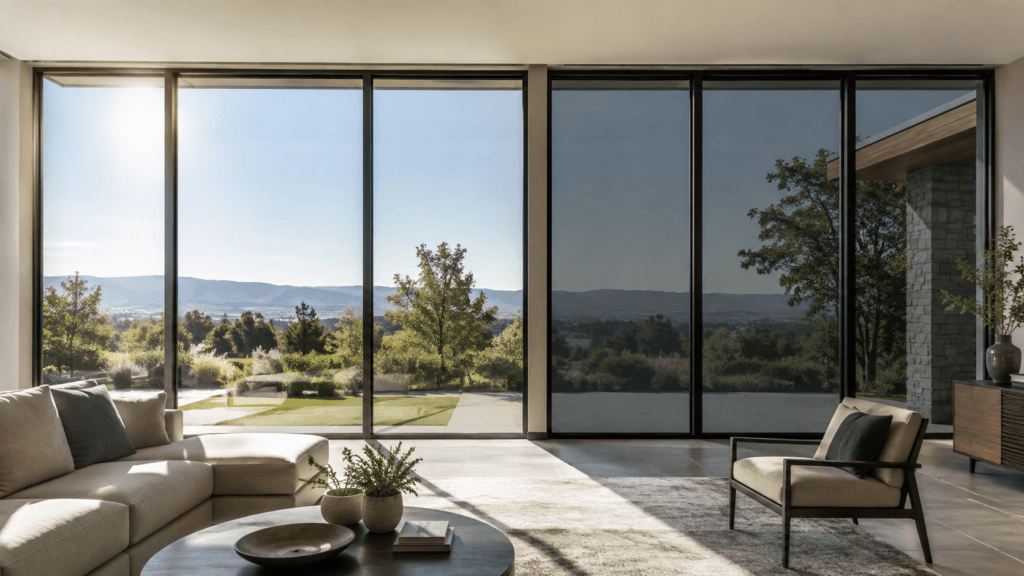
Electrochromic glass is one example. A small electrical voltage causes the glazing to transition between lighter and darker states, allowing the amount of transmitted light and solar energy to change as conditions change.
Instead of permanently darkening a west-facing window, electrochromic glazing can remain relatively clear when sunlight is mild and darken when solar exposure becomes intense.
Controls can be manual or integrated into an automated building system.
The technology has been used extensively in commercial and institutional architecture, including offices and airports, but residential applications are also possible.
The tradeoff is cost and complexity.
Electrochromic glazing is generally incorporated into the glazing system itself. It requires electrical power and controls, and retrofitting an existing residential window is very different from simply applying aftermarket film.
For most homeowners looking to improve several existing windows, traditional film remains the far more accessible option.
For a new home or a premium renovation with large areas of glass, smart glazing becomes a more realistic design consideration.
Window Film vs. Electrochromic Glass
| Feature | Window Film | Electrochromic Glass |
|---|---|---|
| Retrofit existing windows | Usually possible | Usually requires new glazing |
| Tint level | Fixed | Adjustable |
| Electrical power | Not required | Required |
| Initial cost | Lower | Significantly higher |
| Glare reduction | Yes | Yes |
| Solar control | Yes | Yes |
| Appearance | Fixed after installation | Changes with tint state |
| Installation | Applied to existing glass | Integrated glazing system |
| Best fit | Existing homes and targeted problem areas | New construction and premium glazing |
Neither option is automatically better.
They solve similar problems in very different ways.
Smart Privacy Glass Is Something Else Again
“Smart glass” is a broad marketing term, and not every product works like electrochromic glazing.
Another technology homeowners may encounter is PDLC, or polymer-dispersed liquid crystal glass.
PDLC typically switches between clear and translucent or frosted states. Its primary purpose is privacy.
When energized, the glass can appear transparent. When switched to its privacy state, light is scattered and the panel becomes visually obscured.
This makes PDLC popular for bathrooms, interior partitions, conference rooms and other spaces where instant privacy is useful.
It should not be confused with electrochromic glass, which primarily changes tint to manage sunlight and glare.
There are also retrofit smart films that use similar privacy technology, so when a product is marketed simply as “smart tint,” it is worth asking exactly what technology is being offered and what it is designed to accomplish.
What to Check Before Tinting Your Windows
A little investigation before installation can prevent much larger problems later.
Start by identifying the window manufacturer if possible. If the windows are still under warranty, review the current warranty terms before applying anything to the glass.
The installer should also determine what type of glazing is present. A useful conversation should include whether the window is single-pane or insulated, whether Low-E coatings are present, whether the glass is tempered or laminated, and whether the proposed film is approved for that construction.
Ask who accepts responsibility if thermal stress breakage occurs. The answer may involve the window manufacturer, film manufacturer, installer or a separate film warranty.
Appearance deserves attention too. Ask to see a sample on the actual window and look at it during different times of the day. A film that appears almost clear in a showroom can look noticeably different across an entire wall of residential glass.
And finally, make sure the proposed film solves the problem you actually have.
If the problem is glare, choose for glare. If it is privacy, choose for privacy. If the window itself is failing, do not use film to disguise a problem that really requires repair or replacement.
Bottom Line
Home window tinting can be a useful and relatively affordable upgrade when the existing windows are in good condition and there is a specific problem to solve.
It can reduce glare, control solar heat, limit UV exposure and improve privacy without the cost and disruption of replacing an entire window.
But the glass deserves more consideration than simply choosing a tint percentage.
Modern windows may contain Low-E coatings, insulated glazing, tempered or laminated glass and factory-designed components that work together as a system. An aftermarket film that changes heat absorption can also change how that system behaves.
Before installing film, identify the existing glazing, verify that the proposed product is compatible and check the window manufacturer’s warranty requirements.
For homeowners planning new construction or a major renovation, technologies such as electrochromic glass offer a more sophisticated alternative by allowing the glass itself to respond to changing sunlight. For most existing homes, however, properly selected window film remains the simpler retrofit.
The right choice depends on the window you already have and the problem you are actually trying to solve.
Planning a Window Project?
Explore Builzee’s complete Windows guide for window types, frame materials, glass performance, replacement, installation and buying guidance.