How Much Does It Cost to Build a Deck?
A new deck can be a fairly straightforward backyard project or a major addition to the house. That is why two decks with the same square footage can end up with very different prices.
The cost to build a deck depends on much more than size alone. Decking material, framing, foundation work, stairs, railing, height above grade, access to the yard and even the shape of the deck can all change the final number.
For a current national reference, Angi reports an average deck project cost of about $8,319, with most professionally built projects falling between roughly $4,340 and $12,652. It also reports a broad installed range of about $30 to $60 per square foot. Those figures are useful for early planning, but local labor rates and the actual design can move a project well outside that range. Angi
If you are still deciding what the deck will be made from, start with Builzee’s Deck Types & Materials guide before trying to lock down a budget.
Deck Cost at a Glance
These numbers are better treated as planning benchmarks than as a quote. The cost to build a deck can vary considerably depending on materials, elevation, railing, stairs and site conditions.
| Cost item | Rough national benchmark |
|---|---|
| Typical professionally built deck | $4,340–$12,652 |
| National average project | About $8,319 |
| Installed deck cost | About $30–$60 per sq. ft. |
| Professional labor | About $15–$35 per sq. ft. |
| Typical deck permit | About $230–$500 |
Current national figures are based on Angi’s September 2026 deck-cost data. Local pricing can vary considerably. Angi
A basic rectangular deck close to grade is usually easier to keep near the lower end of the range. An elevated deck with stairs, extensive railing, premium decking and difficult site access can move well beyond it.
What Affects Deck Cost the Most?
You can get a rough idea of a project by looking at square footage, but the details determine whether that square footage is relatively inexpensive or expensive to build.
| Cost factor | Usually costs less | Usually costs more |
|---|---|---|
| Size | Smaller footprint | Larger footprint |
| Shape | Simple rectangle | Angles, curves or multiple levels |
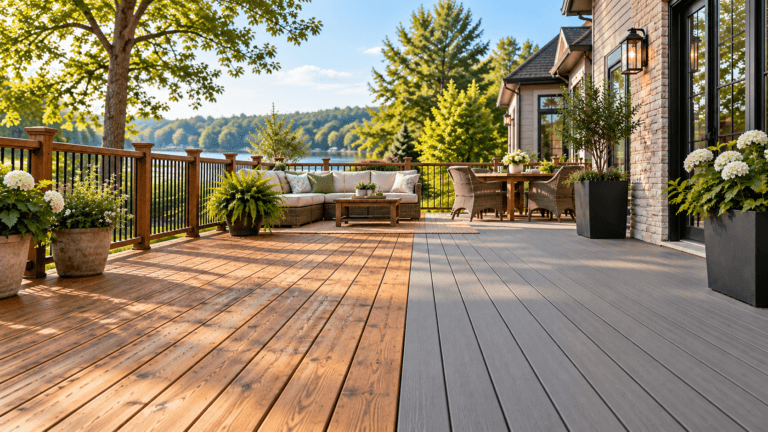
| Decking | Pressure-treated wood | Premium composite, hardwood or specialty products |
| Height | Low to grade | Elevated or second story |
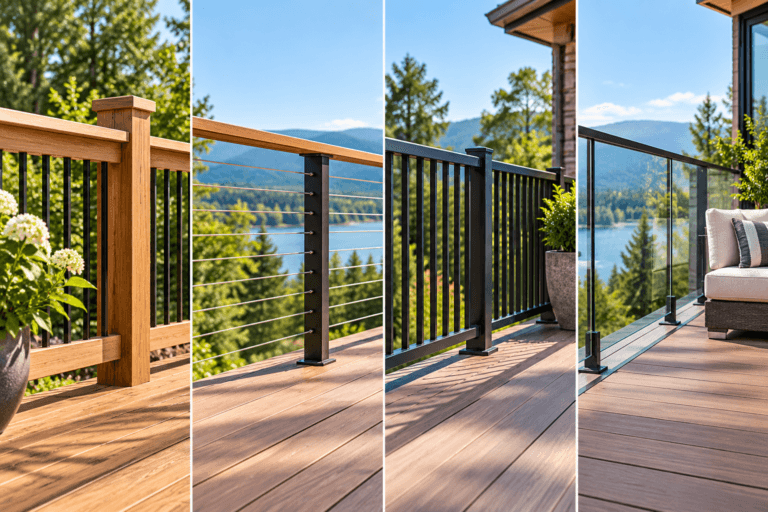
| Railing | Simple system | Cable, glass or custom railing |
| Stairs | Few or none | Long or multiple stair runs |
| Site | Flat, open access | Slopes, tight access or excavation |
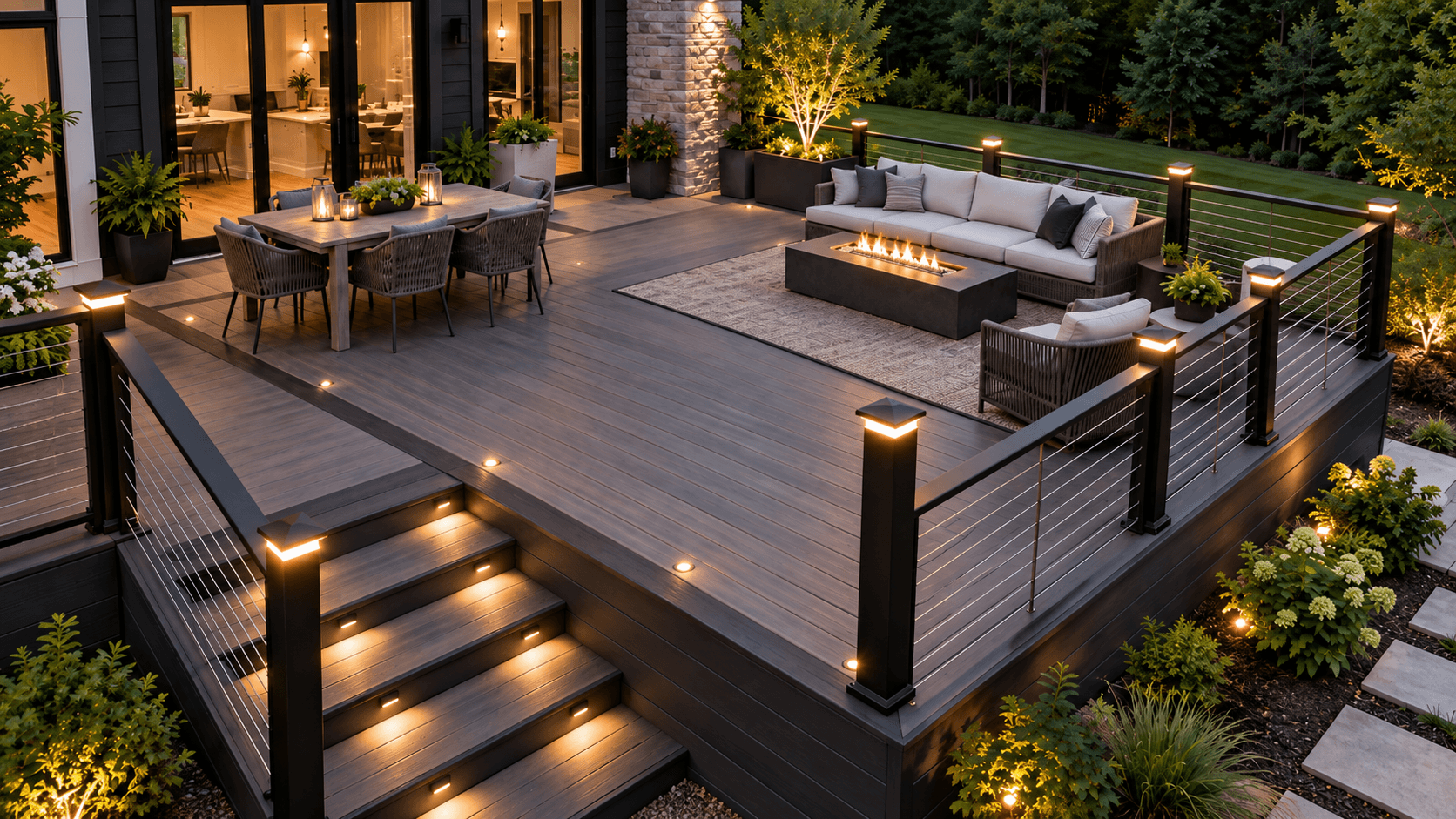
| Features | Basic deck | Lighting, privacy screens, pergolas and built-ins |
The important point is that cost per square foot is not fixed. A small deck loaded with custom details can cost more per square foot than a much larger, simpler deck.
Size
Larger decks require more decking, joists, beams, fasteners, footings and labor. They can also require additional posts or larger structural members as spans increase.
That part is fairly obvious.
What is less obvious is that increasing a deck from 12 feet deep to 16 feet may do more than add four feet of decking. Depending on the layout, it could change joist spans, beam locations, footing requirements or board lengths.
That is why the structure should be planned before quantities are finalized.
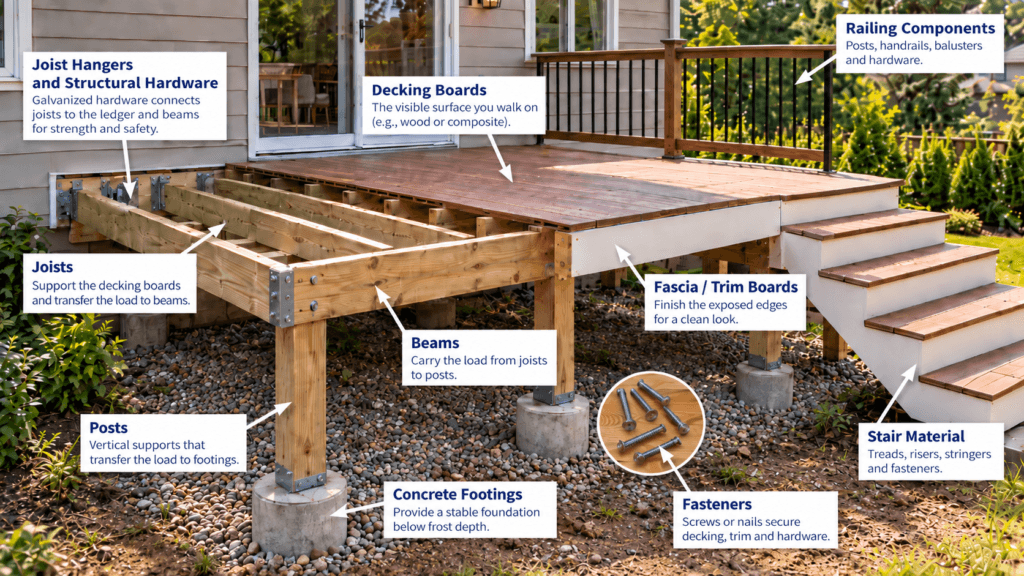
You can see how those components work together in the Builzee Deck Structure & Components guide.
Deck Height
A low deck over a relatively flat yard is generally simpler to build than a deck several feet above grade.
As the deck gets higher, you may add longer posts, more bracing, guards, stairs and more complicated access for workers and materials. Footing and structural requirements can also become more involved.
Elevation is one reason comparing two decks strictly by square footage can be misleading.
Wood vs. Composite Deck Cost
Material choice gets a lot of attention because it is easy to see and easy to compare. It is important, but the price of the deck boards alone does not tell you what the entire deck will cost.
Pressure-Treated Wood
Pressure-treated lumber is commonly used when keeping upfront material cost under control is a priority.
It can be used for both framing and decking, although the visible boards require more ongoing maintenance than most manufactured decking. Cleaning, staining or sealing should be considered part of the long-term ownership cost.
Cedar and Other Natural Woods
Cedar, redwood and premium hardwoods can provide a more distinctive natural appearance but typically move material costs higher.
The exact difference depends heavily on species and local availability.
Premium hardwoods can also affect labor because some materials are denser, harder to cut and may require specific fastening methods.
Composite Decking
Composite usually costs more upfront than basic pressure-treated decking, but routine maintenance is generally lower because the boards do not need periodic staining or sealing.
There is also a wide price range within composite decking itself. Entry-level products and premium capped boards should not be treated as one price category.
For a deeper comparison of the tradeoffs, see Composite Decking vs. Wood once comparing the two materials for your project.
Angi currently places a standard composite-deck installation broadly around $5,400 to $11,500, again depending on size and product selection. Angi
Framing and Foundations Still Cost Money
It is easy to spend most of the planning time choosing a deck board and almost none thinking about what is underneath it.
But the finished surface is only one part of the material package.
A deck may also require:
- Concrete footings
- Posts
- Beams
- Joists
- Blocking
- Ledger material
- Joist hangers
- Post bases and caps
- Structural screws and bolts
- Flashing
- Fascia and trim
On an elevated or heavily loaded deck, the structure can represent a significant share of the project cost.
The foundation can also change with soil conditions, frost depth, deck size and local requirements. A sloping site or difficult excavation can make what looks like a simple footing much more labor intensive.
Stairs and Railings Can Change the Budget Quickly
These are two items homeowners often underestimate.
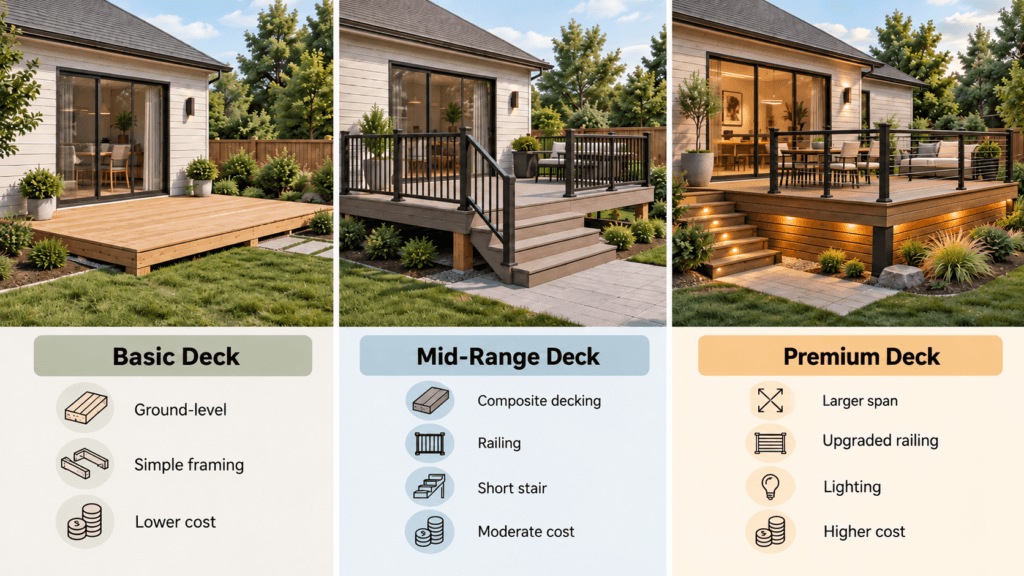
A deck that sits just above grade may need only a short step or two. Raise that same deck several feet and you may now need a full stair system with stringers, treads, landings, handrails and guards.
Railing works the same way.
A basic railing system around a small portion of a deck is very different from running premium cable or glass railing around a large elevated deck.
Current installed railing costs vary widely by material. For example, HomeGuide reports broad installed ranges of roughly $25 to $60 per linear foot for composite or vinyl railing, while cable and glass systems can cost considerably more. HomeGuide
Rather than selecting the railing after the rest of the deck has been priced, include it in the original scope.
Labor and Site Conditions Matter
Labor is one of the largest parts of a professionally built deck. Angi currently estimates professional deck-building labor at roughly $15 to $35 per square foot nationally. Angi
That range can move depending on where the house is located and how easily the crew can work.
A flat backyard with direct driveway access is much easier than carrying lumber through a finished house, down a narrow side yard or up a steep slope.
Other conditions that can increase labor include:
Demolition
If an existing deck has to be removed first, demolition, hauling and disposal become part of the project.
Do not assume demolition is included in a replacement-deck quote unless it is specifically listed.
Sloped Ground
Slopes can complicate layout, excavation, footing installation and material handling.
Tight Access
Long material carries and limited equipment access add time even if the finished deck itself is straightforward.
Second-Story Work
Working higher above grade generally requires more setup and more attention to access, staging and fall protection.
Hidden Damage
Replacement projects sometimes expose deteriorated siding, ledger connections, rim joists or other parts of the house that could not be fully inspected before demolition.
A good budget should leave some room for conditions that cannot be seen until the existing work is opened.
Costs Homeowners Often Forget
The easiest way to underestimate a deck is to price the obvious materials and forget everything around them.
Permits
Whether a permit is required and how much it costs depends on the local jurisdiction and the project.
Angi currently reports typical deck permit costs around $230 to $500 nationally, but some locations can be considerably different. Angi
Always check locally before construction begins rather than assuming a small deck is exempt.
Delivery
Long boards, framing lumber and railing packages may require jobsite delivery even when individual materials seem easy to purchase.
Fascia and Trim
Fascia boards, picture-frame borders and finished stair details can use more premium material than expected.
Hardware
Structural screws, hangers, anchors, post bases and specialty fasteners do not look expensive one piece at a time, but a complete deck can use a lot of them.
Lighting
Post lights, stair lights and low-voltage accent lighting usually require more than the fixtures themselves. Wiring, transformers and electrical work need to be included.
Landscaping
Footing excavation, construction traffic and demolition can disturb the yard around a deck. Allow for grading, planting, mulch, irrigation repair or other restoration if needed.
How Many Deck Boards Will You Need?
Before pricing the decking itself, determine the actual quantity.
Deck area alone does not tell you exactly how many boards to buy. Board width, spacing, available lengths, picture-frame borders, breaker boards and waste all affect the order.
Builzee’s Deck Board Calculator can estimate board quantity based on your deck dimensions, board size, spacing and waste allowance.
That gives you a much better starting point when comparing material options than simply multiplying deck square footage by the advertised price of a board.
How to Compare Deck Quotes
When several contractors price the same project, the lowest total is not automatically the least expensive version of the same deck.
Sometimes it is simply a different scope.
Before comparing totals, check whether each proposal includes the same:
- Deck dimensions
- Decking manufacturer and product line
- Framing material
- Footing and foundation work
- Stairs
- Railing
- Fascia and trim
- Demolition
- Debris removal
- Permits
- Delivery
- Hardware
- Lighting or electrical work
- Site restoration
A quote using basic pressure-treated framing and decking is not directly comparable to one using premium composite decking, upgraded railing and finished fascia.
The Builzee Deck Cost & Buying guide goes deeper into quantities, material ordering and comparing bids.
Ways to Keep Deck Cost Under Control
Reducing cost does not necessarily mean buying the cheapest material available.
Often the biggest savings come from keeping the design efficient.
A straightforward rectangular footprint generally uses materials more efficiently than a deck with multiple bump-outs and angles. Keeping the deck closer to grade can reduce stairs, railing and structural complexity. Standard board lengths may also reduce waste compared with layouts that create repeated short cuts.
Material choices can then be prioritized where they matter most.
For example, someone who wants low maintenance may decide that spending more on composite decking is worthwhile while keeping the railing system simple. Another homeowner may prefer pressure-treated decking but spend more on a large entertaining area or upgraded railing.
Planning those priorities before construction is much easier than trying to cut costs after everything has already been designed.
If you are still working through size, traffic flow and how the deck connects to the house, use the Builzee Deck Planning & Layout guide before finalizing the budget.
Bottom Line
There is no single price that applies to every deck.
Square footage gives you a starting point, but material choice, deck height, framing, foundations, railing, stairs, labor and site conditions determine what the project actually costs.
Start with a clear layout, calculate the materials you can quantify and make sure anything you compare is based on the same scope. A realistic budget built around the complete deck is much more useful than an attractive price based only on the boards you see on top.
Planning a Deck Project?
Explore Builzee’s Decks & Outdoor Living guides for practical help with railing, materials, layout, structure, installation, maintenance and buying decisions.