Composite Decking vs. Wood: Which Is Better for Your Deck?
Choosing between composite decking and wood is not just a matter of deciding which surface looks better. The two materials differ in upfront price, maintenance, weather resistance, surface temperature, installation requirements and how they change as they age.
Wood remains popular because of its natural appearance and broad range of price points. Composite decking generally costs more upfront, but it is designed to reduce routine maintenance and eliminate the need for regular staining or sealing.
Neither option is automatically better for every deck. The right choice depends on your budget, climate, maintenance expectations and how you want the finished deck to look and perform over time.
Composite Decking vs. Wood at a Glance
The biggest difference between the two materials is what happens after installation.
Wood gives you a natural material that can be sanded, stained and refinished as it ages. Composite decking is manufactured to provide a more consistent surface with less routine maintenance, but damaged boards usually need to be replaced rather than refinished.
| Feature | Wood Decking | Composite Decking |
|---|---|---|
| Upfront cost | Usually lower for pressure-treated lumber | Usually higher |
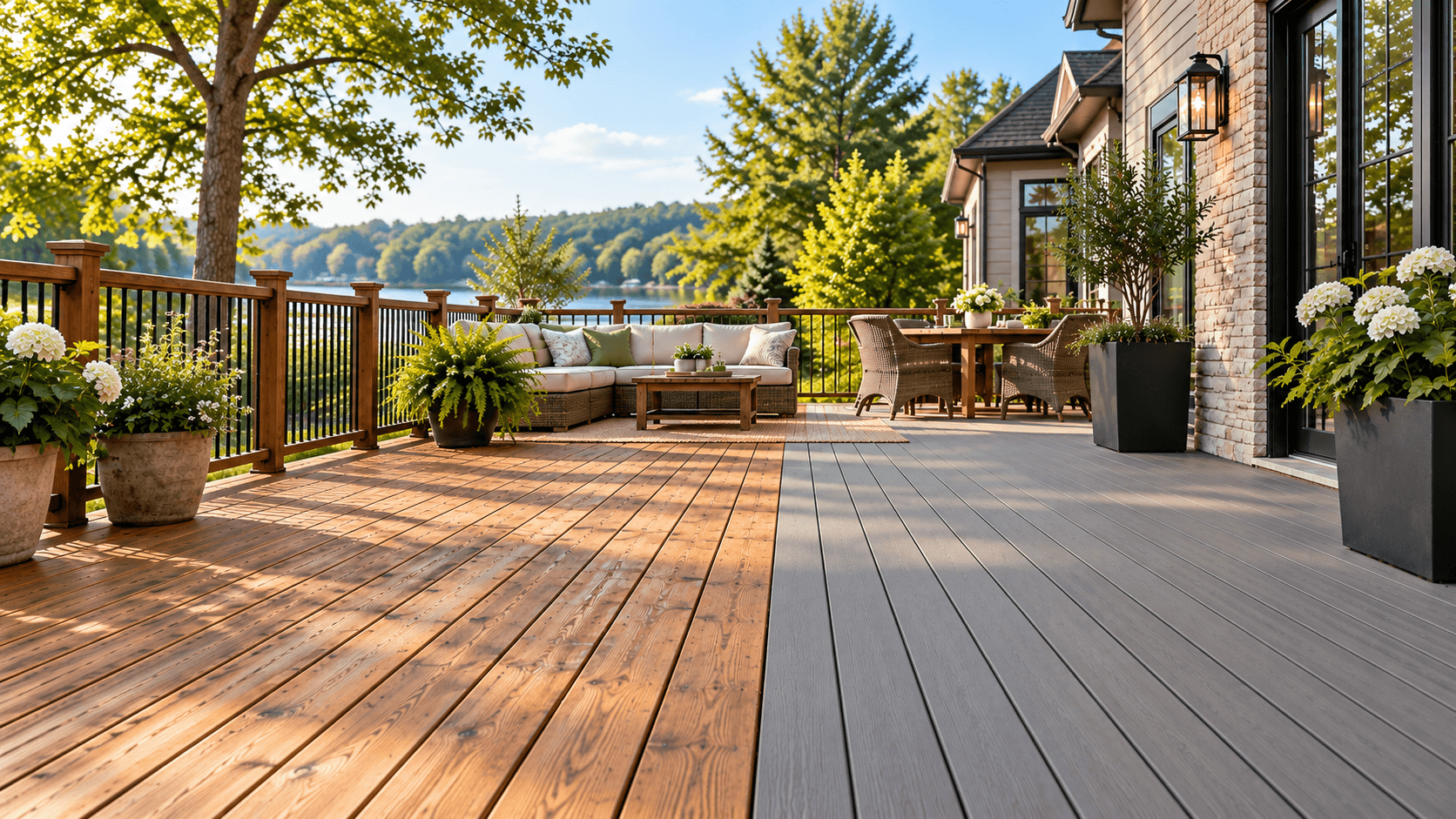
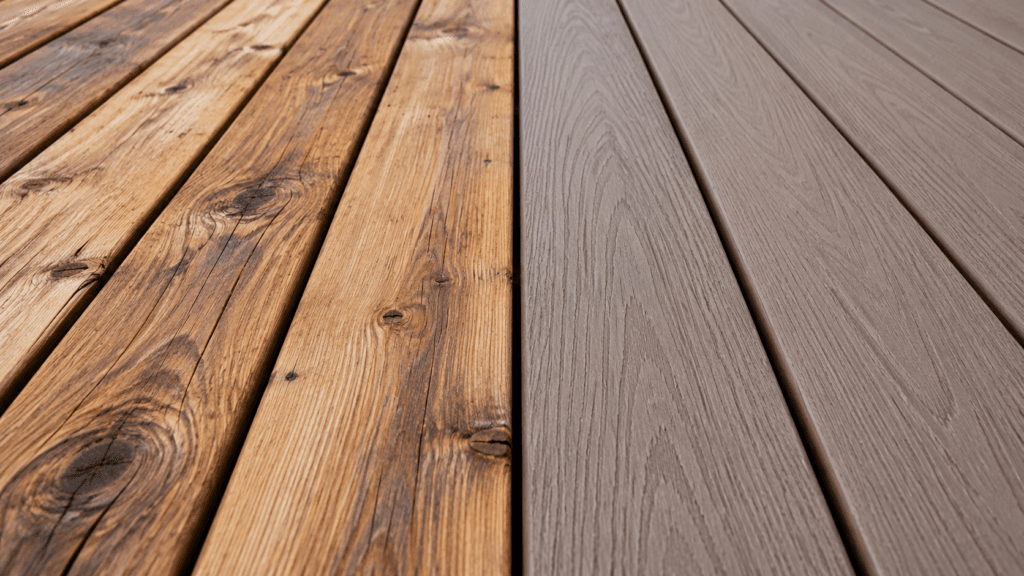
| Appearance | Natural grain and variation | Manufactured wood-look finish |
| Maintenance | Cleaning plus periodic staining or sealing | Primarily cleaning |
| Moisture resistance | Depends on species, treatment and maintenance | Generally strong |
| Fading/weathering | Naturally changes over time | Varies by product and color |
| Repairability | Can often be sanded or refinished | Damaged boards typically replaced |
| Heat in direct sun | Varies by species and finish | Can become hot, especially darker colors |
| Board consistency | Natural variation | More uniform |
| Installation | Familiar woodworking methods | Product-specific spacing and fastening requirements |
If you are still comparing the broader range of available deck products, start with Builzee’s Deck Types & Materials guide before narrowing the decision to wood or composite.
Upfront Cost
Pressure-treated lumber is usually the lower-cost way to build a wood deck. Cedar, redwood and tropical hardwoods can move considerably higher depending on species, grade and local availability.
Composite decking typically starts above pressure-treated wood and can increase significantly as you move into premium product lines with more detailed grain patterns, multiple colors and enhanced surface finishes.
But comparing only the price per board can be misleading.
Fasteners, fascia, picture-frame borders, railing, framing requirements and waste all contribute to the material package. Some composite systems also use proprietary clips or hidden-fastener systems that should be included when comparing prices.
Our Deck Cost & Buying guide goes deeper into the other components that affect the final project budget.
Think Beyond the Initial Purchase
The lower-cost material on day one is not necessarily the lower-cost material over the life of the deck.
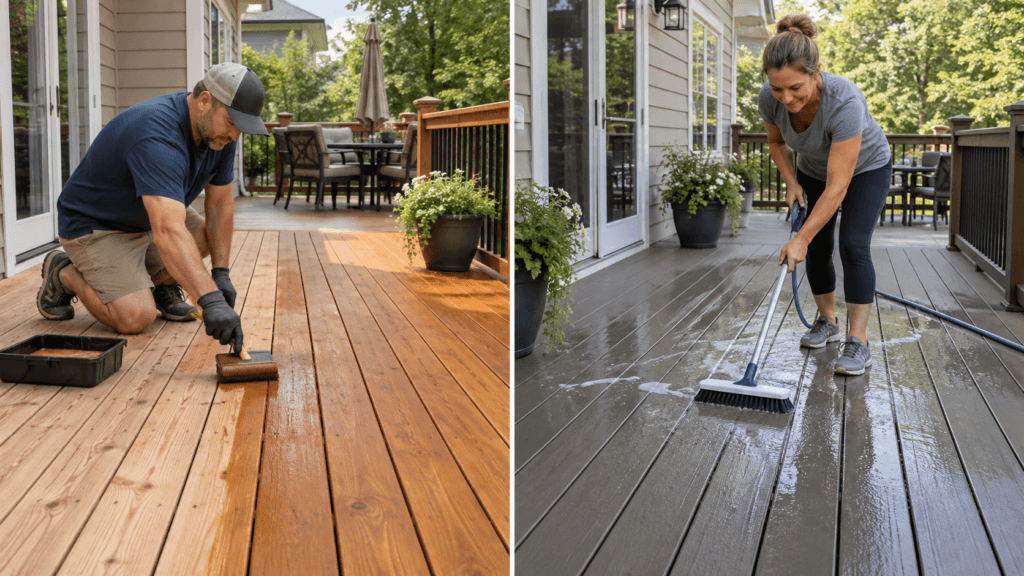
A wood deck may need periodic cleaning, stain, sealer and eventually sanding or board replacement. Composite costs more upfront but generally eliminates routine refinishing.
That does not mean composite is maintenance-free. It means the type of maintenance is different.
Maintenance
This is where the difference between the two materials becomes much more noticeable.
Wood Decking
Wood is exposed directly to sunlight, rain and changing humidity. Over time, an unfinished surface can fade, check, crack or absorb moisture.
Routine care may include:
- Sweeping and cleaning
- Removing leaves and debris from board gaps
- Checking for loose fasteners
- Replacing damaged boards
- Cleaning mildew or staining
- Reapplying stain or water-repellent finish when needed
How frequently refinishing is needed depends on the wood species, product, exposure and finish rather than a universal schedule.
Composite Decking
Modern composite decking primarily needs cleaning rather than refinishing. Dirt, pollen, leaves, food spills and mildew can still collect on the surface, so the deck should not simply be installed and forgotten.
Manufacturers also have their own cleaning instructions. For example, Trex recommends soap and water for routine cleaning of its current high-performance decking, while TimberTech provides product-specific guidance for cleaners, brushes and pressure washing. Always follow the instructions for the actual product installed rather than treating every composite board the same.
For more on long-term upkeep, see Builzee’s Deck Repair & Maintenance guide.
Durability and Long-Term Wear
Both materials can perform well when installed correctly, but they fail differently.
Wood can split, check, cup, rot or become soft when moisture remains trapped. Pressure treatment helps protect lumber from decay, but good drainage, ventilation and maintenance are still important.
Composite does not behave like solid lumber. It is much less susceptible to decay from moisture, but the surface can still scratch, stain or become damaged. Not every scratch disappears, and a badly damaged composite board usually cannot simply be sanded and refinished like wood.
The framing underneath matters regardless of the decking material. Installing composite boards does not make the joists, beams, ledger or posts maintenance-free.
Appearance
This part comes down heavily to personal preference.
Natural wood has real grain, knots, color variation and imperfections. Even boards from the same bundle may look slightly different. For many homeowners, that variation is exactly the appeal.
Wood also changes with age. Depending on the species and finish, it may darken, fade or weather toward gray unless the appearance is maintained with stain or sealer.
Composite manufacturers have become much better at producing realistic grain and color variation. Premium products may combine several tones within one board rather than repeating a uniform pattern.
Still, it is a manufactured surface.
If you want actual wood that can be sanded, stained and changed later, composite cannot fully duplicate that. If you prefer consistent color and do not want to maintain a stained finish, composite may make more sense.
Heat and Sun Exposure
Any deck surface can become hot in direct sunlight.
Dark colors generally absorb more solar heat, so color selection matters whether you are choosing stained wood or composite decking. Some composite product lines are specifically designed to reduce heat buildup, but performance varies by manufacturer and color.
This matters most when the deck receives strong afternoon sun, surrounds a pool or is frequently used barefoot.
Before selecting a dark board because it looks good on a sample, consider where the deck is located and how much direct sun it receives during the hottest part of the day.
Moisture and Weather
Wood and water require careful detailing.
The deck should allow rain to drain away rather than remain trapped between boards or against framing. Leaves and debris should also be removed from areas where they hold moisture.
Wood decking needs room to dry after wetting. Boards that remain damp for long periods are more likely to experience decay, staining and movement.
Composite boards resist moisture differently, but drainage still matters. The substructure underneath is usually wood, and trapped debris or standing water can still affect joists, beams and connections.
Neither material eliminates the need for proper flashing, board spacing and water management.
Installation Differences
Wood decking is familiar to most carpenters and can generally be cut using standard woodworking tools. Fastening methods vary, but face screws remain common and damaged boards are relatively straightforward to replace.
Composite decking also uses conventional saws and tools, but the installation details are more product-specific.
Manufacturers may specify:
- Maximum joist spacing
- Board gaps
- End-to-end spacing
- Fastener locations
- Hidden-fastener systems
- Additional framing around picture-frame borders
- Support requirements at board ends and butt joints
Do not assume a framing layout designed for one decking product automatically works for another.
Builzee’s Deck Installation guide covers board layout, joist support, spacing, fasteners and other details that should be planned before the boards go down.
Which Material Makes More Sense for You?
There is no universal answer, but the decision becomes easier when you think about what matters most to you.
Wood May Make More Sense If:
You want the lowest initial cost and are considering pressure-treated lumber.
You strongly prefer real wood grain and natural variation.
You like being able to change the deck color later with stain.
You are comfortable with periodic cleaning and refinishing.
You want individual boards that can often be repaired, sanded or replaced relatively easily.
Composite May Make More Sense If:
You want to reduce routine refinishing.
You prefer a more consistent appearance from board to board.
The deck will be exposed to frequent moisture.
You are willing to spend more upfront for lower-maintenance decking.
You prefer hidden-fastener systems and contemporary board finishes.
You do not want staining or sealing to become part of your regular maintenance schedule.
Do Not Ignore the Framing
One common mistake is spending heavily on premium decking while treating the structure underneath as an afterthought.
The surface boards are only one part of the deck.
Joists need to be properly spaced. Board ends need support. Picture-frame borders may require additional framing. The ledger needs proper flashing, and posts, beams and footings need to carry the deck loads correctly.
A premium composite board installed over poorly detailed framing will not correct structural or moisture problems underneath it.
That is also why your decking selection should be made before the framing is finalized rather than after the structure is already built.
Estimate the Decking Before You Buy
Once you know the deck dimensions and board size, calculate the quantity before ordering material.
Board width, spacing, deck dimensions, waste and layout can all change the number of boards required. Picture frames, breaker boards and unusual deck shapes can add additional material beyond a simple square-foot calculation.
Use Builzee’s Deck Board Calculator to estimate the board quantity and waste allowance before placing the order.
Bottom Line
Wood and composite can both make excellent decking, but they solve different priorities.
Wood usually provides the lower entry price and the unmistakable look of a natural material, with the tradeoff of more ongoing maintenance. Composite generally requires a larger upfront investment but reduces the need for staining and refinishing while providing a more consistent surface.
The better choice is the one that fits your budget, exposure, appearance preferences and willingness to maintain the deck over time. Compare the complete project rather than the board price alone, and make the material decision early enough that the framing, fasteners and layout can be designed around it.
Planning Your Deck?
Compare materials, understand the structure and work through the key decisions before you build. Explore Builzee’s Decks & Outdoor Living guides for practical help with planning, installation, maintenance and buying.