How to Clean a Dishwasher: Remove Odors, Grease & Buildup
Kitchen maintenance / Practical DIY
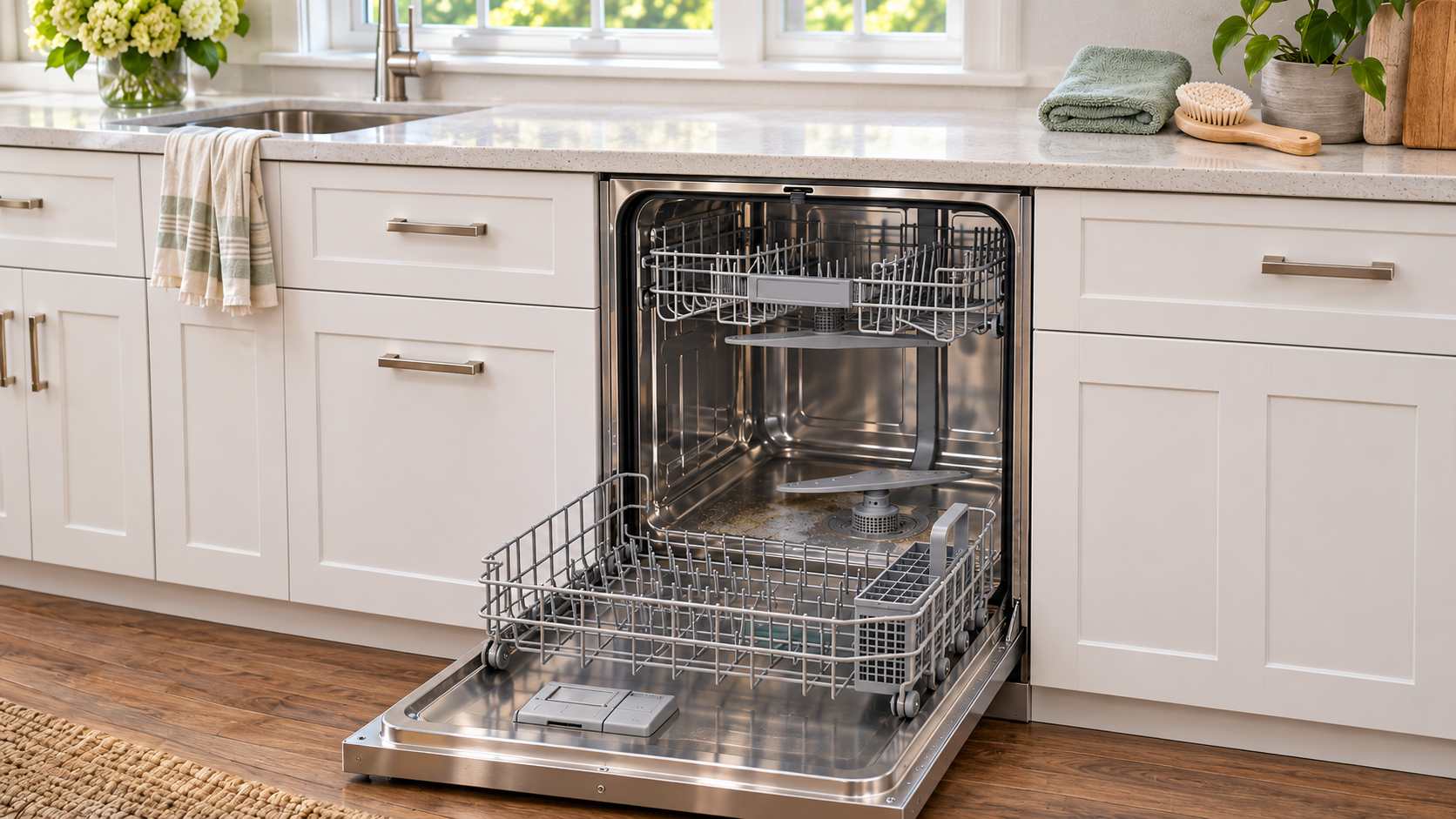
If your dishwasher smells sour when you open it, leaves gritty specks on glasses, or has a cloudy film on the walls, you may not need a repair call. Often, the first step is a thorough cleaning of the filter, tub, seals and spray arms. Learning how to clean a dishwasher properly also means knowing which parts are safe to remove and which cleaning products your model actually allows.
This guide walks through a routine deep clean, explains common odor and residue problems, and shows when a persistent issue deserves more than another cleaning cycle.
Quick answer: How do you clean a dishwasher?
Empty the dishwasher, remove visible debris, clean the filter if your model has a removable one, wipe the door gasket and tub edges, check the spray arms, then run an empty cleaning cycle using a manufacturer-approved dishwasher cleaner. Reinstall all parts securely before running the machine.
Look up your model’s owner’s manual before removing parts or using vinegar, descaler, tablets or any other cleaning product. Not every dishwasher is built or cleaned the same way.
Why does a dishwasher get dirty if it cleans dishes?
A dishwasher moves hot water and detergent around the load, but food particles, oils and minerals still have places to accumulate. The filter catches debris that should not recirculate onto dishes. Door edges and gasket folds receive less direct spray, so residue can build up there even when the rest of the tub looks clean.
Often linked to trapped food, wet residue or buildup around the filter and gasket.
Check the filter, spray arm openings and loading pattern first.
May be hard-water minerals, not leftover food. The treatment may be different.
May call for an approved dishwasher-cleaning product and a suitable hot cycle.
One important distinction: cleaning removes deposits you can reach or flush away; it does not fix a failed circulation pump, blocked drain hose, leaking valve or defective heater. Start with the inexpensive maintenance checks, but don’t keep repeating them if symptoms suggest a mechanical problem.
What do you need to clean a dishwasher?
Most routine cleaning calls for a few simple household tools. Specialized cleaning products are optional only if your manufacturer’s instructions permit alternatives.
Gather these
- Microfiber cloth or soft sponge
- Small soft-bristled brush
- Warm water and a little mild dish soap for removable parts, if allowed
- Dry towel and flashlight
- Dishwasher-safe cleaner approved for your appliance
- Your dishwasher’s model-specific manual
Keep these away
- Steel wool, abrasive pads and wire brushes
- Sharp objects used to scrape plastic or gaskets
- Bleach, ammonia or drain-opening chemicals unless specifically permitted
- Unapproved descalers and concentrated acids
- Any combination of different cleaning products
How to clean a dishwasher step by step
Work from visible debris to hidden buildup. That order matters: a cleaning tablet cannot remove a piece of food lodged in a filter, and a spotless door gasket won’t help if a spray arm cannot rotate. Keep the appliance off and cool while wiping and inspecting its interior.
Empty the machine and check the bottom of the tub
Remove the dishes and utensils. Pull the bottom rack forward on its tracks or lift it out if needed and permitted by the manual. Look around the filter well and the lower front corners for loose labels, food scraps, broken glass or other objects.
Remove reachable debris carefully with a soft cloth. If you see glass or other sharp material, protect your hands and avoid reaching blindly into the sump. A small amount of water may normally remain below the filter area on some models; a broad pool covering the tub floor is a different concern.
Find and clean the dishwasher filter
On many modern dishwashers, the filter sits at the bottom of the tub under the lower rack, near the base of the lower spray arm. Some have a cylindrical filter that twists loose plus a flat mesh screen; others use a different arrangement, including filtration components that owners are not meant to remove.
If your manual identifies a user-removable filter, follow its release direction, remove any companion mesh screen as instructed and rinse the pieces under warm running water. Use mild soap and a soft brush on stuck food or film. Never scrape fine mesh with metal or force a part that resists removal.
Inspect the screen for tears or cracks. Reinstall each piece in the correct position and lock it fully. Running the dishwasher with a missing or loose filter can allow debris to reach parts that were designed to be protected.
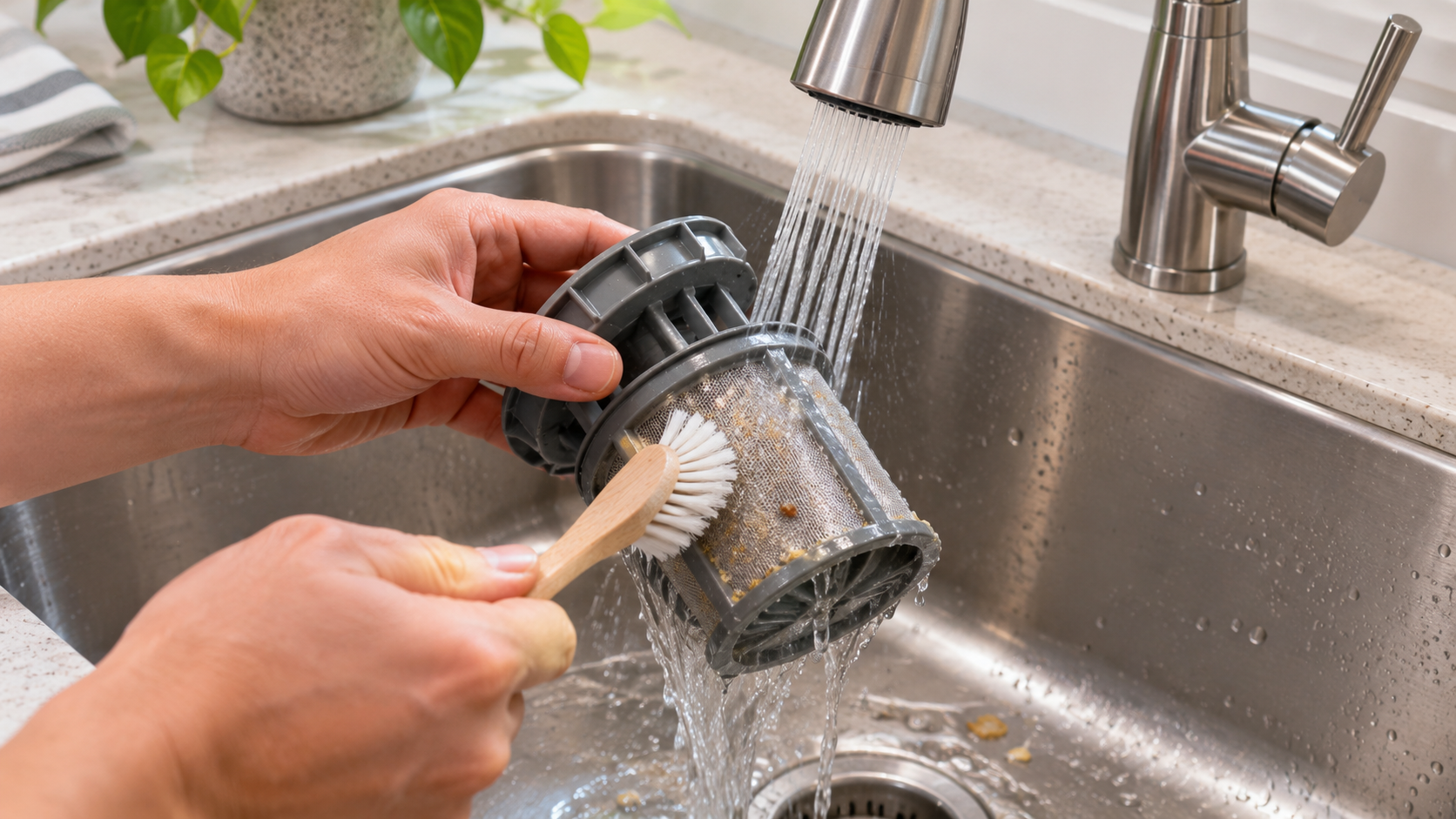
Why this is worth doing: A dirty filter can contribute to odor and food particles returning to dishes. Bosch advises using mild soap, water and a soft brush; Whirlpool cautions against abrasive brushes and operating with a filter that is not locked in place. See the Bosch filter guide and Whirlpool filter instructions.
Inspect the spray arms and their openings
The spinning spray arms distribute wash water through small openings. Check the lower and upper arms for food particles or mineral deposits blocking these holes. Confirm each accessible arm can rotate freely without striking the rack or a loose utensil.
If the manual allows an arm to be removed, rinse it and clear its openings using the approved method. Bosch describes checking under running water and gently loosening debris from holes with a toothpick on applicable models. Avoid enlarging a nozzle, bending an arm or taking apart pieces that are not user-serviceable.
Put any removed arm back exactly as directed. An arm that is not seated correctly may stop spraying or hit the rack during operation.
Wipe the tub, door edges and detergent dispenser area
Use a damp microfiber cloth to wipe the accessible stainless steel or plastic tub, the inside face of the door and the bottom front lip where residue often collects. Gently clean around the detergent dispenser without forcing its lid or packing material into its hinges.
For greasy spots, use a small amount of mild soapy water if the manufacturer permits it, then wipe off the soap with a separate damp cloth. Avoid saturating the control panel, vents and electrical seams. The aim is to remove surface grime, not to flood hidden cavities.
Clean the door gasket and lower door seal
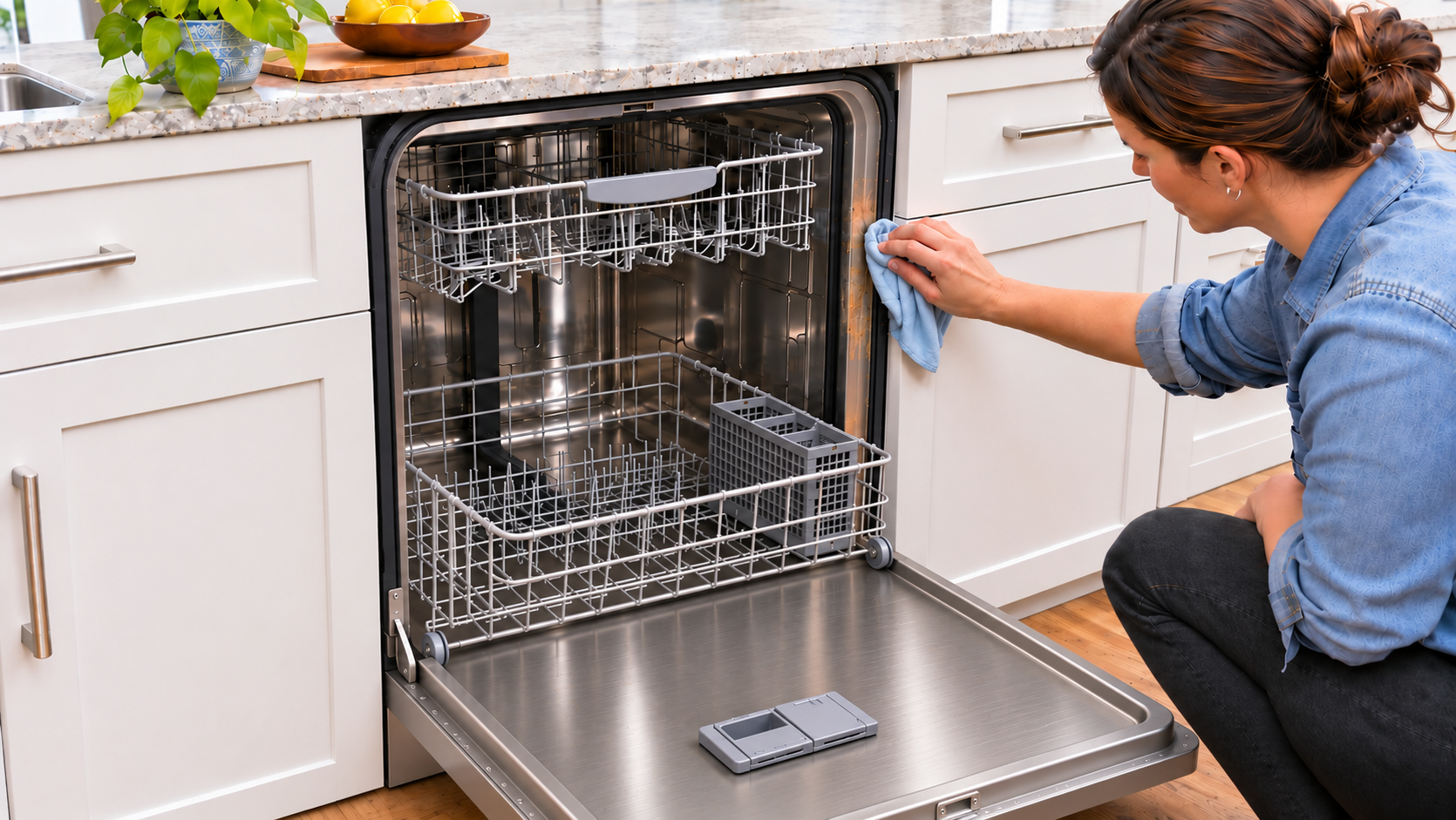
The flexible gasket around the tub opening creates the water seal when the dishwasher closes. Its edges and folds can hold food residue and moisture even when the main tub is clean. Wipe the exposed gasket slowly with a damp cloth, concentrating on corners and the sides of the opening.
Clean the accessible lower door edge separately, since the construction can differ from the side and top gasket. Do not pull a gasket out of its channel, pry against it or assume a gap is a defect. If the rubber is torn, brittle or loose, check the replacement procedure for your model rather than improvising a sealant repair.
Finish with a clean, dry cloth. Pay attention to any grime in the cabinet-facing lower corners that a normal spray cycle may not wash directly.
Choose an approved interior-cleaning cycle
After reinstalling the filter, racks and any removable spray arms, run a cleaning cycle according to your appliance’s instructions. Many models allow a dishwasher-cleaning tablet or liquid cleaner, but the location of the product and the selected cycle depend on the cleaner label and the appliance. Some require an empty tub; others allow cleaning during a normal load.
If your dishwasher offers a dedicated machine-care or self-clean cycle, check which cleaner it accepts. Otherwise, use the cycle and temperature recommended by the manufacturer. Do not add extra detergent because the tub looks dirty, and do not combine multiple products to try to make them work faster.
Check results and restore normal operation
When the cycle ends and the interior has cooled, open the dishwasher and inspect the tub, spray arms and gasket areas. The odor should be reduced, the filter should be secure and no cleaning-product residue should remain where the manufacturer says it should not. If instructed by the product label, run an additional rinse.
Make sure both racks roll correctly, the door closes without resistance and the appliance completes its next normal load. Repeat aggressive cleaning cycles only if the product guidance calls for it. If odors or poor cleaning return immediately, move to troubleshooting instead.
Can you clean a dishwasher with vinegar or baking soda?
You’ll find plenty of online advice about placing a cup of vinegar inside an empty dishwasher. Some manufacturers, including Whirlpool, describe specific vinegar cleaning methods for certain machines. Whirlpool also warns that repeated vinegar use can damage dishwasher components because vinegar is acidic. Other manufacturers emphasize purpose-made cleaners and descalers instead.
The safest general recommendation is to use a cleaner explicitly approved for your dishwasher. Only use vinegar if your appliance’s instructions permit it, and follow that method rather than guessing at concentration, location or cycle. Baking soda is sometimes suggested for odors, but it is not a universal substitute for filter cleaning or for a manufacturer-recommended descaler.
| Cleaning method | Best use | What to check first |
|---|---|---|
| Warm water, soft cloth, mild soap | Wipe accessible surfaces and removable filters when permitted | Instructions for mesh screens, seals and painted or plastic surfaces |
| Dishwasher cleaner | General grease, film and odor maintenance | Approved product, placement, whether dishes may remain and cycle setting |
| Dishwasher descaler | Mineral deposits caused by hard water | Model compatibility, water hardness and correct frequency |
| White vinegar | Occasional cleaning only where specifically approved | Manufacturer permission and instructions; repeated acid exposure can be damaging |
| Baking soda | Limited odor treatment on models that permit it | Not a substitute for cleaning the filter or correcting drainage problems |
For more detail on manufacturer-approved cleaning approaches, review Whirlpool’s dishwasher cleaning guide and Bosch’s cleaning and maintenance instructions.
How often should you clean your dishwasher?
There isn’t one universal interval. Frequency depends on the filter design, number of loads, how thoroughly food is scraped from dishes and local water hardness. A busy household with visible food accumulation may need filter attention more often than a lightly used appliance.
| Task | Useful starting interval | Adjust when… |
|---|---|---|
| Remove visible scraps | After loads, as needed | Food collects around the sump or door lip |
| Inspect removable filter | Every few weeks initially | You run frequent loads or see food and gritty dishes |
| Wipe gasket and door lip | About monthly | Odor or residue appears sooner |
| Run approved machine-clean cycle | Roughly monthly, or per manual | Hard water or heavy use makes buildup recur |
| Inspect spray arms | Every few months, or as needed | Spray coverage worsens or openings look blocked |
These are starting points, not appliance requirements. Whirlpool’s filter guidance varies substantially based on load frequency and whether dishes are scraped or rinsed. Your exact model manual takes precedence over any generic calendar.
Scrape large food pieces before loading instead of expecting the filter to handle them all.
Check filter seating and spray arms before buying more detergent or a stronger cleaner.
Review detergent dose, rinse aid, water hardness and approved descaling rather than scrubbing blindly.
Troubleshooting: What if the dishwasher still smells or leaves dirty dishes?
Use the symptom to narrow the next step. Different problems can look similar, so cleaning repeatedly without checking performance can waste time and products.
| What you notice | Start here | When to escalate |
|---|---|---|
| Rotten food or sour smell | Inspect filter, gasket folds, lower door lip and debris around the tub | Odor persists after a complete cleaning or comes from the drain connection |
| Dirty particles on dishes | Clean and secure filter; check spray arms and loading clearance | Water circulation remains weak or washing is consistently poor |
| White film and spotting | Assess water hardness, rinse aid and manufacturer-approved descaling | Deposits persist despite correct products and settings |
| Water pooling on tub floor | Check accessible filter area and consult drainage troubleshooting | Standing water persists, drain error appears or water leaks onto floor |
| Musty smell despite a clean filter | Wipe gasket and inspect visible door and tub surfaces | Odor quickly returns or there is evidence of leakage or persistent moisture |
Is a smelly dishwasher always a cleaning problem?
No. Poor drainage, an incorrectly installed drain hose, a blocked air gap where one is fitted, or a plumbing issue can allow odors to return. If you smell sewage or see wastewater backing into the tub, investigate the drain system rather than pouring additional cleaner into the appliance. Drain hose routing and under-sink connections are model- and installation-specific.
What if dishes are still cloudy or greasy?
Check more than the interior finish. An overcrowded rack can prevent spray from reaching surfaces. A tall cutting board or pot handle may stop an arm from spinning. Incorrect detergent quantity, short wash programs and inadequate hot-water supply can also affect results. Address the obvious loading and maintenance causes before assuming the dishwasher itself needs replacement.
When should you call for service?
Call a qualified appliance technician or plumber as appropriate if the unit leaks, repeatedly fails to drain, trips a breaker, makes new grinding noises, displays persistent faults or needs access to wiring, a pump or fixed plumbing. Water damage and electrical problems are not worth treating as a routine cleaning experiment.
Common dishwasher-cleaning mistakes to avoid
Before you finish, check these details
- The filter is installed and locked, not just sitting in its opening.
- Any removable spray arms are properly reattached and can rotate.
- No cleaner has been mixed with another product.
- You have not pulled the rubber gasket out of its channel.
- Lower rack wheels and door guides remain aligned and undamaged.
- No cleaning liquid has been sprayed into the control panel or wiring areas.
- The cleaner and cycle were allowed by your model’s instructions.
Another mistake is leaving a dirty filter out during a test run. Filters protect the wash and drain components, so don’t operate the machine until the required parts are reinstalled. Likewise, don’t use a strong acid every week because one cleaning tutorial says it removes mineral film. Choose a product matched to the actual deposit and the appliance’s approved maintenance method.
If you’re also doing broader kitchen upkeep, the Builzee Kitchens guide covers appliance planning and other home improvement decisions. For unrelated water leaks at the sink, see our leaky faucet troubleshooting guide.
Frequently asked questions
Can you clean a dishwasher without removing the filter?
Yes, you can wipe the accessible tub and gasket and run an approved cleaning cycle. But if your model has a removable filter with trapped debris, the cycle may not clear it. Follow the manual to clean that filter rather than skipping it.
Where is the dishwasher filter located?
On many models it is in the floor of the dishwasher under the bottom rack, often near the lower spray arm. Designs vary, and some models do not have a user-removable filter. Use the model number to locate the correct instructions.
Can you run a dishwasher empty to clean it?
Usually, yes, when the manufacturer and cleaning-product label direct you to run an empty cleaning or maintenance cycle. Check the required cleaner placement and cycle settings first.
Can vinegar damage a dishwasher?
Repeated acid exposure may damage components on some dishwashers. Use vinegar only where the appliance maker specifically permits it; for regular maintenance, an approved dishwasher cleaner is the safer default.
How do you clean a smelly dishwasher naturally?
Start without chemicals: remove food debris, wash the removable filter where permitted, and wipe the door seals and lower lip. That often addresses the source. If odor remains, use a model-approved treatment rather than mixing household ingredients.
How often should you clean the dishwasher filter?
It depends on the filter, number of loads and food left on dishes. Inspect it every few weeks initially and follow the manual’s interval. Some households require more frequent attention; others can go longer.
Why does my dishwasher smell after a cleaning cycle?
Debris can remain in the filter, under accessible edges or in the drain system. Recheck those areas and look for standing water. A persistent sewage-like odor or draining problem warrants additional diagnosis.
Should you clean the spray arms?
Inspect them if wash performance drops or spray openings are visibly blocked. Follow the model instructions for removal and cleaning. Never force an arm off or enlarge its nozzle holes.
The bottom line
To clean a dishwasher effectively, start with the parts that actually collect debris: the filter, tub bottom, door seals and spray arms. Then use an approved cleaner and cycle to address film or grease that a cloth can’t reach. A short, repeatable maintenance routine can help keep dishes cleaner and reduce avoidable service calls.
Just as important, know when cleaning is no longer the answer. Persistent standing water, leaks, electrical faults or recurring drain odors need diagnosis, not another bottle of cleaning solution.
More practical fixes. Fewer expensive surprises.
Explore Builzee’s kitchen guides for appliance decisions, renovation planning, layout tips and practical ways to understand the work before spending money.
Explore Kitchen Guides →