
Composite Decking Cost: Materials, Installation & Hidden Expenses
Composite decking cost can mean three very different things: the price of the boards, the cost to replace boards on a sound existing frame, or the price of building a complete deck. Those numbers shouldn’t be compared as if they describe the same project.
A homeowner replacing worn wood boards might be able to reuse the structure underneath. Someone building a deck from scratch needs framing, footings, hardware, and possibly railings and stairs before the first composite board goes down. The surface may look similar when finished, but the budgets are not.
This guide separates those scopes, explains where entry-level and premium composite boards differ, and gives you sample budgets and a quote checklist you can actually use before hiring a contractor.
Composite Decking Cost at a Glance
Source: HomeGuide’s 2026 composite decking cost guide, which distinguishes deck-surface boards from a complete installed deck. National planning figures are not quotes for your location.
Boards only
You’re pricing decking planks. Add waste, delivery, fascia, fasteners and any other materials before calling it a project budget.
Resurface
Remove old surface boards and install composite over a frame that has been inspected and approved for reuse.
Build the whole deck
Pay for the structural frame, footings, surface, installation and all selected accessories. This is the higher total-cost category.
What Does the Price Actually Include?
It’s easy to find a board advertised by the piece or by square foot and assume that’s what the finished deck will cost. In reality, the total depends on which parts of the deck you’re purchasing.
| Work item | Buy boards | Resurface existing deck | Build new deck |
|---|---|---|---|
| Composite decking boards | Yes | Yes | Yes |
| Deck board installation | No | Yes | Yes |
| Removal of old boards | No | Usually | Only if replacing an old deck |
| Joists, beams, posts and footings | No | Only repairs/upgrades | Yes |
| Fasteners, trim and fascia | Often separate | Confirm scope | Confirm scope |
| Railings and stairs | No | If replaced or altered | As design requires |
| Permits and site work | No | Jurisdiction/project dependent | Often required |
“Installed” does not always mean every accessory is included. Confirm the estimator’s assumptions and read the contractor’s written exclusions.
Composite Decking Cost by Board Quality
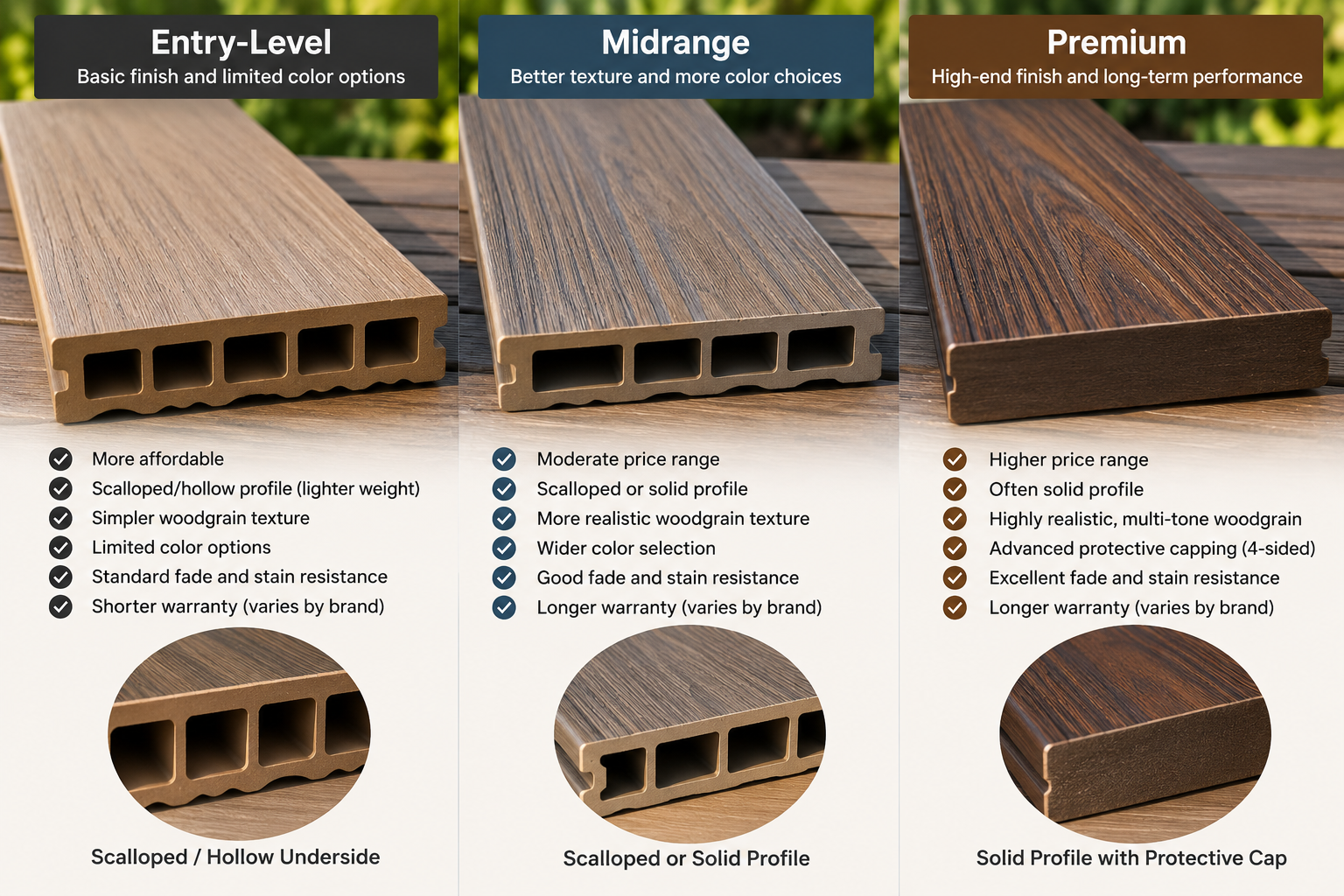
Composite decking comes in basic, midrange and premium collections. The higher price often reflects the surface finish, color variation, protective coating, warranty terms and product design. A more expensive board is not necessarily thicker, nor is a scalloped underside automatically a defect.
For instance, Trex Enhance uses a lightweight scalloped profile, while Trex Select offers a solid profile. These are differences between specific product lines, not a universal rule that every hollow-looking board is low quality. Compare the actual board specifications and warranties, not just a cross-section.
| What changes | Entry-level | Midrange | Premium |
|---|---|---|---|
| Woodgrain look | Simpler, more uniform | More texture and variation | Often detailed, multitone finishes |
| Color selection | Usually limited | More finishes | Often expanded, designer-oriented options |
| Board profile | Can be scalloped | Scalloped or solid | Often solid; check actual line |
| Surface performance | Product dependent | Product dependent | May offer enhanced stain/scratch performance |
| Warranty | Check coverage and exclusions | Check coverage and exclusions | Often longer, not always broader |
Trex and TimberTech are two familiar names, but their collections and material families aren’t identical. TimberTech also sells advanced-PVC decking, which is not the same product composition as wood-plastic composite. A price comparison should identify the exact collection and whether you’re looking at composite or PVC. Its deck cost overview also shows why framing, labor and added features matter beyond the board price.
For a manufacturer perspective on features and collections, Trex explains differences between its lines in its decking FAQs.
Board-only prices are not the same as the material package for an entire deck. Fasteners, fascia, framing, posts, concrete and railing are additional materials, even before installation labor.
Resurface an Existing Deck or Build a New One?
This choice can matter more than the difference between two composite decking brands. If the existing deck frame is safe and suitable for the new boards, resurfacing may avoid the cost of rebuilding the joists, beams, posts and footings. But a new surface will not make a deteriorated structure safe.
Resurfacing may make sense when…
The posts, beams, joists, connections, ledger and footings are sound; the frame meets applicable requirements; and the selected composite boards can be installed at the existing joist spacing. Removal, disposal and minor repairs still need a budget.
Rebuilding may be necessary when…
There’s decay, inadequate support, unsafe connections, poor ledger flashing or an unsuitable frame. A new structure may also be needed if you’re changing the deck size, elevation or layout.
Before committing to resurfacing, ask for a structural inspection. Check the joist spacing against the exact composite board’s instructions; changing from wood to composite may require additional joists or blocking. Stair-tread requirements can be tighter than those for the main deck.
For the broader scope of a complete deck project, read Builzee’s Cost to Build a Deck guide.
What You’re Paying for Beneath the Composite Boards
The walking surface gets most of the attention, but the supporting frame determines whether the deck is safe and how long the installation may last. A contractor building from scratch must address the deck’s connection to the house, or design it as a freestanding structure, along with the load path to the footings.
Support the deck surface and define board span limits. Existing joists may need reinforcement or replacement.
Transfer deck loads into the ground. Soil, height, span and frost conditions affect their design.
For attached decks, the connection and water management at the house are critical; a superficial board swap won’t correct defects.
Hidden deck clips, structural hardware and corrosion-compatible fasteners serve different purposes and should be specified separately.

Particular care is needed where railings attach and where stairs meet the deck. These elements carry different loads from ordinary floor boards. Any new or reused deck structure should be evaluated against applicable codes and the specific product manufacturer’s installation requirements.
Composite Decking Cost Examples by Deck Size
Using the broad $40–$80-per-square-foot national range for a complete new composite deck, here’s what several deck sizes imply. The purpose is to establish an early planning window, not to replace an itemized bid.
All three ranges are calculated directly from the same $40–$80/sq. ft. benchmark. Custom railings, difficult site conditions, multi-level construction and premium upgrades may exceed it.
Two Different 300-Square-Foot Projects
Now compare a hypothetical 300-square-foot resurfacing job with a hypothetical 300-square-foot new deck. These examples deliberately show their assumptions, because a single national average can hide too much.
Resurface an Existing 300-SF Deck
Retain the sound framing and usable existing railing; remove old boards and install midrange composite decking.
| Scope | Illustrative amount |
|---|---|
| Composite boards (300 SF at $10/SF) | $3,000 |
| Fasteners, edge/fascia materials | $600 |
| Remove and dispose of old decking | $650 |
| Installation labor | $2,150 |
| Example total | $6,400 |
Build a Complete 300-SF Composite Deck
Assumes typical footing and framing work, a straightforward layout, basic railing and stairs, and no unusual site complications.
| Scope | Illustrative amount |
|---|---|
| Footings, structural framing and labor | $6,200 |
| Composite surface, fasteners, fascia and installation | $6,100 |
| Basic railing and stairs | $3,400 |
| Permits, delivery and site finishing | $1,100 |
| Example total | $16,800 |
These line items are illustrative Builzee budgeting scenarios, not actual bids, measured national line-item averages or guarantees. Example A excludes railing replacement, concealed framing repairs and permitting if required. Example B equals $56 per square foot and falls within the broad complete-new-deck benchmark.
The lesson isn’t that one project will always save a specific amount. It’s that reusing suitable structural framing eliminates major work. If the framing fails inspection, a resurfacing quote may turn into a rebuilding quote.
How to Estimate Composite Deck Board Quantities
Start with the finished area, but don’t stop there. The number of boards depends on actual board width, required spacing, direction, available stock lengths, butt joints and waste.
For instance, a 12-by-20-foot deck covers 240 square feet. That does not automatically mean you can purchase 240 square feet of boards without waste. Picture-frame borders, end cuts and the stock lengths available at your supplier affect the order.
- Measure each rectangular deck section and its orientation.
- Select the actual face width of your chosen composite board, not just the nominal size.
- Use the manufacturer’s required board spacing and supported joist layout.
- Account for stock lengths, cuts, border boards and reasonable waste.
- Price fascia, stairs, fasteners and railing separately from the main decking field.
Use Builzee’s Deck Board Calculator to estimate boards and total linear footage. It is a quantity tool, not a structural-design or cost estimator, so confirm the final order against the construction drawings and manufacturer instructions.
Composite vs. Wood Decking: Is the Higher Price Worth It?
Pressure-treated wood often costs less initially. Composite typically costs more upfront, but it does not need the same recurring staining or sealing cycle as exposed wood decking. Neither material is completely maintenance-free.
| Consideration | Composite decking | Pressure-treated wood |
|---|---|---|
| Upfront material cost | Usually higher | Usually lower |
| Routine maintenance | Washing and inspection; no routine staining for most capped products | Cleaning, periodic refinishing and inspection |
| Appearance | Manufactured grain and colors; often consistent over time | Real wood grain; finish changes with weathering |
| Repairs | Individual boards can be replaced, subject to product availability | Individual boards are commonly replaceable |
| Structural framing | Still required unless using an approved alternative system | Still required |
A fair long-term comparison includes cleaning, periodic wood refinishing, repairs and how long you plan to remain in the home. It also accounts for sun exposure, heat, surface traction and the particular product’s warranty. Composite can be a strong fit for someone who wants less recurring finish work, but that doesn’t make every premium board a good value for every deck.
What Should Be Included in a Composite Decking Estimate?
Ask contractors to price the same drawings, materials and project scope. A lower bid may simply leave out demolition, fascia, stairs or other work rather than represent a better price.
- Deck dimensions, total area and layout
- New construction or resurfacing scope
- Board manufacturer, collection, color and profile
- Actual board sizes and planned board direction
- Framing inspection and structural repairs
- Footings, posts, beams and joists if building new
- Ledger attachment and flashing details
- Approved joist spacing and blocking
- Fastener system and fastening specification
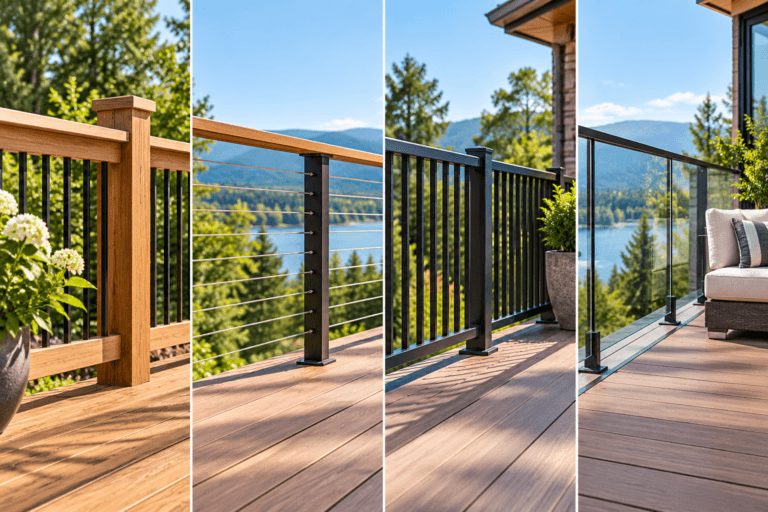
- Fascia, borders, stairs and railing details
- Old deck demolition and disposal
- Permits, engineering and inspections as applicable
- Site access, protection and final cleanup
- Product warranty and workmanship warranty
- Allowances, exclusions and change-order process
- Delivery, schedule and payment milestones
“What would change this price after work starts?” Ask specifically about hidden framing damage, unsuitable joist spacing, footing conditions, railing attachment and work excluded from the estimate.
Composite Decking Cost FAQs
How much does composite decking cost per square foot?
Common composite boards can cost roughly $5–$15 per square foot for the boards alone, while a complete professionally built composite deck is often estimated around $40–$80 per square foot nationally. The scopes are not interchangeable, and premium products and site conditions can push prices higher.
Is it cheaper to replace only the deck boards?
Often, if the existing frame is sound, properly connected and suitable for the chosen composite decking. Reusing the structure can avoid major framing and footing costs, but a thorough inspection is essential before deciding.
Does premium composite decking always have a solid core?
No. Hollow, scalloped, solid and capped constructions describe different product features. Their quality and suitability depend on the complete manufacturer specification, not the amount of material visible in a cut end.
Does composite decking get hot in the sun?
It can. Surface temperature varies with color, sunlight, texture and product formulation. Compare actual samples in your climate, especially for an uncovered deck or areas used barefoot.
Can I install composite boards over my existing wood boards?
Generally, the old surface should be removed so the frame can be inspected and the new boards fastened to an approved support system. Follow the selected manufacturer’s installation instructions rather than layering boards over an unknown condition.
Will the Deck Board Calculator give me the full project price?
No. It estimates decking quantities and linear footage. Framing, fasteners, railing, stairs, permit requirements and labor must be evaluated separately.
Get the Scope Right Before Comparing Composite Decking Prices
For a complete deck, composite decking cost is as much about what supports the boards as it is about the boards themselves. Start by deciding whether the project is a simple material purchase, a structurally sound resurfacing job or an entirely new build.
Then pick the actual board collection, check the framing and installation requirements, calculate the quantity, and ask contractors to price the same scope. That’s how you get a useful comparison rather than three unrelated numbers.