
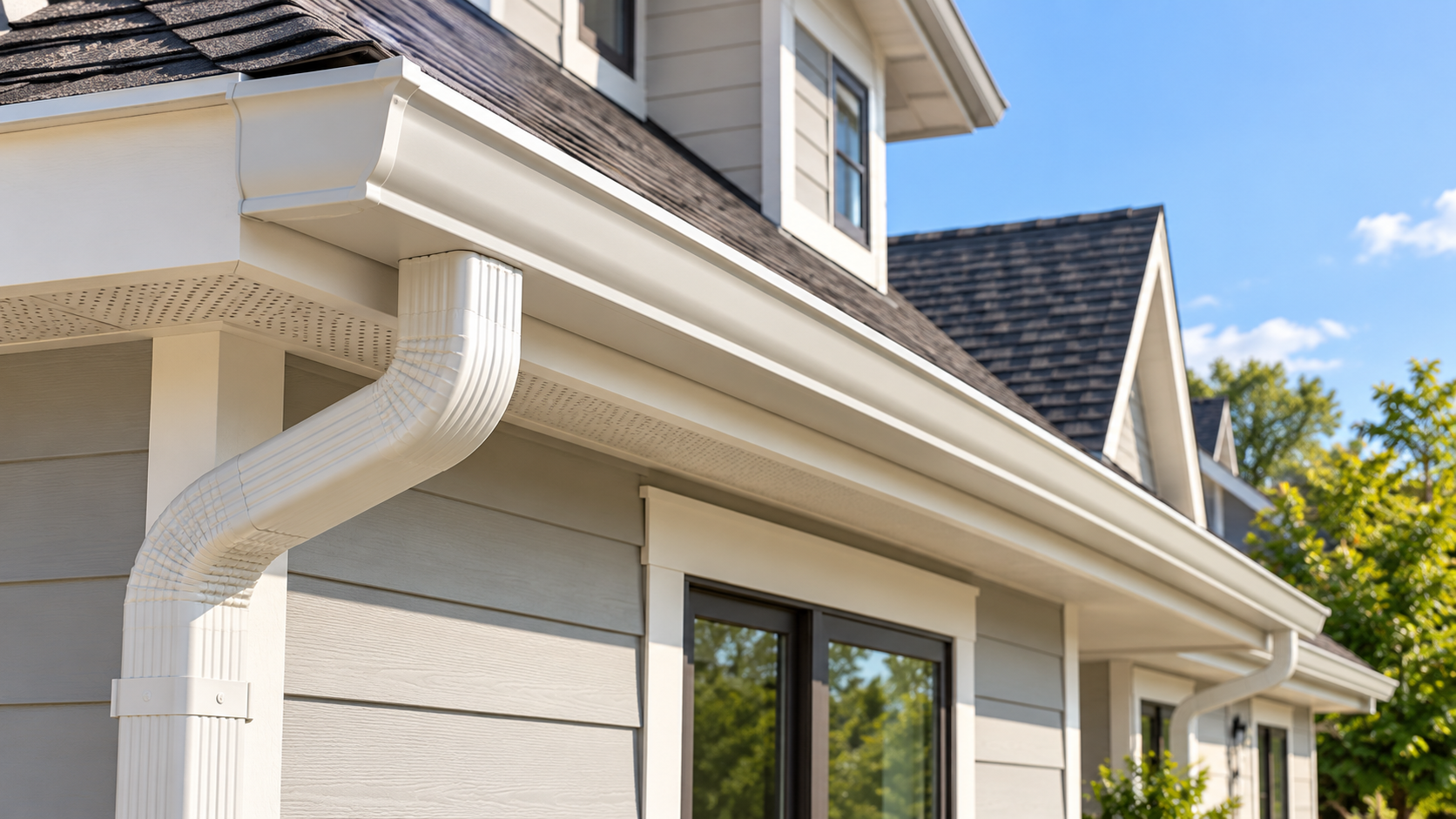
Gutter Replacement Cost: How Much Does It Cost to Replace Gutters?
Gutter replacement cost depends on the length of the roof edges that need gutters, the material and size, the number of downspouts, and whether deteriorated fascia must be repaired. A simple per-foot quote can hide substantial differences in the installed scope.
This guide helps you estimate the gutter system itself, understand where extra costs arise, and compare proposals based on how the roof actually drains.
Planning benchmarks: HomeGuide gutter installation cost data (2026 guide). Final quotes depend on location, scope and existing conditions.
Gutter Replacement Cost by Length and Scope
A useful starting point is $12–$25 per linear foot installed, with many whole-home jobs around $2,200–$5,000. These are broad estimates, not a fixed local rate. A two-story house with narrow access, multiple corners and extensive old-gutter removal can cost materially more per foot than a straightforward ranch house.
| Gutter length | Illustrative installed range | Check separately |
|---|---|---|
| 100 linear feet | $1,200–$2,500 | Small-job minimum and downspout count |
| 150 linear feet | $1,800–$3,750 | Old-system removal and discharge |
| 200 linear feet | $2,400–$5,000 | Multiple downspouts and second-story work |
| 250 linear feet | $3,000–$6,250 | Access, number of corners and fascia repairs |
The table simply multiplies the national installed range by gutter length. It should not be interpreted as four separate contractor bids. Some companies include downspouts, disposal and fittings in their price; others list them as extras. Never add a second downspout allowance to an all-inclusive quote without checking its scope.
Ask whether the quote includes hidden hangers, correct slope, outlets, elbows, end caps, corners, sealant, downspouts, removal, cleanup and discharge extensions. A low unit rate with numerous exclusions can cost more when the work is complete.
Gutter Replacement Cost by Material
Material selection changes both the initial cost and expected maintenance. The ranges below are broad installed estimates for conventional residential systems; profiles, thickness, coatings and local availability vary.
| Gutter material | Approximate installed cost / LF | Tradeoff |
|---|---|---|
| Vinyl / PVC | $8–$12 | Lowest initial cost; more joints and temperature sensitivity |
| Aluminum | $10–$20 | Lightweight, rust resistant, widely offered in seamless runs |
| Galvanized steel | $10–$35 | Strong but heavier; protective finish and corrosion control matter |
| Copper | $25–$40+ | Premium appearance, specialized fittings and workmanship |

Seamless gutters
Made to the required straight-run length, normally on site. They reduce joints along long runs, though corners and outlets still require proper seals and detailing. Seamless aluminum is a strong default to price for whole-home replacements.
Sectional gutters
Sold in shorter pieces joined in the field. They can work for smaller installations or DIY work, but every added joint is a potential maintenance point. Compare full installed costs, not product prices alone.
Aluminum is often the balance of cost, corrosion resistance and available colors. Vinyl appeals to smaller budgets but can become brittle; steel requires sound protective coatings and adequate support; copper is typically chosen for architectural character and long service life rather than low upfront price. HomeGuide’s material breakdown is a useful benchmark, but local contractors may quote different systems.
How to Estimate Gutter Linear Feet
Gutters are measured along the roof edges that actually collect runoff, not by house floor area. For a conventional gable roof, they usually run at the horizontal eaves, not every sloped rake. Roof valleys and upper-level drainage may require more capacity without increasing the length of every gutter.
Identify eaves, roof valleys, upper roofs and garages.
Record the horizontal length for every guttered edge.
Flag corners, outlets and where runoff will discharge.
Note steep ground, upper stories and damaged fascia.
Front main roof (48 LF), rear main roof (48 LF), garage (22 LF), patio (18 LF). Use roughly 140 LF for early planning, then have the installer field-verify each gutter run and outlet location.
A 2,000-square-foot house does not need 2,000 linear feet of gutters, and two houses with identical floor areas can have very different roof plans. Do not size gutters by length alone: the roof area draining into each run is critical.
5-Inch vs. 6-Inch Gutters, Downspouts and Drainage
Five-inch K-style gutters are common for residential applications. Six-inch gutters offer greater capacity, which can help with large roof catchments, heavy-rain locations and valleys that concentrate runoff. But a larger gutter without adequate downspouts can still overflow.
Roof catchment
Review how much pitched roof area feeds each run, not just the eave length. Multiple roof planes discharging to one corner require special attention.
Downspouts
Size and locate outlets using runoff demand, gutter capacity and the route to an approved discharge. A long run may need more than one outlet.
Discharge
Price splash blocks, extensions or connections separately where needed. Water should not be left to collect at the foundation or against siding.
Adding downspouts costs more when they run down two-story walls, require multiple elbows or cross complicated landscaping. Ask whether existing downspouts will be reused and how the connection sizes are being verified. If clean gutters repeatedly overflow, the problem could be system capacity, slope, a blocked downspout or the discharge arrangement, not just worn materials.
Working at roof edges can require fall protection and specialized access. Difficult or tall installations belong with qualified, insured contractors. Request pricing based on the actual site, including protection for landscaping and exterior finishes.
Fascia, Soffit and Removal Costs Can Change the Job
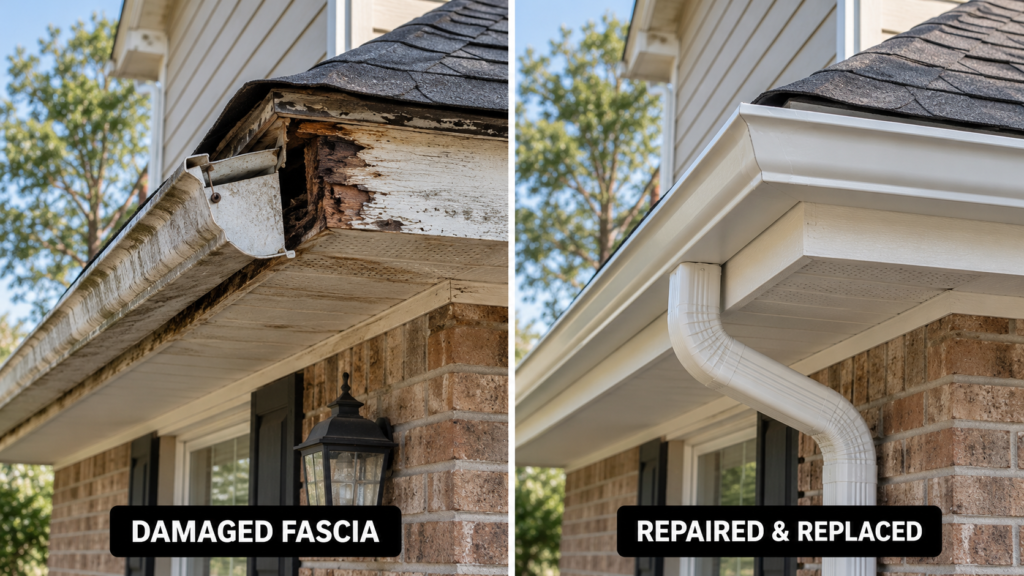
The fascia supports many gutter systems. Water staining, peeling paint, soft wood, sagging or separated brackets can mean the existing roof-edge substrate needs repair before a new gutter is attached. Soffit damage may also appear under the overhang. Do not cover compromised material with a new gutter and assume it will hold.
Look behind the old gutter
Ask the installer to document deteriorated fascia, agree on a unit-price or change-order process for unforeseen repairs, and clarify whether painting the repaired trim is included.
Removal of old hangers, straps, outlets and downspouts should include disposal and appropriate treatment of unused fastening holes.
Also decide whether gutter guards are needed. They may reduce some debris but are not maintenance-free, and can create another cost or cleaning issue.
It can make sense to coordinate gutter replacement with a roof replacement so drip edges and gutter placement are detailed together, but sound gutters do not automatically need replacement whenever the roof is redone.
Two Gutter Replacement Cost Examples
These examples preserve Builzee’s original scope assumptions for a simple seamless aluminum system, accessible eaves and no major fascia damage. In each example, the gutter-run allowance includes normal fittings, fasteners and installation labor; downspouts are counted separately, not twice.
| Cost item | 150 LF project | 200 LF project |
|---|---|---|
| Seamless aluminum runs installed | $1,800 | $2,400 |
| Old gutter removal / disposal | $225 | $300 |
| New downspouts / installation | $270 | $400 |
| Discharge extensions / accessories | $90 | $120 |
| Illustrative total | $2,385 | $3,220 |
Budget exercises only, not regional averages or contractor bids. The 150 LF version assumes three conventional downspout assemblies; the 200 LF version assumes four. Excludes major fascia repair, premium guards, complicated subsurface drainage and unusual access.
Small jobs may have higher mobilization cost per foot, while a longer clean run can sometimes be installed more efficiently. The amount of demolition and number of downspouts can shift the total just as much as gutter length.
Gutter Guards, Material Thickness and Roof Coordination
Gutter guards: a guard may reduce leaf accumulation, but fine debris and roof grit can still require maintenance. Compare the material, how it fastens to the gutter, whether it affects roof shingle warranties, and how accessible it will be for cleaning. Avoid pricing guards automatically unless trees or maintenance access justify them.
Material thickness: aluminum systems may be manufactured at different nominal thicknesses. Ask for the actual material specification, profile and finish. A price quote for an unspecified “aluminum gutter” cannot be fairly compared with one naming the exact metal thickness and gutter system.
Coordination with the roof: assess how the gutter aligns with the drip edge and fascia and whether water can run behind the gutter. If roofing work is planned, arrange coordination of removal and reinstallation so that roof-edge flashing and gutters are not handled as disconnected projects.
Slope and discharge: the gutter should drain toward its outlets without trapping water. The actual pitch and hanger spacing depend on the product, roof configuration and site conditions; have the installer specify the planned approach and confirm drainage before closeout.
When Gutter Repair Is Better Than Full Replacement
Repair may be enough
- One leaking joint or end cap
- Several loose hangers with sound fascia
- A local dent or separated outlet
- A section that can be matched and replaced
- Remaining runs drain properly
Replacement may be justified
- Widespread cracks, corrosion or leaking seams
- Repeated sagging or poor overall slope
- Multiple failed sections or incompatible repairs
- Undersized gutters for actual roof runoff
- Many aging components nearing the end of service life
Vinyl may last roughly 10–20 years, aluminum commonly about 20–30 years, and well-maintained copper may last much longer. These are broad lifespan expectations, not replacement deadlines. Climate, cleaning, fasteners and installation quality can shorten or extend service life.
Gutter Replacement Estimate Checklist
When bids vary, check whether contractors actually priced the same system. Use the checklist while reviewing each proposal.
Ask about the material thickness and downspout dimensions, not just “aluminum gutters.” Confirm who owns the scope at the roof drip edge, and do not let a contractor skip drainage design merely because the new system looks like the old one.
Budget for Water Management, Not Just New Metal
The best gutter replacement quote identifies the runs, materials, attachments, downspouts and discharge conditions. Use linear-foot pricing for early planning, then make the final decision from a defined system and a clear approach to fascia repairs.
Further reading: HomeGuide gutter installation costs and This Old House gutter maintenance guidance. Builzee provides general homeowner education; verify local requirements and manufacturer instructions.

