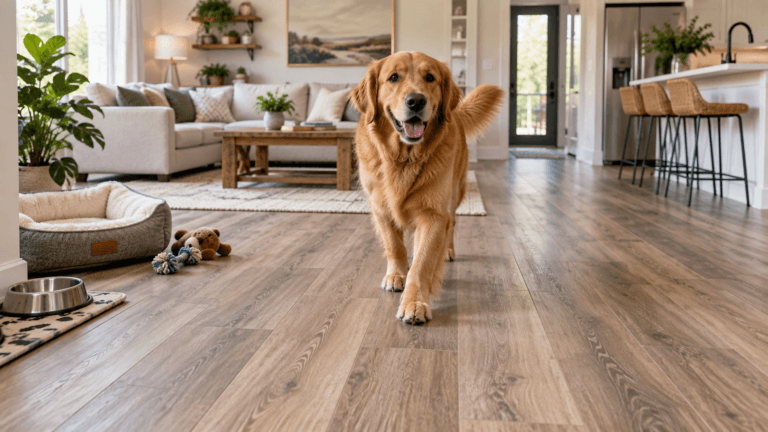
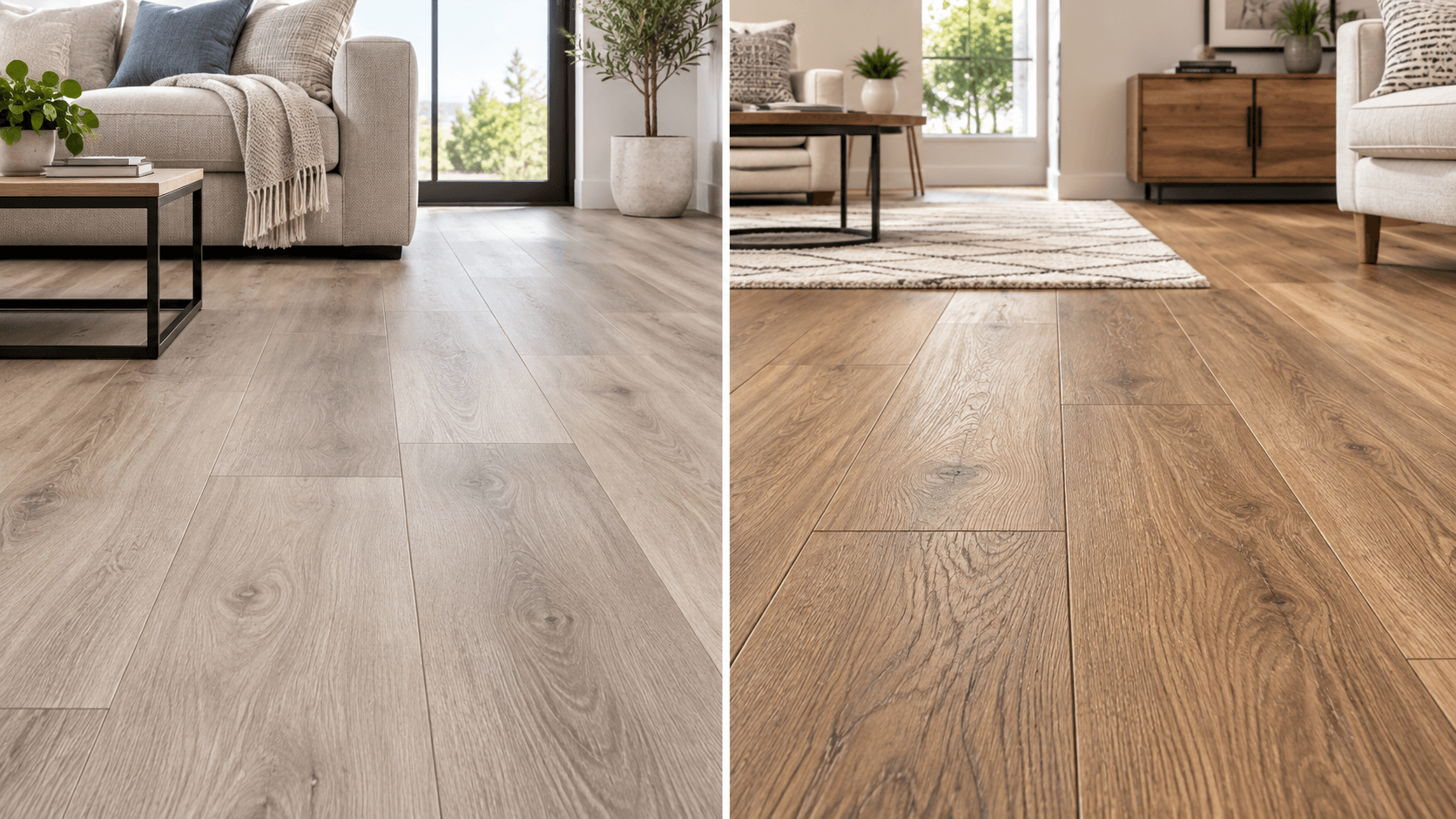
LVP vs Laminate Flooring: Which Is Better for Your Home?
Luxury vinyl plank and laminate are two of the most popular flooring choices for homeowners who want the look of wood without paying for solid hardwood. At first glance, they can look very similar. Both are available in realistic wood patterns, both can be installed as floating floors, and both are generally easier to maintain than traditional hardwood.
The differences start to matter once you look at how each material is built.
LVP is made primarily from synthetic vinyl layers, while laminate usually has a dense wood-fiber core beneath a printed decorative surface. That difference affects how each floor handles water, scratches, dents, sound and long-term wear.
Neither material is automatically better for every home. The right choice usually depends on where the flooring is going and what matters most in that room.
For a broader look at hardwood, engineered wood, vinyl, laminate, tile and carpet, see our Flooring Types & Materials guide.
LVP vs Laminate at a Glance
Here is the short version before getting into the details.
| Feature | LVP | Laminate |
|---|---|---|
| Water resistance | Usually better | Varies by product |
| Scratch resistance | Good | Often very good |
| Dent resistance | Can dent under heavy loads | Generally more rigid |
| Wood appearance | Very realistic on better products | Often excellent |
| Feel underfoot | Slightly softer | Firmer |
| Sound | Usually quieter | Can sound more hollow |
| Installation | Floating or glue-down | Usually floating |
| Refinishing | No | No |
| Individual plank repair | Sometimes | Sometimes |
| Bathrooms | Often a better fit | Product-dependent |
| Basements | Common choice | Requires moisture consideration |
| Pets | Very good overall | Very good for scratches |
| Typical price | Wide range | Wide range |
The quality of the specific product matters just as much as the category. A premium laminate can outperform an inexpensive LVP in several areas, and the reverse is also true.
What Is LVP?
Luxury vinyl plank is a layered synthetic flooring designed to resemble wood planks. You may also see similar products sold as luxury vinyl tile, rigid-core vinyl, SPC or WPC flooring.
The exact construction varies, but most products include a backing layer, a core, a printed design layer and a clear wear layer on top.
One of LVP’s biggest advantages is moisture resistance. Many products are marketed as waterproof because the plank itself does not absorb water the way a wood-fiber core can.
That makes LVP especially common in kitchens, bathrooms, laundry rooms, basements and homes with pets.
It is important to remember that waterproof flooring does not make the entire floor assembly waterproof. Water can still travel through perimeter gaps, seams and penetrations and reach the subfloor below.
If you are installing over concrete or dealing with an older subfloor, our Subfloors & Preparation guide covers moisture, flatness and underlayment in more detail.
What Is Laminate Flooring?
Laminate flooring usually has a high-density fiberboard core with a printed image layer and a durable transparent surface above it.
Modern laminate looks much better than the products many people remember from years ago. Better versions use high-resolution printing, textured surfaces and deeper embossing to reproduce wood grain, knots and plank variation.
Because the top surface is hard and rigid, laminate can perform very well against everyday scratches.
Its main weakness has traditionally been water. If moisture reaches the fiberboard core, the material can swell and permanently deform.
Newer water-resistant and waterproof-rated laminate products have improved significantly, but the limitations vary by manufacturer. That makes it especially important to read the actual installation and warranty requirements rather than assuming all laminate performs the same way around water.
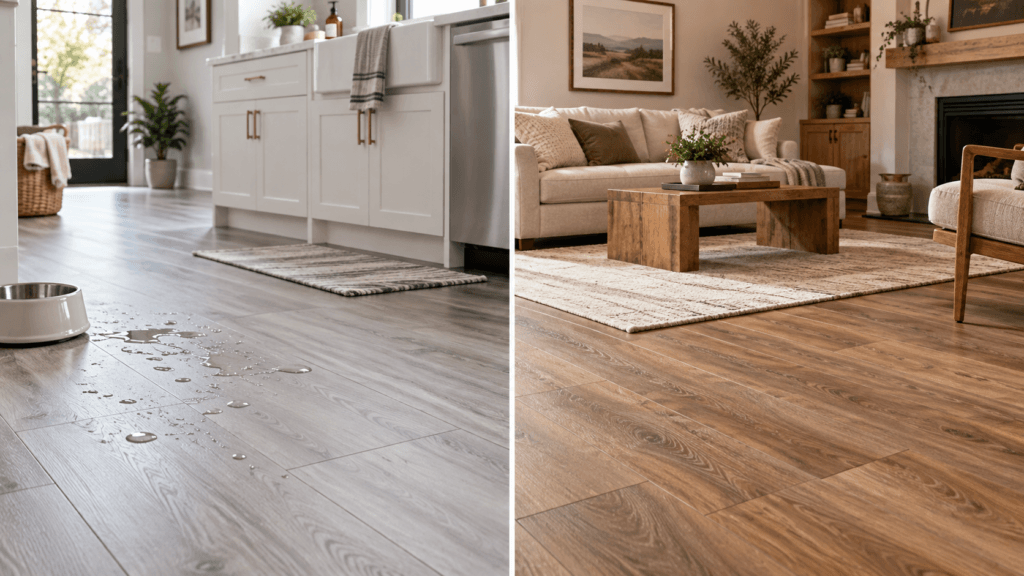
Water Resistance: LVP Has the Clearer Advantage
For bathrooms, laundry rooms, basements and other moisture-prone areas, LVP usually has the advantage.
The vinyl construction itself is not easily damaged by water. That makes accidental spills, pet accidents and routine wet cleaning less concerning than they would be with traditional laminate.
Laminate has improved, though.
Many newer laminate floors use water-resistant cores, tighter locking systems and sealed edges designed to slow moisture intrusion. Some manufacturers even approve certain products for bathrooms and kitchens.
The important distinction is that the term “waterproof” can refer to the flooring material itself, not necessarily the complete installed floor.
For either product, standing water should still be cleaned up as soon as practical.
Better choice for moisture-heavy spaces: LVP
That does not mean laminate should automatically be ruled out in a kitchen or powder room. It means the exact product specifications become more important.
Scratch Resistance: Laminate Can Be Surprisingly Tough
This is one area where laminate often performs extremely well.
The wear surface on good laminate flooring is hard and resistant to scratching from normal foot traffic, pets and furniture movement.
Many laminate products also carry an AC rating, which indicates the level of wear the surface is designed to handle.
LVP also has good scratch resistance, especially products with thicker wear layers and protective surface coatings, but it is not scratch-proof.
Dragging furniture, grit from shoes and sharp pet claws can mark either material.
For homes with large dogs, laminate may resist fine surface scratching extremely well, while LVP may offer better moisture resistance when accidents happen.
That is why pet owners should look at the entire situation rather than just one performance category.
Dent Resistance: The Core Makes a Difference
LVP tends to feel slightly softer underfoot, but that softness also means some products can be more vulnerable to indentation.
Heavy furniture, narrow furniture legs and concentrated loads can leave dents in softer vinyl products.
Laminate has a denser, more rigid core and may resist indentation better in many situations.
Again, product quality matters. Rigid-core LVP can be much more dimensionally stable than softer flexible vinyl.
Furniture pads are a good idea with either material.
Appearance: Both Can Look Convincing
There is no longer a simple answer to which one looks more like real wood.
Premium products in both categories can be very convincing.
Laminate has historically had an advantage in wood realism because the printed layer can reproduce detailed grain patterns very effectively. Embossed-in-register products align the surface texture with the printed wood grain, which can make the floor feel more authentic.
LVP has caught up considerably. Higher-quality vinyl planks now offer realistic grain patterns, matte finishes, beveled edges and larger plank formats.
The bigger visual differences usually come down to the specific product rather than whether it is technically vinyl or laminate.
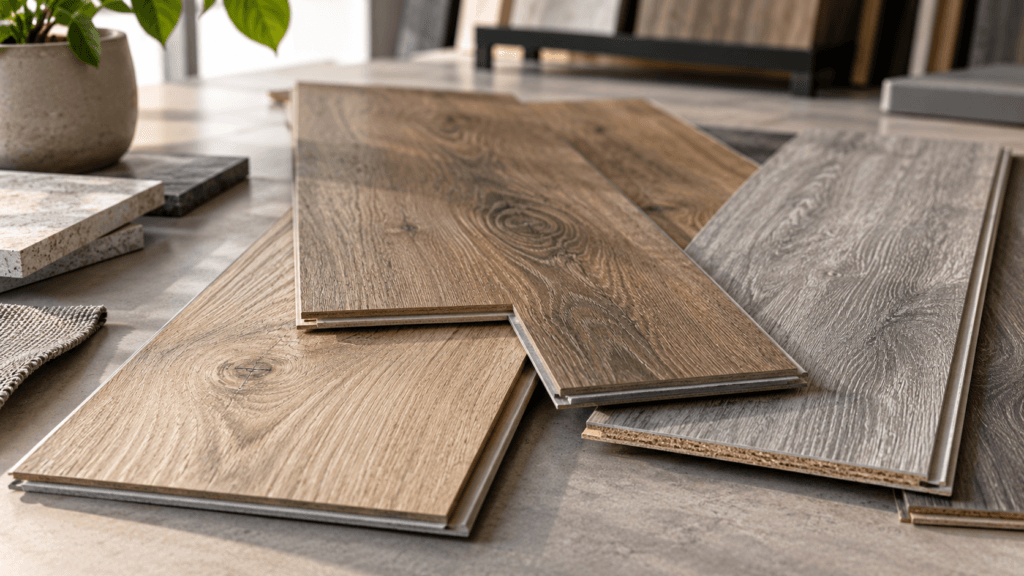
One thing worth checking in the showroom is pattern repetition. Less expensive products may repeat the same printed wood pattern frequently, which can make a large floor look artificial.
Lay several planks next to each other before buying if possible.
Comfort and Sound
LVP generally feels a little softer and quieter underfoot.
Vinyl has some natural flexibility, and many floating LVP products include an attached pad that helps with sound and comfort.
Laminate tends to feel harder and more rigid. Depending on the room and underlayment, it can sometimes have a slightly hollow sound when walked on.
A good underlayment can make a significant difference with either product.
Do not automatically add extra underlayment to flooring that already has an attached pad. Some manufacturers do not allow additional cushioning because too much movement can affect the locking joints.
Our Flooring Installation guide covers floating floors, underlayment, expansion gaps and other installation details.
Installation: Both Can Be DIY-Friendly
One reason LVP and laminate are so popular is that many products use click-lock installation.
The planks connect to each other and float over the subfloor rather than being permanently attached.
For a reasonably square room with a flat subfloor, either material can be approachable for an experienced DIYer.
LVP also comes in glue-down versions, which are common in some residential and commercial applications.
Laminate is most commonly installed as a floating floor.
Regardless of which product you choose, the floor underneath needs to be flat.
A floating floor does not correct an uneven subfloor. High spots, dips and abrupt elevation changes can cause movement, noise and joint problems after installation.
Maintenance Is Similar
Both LVP and laminate are relatively easy to maintain.
Routine care usually consists of:
- Vacuuming or sweeping regularly
- Removing grit before it scratches the surface
- Wiping up spills promptly
- Damp mopping with an approved cleaner
- Using furniture pads
- Avoiding abrasive scrubbers
- Following the manufacturer’s cleaning instructions
LVP is generally more forgiving when water is involved.
Laminate should usually be cleaned with less moisture, especially around plank seams.
Neither flooring should automatically be steam cleaned unless the manufacturer specifically allows it.
For more detail on cleaning, damage and repairs, see our Flooring Maintenance, Repair & Refinishing guide.
Can LVP or Laminate Be Refinished?
No, not in the way hardwood can.
Solid hardwood can often be sanded and refinished because the wear surface is real wood.
LVP and laminate rely on thin decorative surface layers. Once those surfaces are seriously damaged, sanding them would destroy the appearance of the plank.
Minor scratches may sometimes be disguised or repaired, but deep damage usually means replacing the affected plank.
That is one reason it is worth keeping an unopened carton or at least several extra pieces after installation.
Years later, the same color or pattern may no longer be available.
LVP vs Laminate for Kitchens
Both can work in kitchens, but LVP usually has the easier case.
Kitchens combine spills, appliances, heavy traffic and frequent cleaning. LVP’s resistance to moisture makes it a practical option in that environment.
Laminate can also work well if the manufacturer approves it for kitchens and the product has good water resistance.
Whichever you choose, pay attention to appliance clearances and flooring height before installation.
Dishwashers are a common example. Raising the finished floor around an appliance can make removal more difficult later if the dishwasher becomes trapped below the countertop.
LVP vs Laminate for Bathrooms
LVP is usually the safer choice for bathrooms.
Bathrooms expose flooring to splashes, wet feet and repeated humidity. Vinyl handles those conditions better than traditional fiberboard-core laminate.
Some newer laminate products are approved for bathrooms, but check the warranty carefully.
Look for restrictions involving standing water, perimeter sealing and installation around tubs, toilets and showers.
Tile is still another strong bathroom option, especially when long-term water resistance and durability are priorities.
LVP vs Laminate for Basements
LVP is very common in basements because of its moisture resistance.
That does not mean you can ignore the concrete slab.
Moisture vapor can still affect underlayment, adhesives and other parts of the flooring assembly even if the vinyl plank itself is waterproof.
Laminate can also be used over concrete in some situations, but moisture testing and the correct vapor-control system become especially important.
Never assume a basement slab is dry just because it looks dry.
LVP vs Laminate for Pets
Both can be good choices for homes with dogs and cats.
Laminate often performs very well against claw scratches because of its hard wear surface.
LVP has the advantage when pet accidents, water bowls and moisture are bigger concerns.
For many pet owners, LVP offers the more balanced combination of moisture resistance, easy cleaning and decent scratch resistance.
Large dogs can still scratch either surface, and heavy furniture or crates can dent softer vinyl.
Using runners in high-traffic areas and keeping pet nails trimmed helps with both materials.
LVP vs Laminate for Bedrooms and Living Rooms
In dry living areas, the decision becomes much closer.
Both materials can perform well in bedrooms, living rooms and home offices.
Laminate may appeal more to someone who prioritizes a hard surface, realistic wood texture and scratch resistance.
LVP may be better for someone who prefers a slightly softer floor, quieter feel and greater protection from spills.
Appearance may ultimately become the deciding factor.
In these rooms, there is less reason to choose based on water resistance alone.
What About Cost?
LVP and laminate have significant price overlap.
Entry-level versions of either material can be relatively inexpensive, while premium products can cost considerably more.
Factors that affect price include:
- Overall thickness
- Core construction
- Wear layer
- Surface texture
- Plank size
- Attached underlayment
- Brand
- Warranty
- Installation system
Do not compare material price alone.
A floor that appears cheaper may require additional underlayment, more subfloor preparation or a more expensive installation method.
Our Flooring Cost & Buying Guide covers waste allowances, product quality, quote comparisons and other costs that are easy to overlook.
LVP Pros and Cons
Advantages
- Strong moisture resistance
- Good option for kitchens and bathrooms
- Comfortable underfoot
- Relatively quiet
- Many realistic wood styles
- Easy routine maintenance
- DIY-friendly click-lock options
- Works well over many properly prepared substrates
Drawbacks
- Can scratch
- Softer products may dent
- Cannot be refinished
- Quality varies significantly
- Some inexpensive products can look artificial
- Damaged planks usually need replacement
Laminate Pros and Cons
Advantages
- Excellent scratch resistance on many products
- Realistic wood appearance
- Hard, stable surface
- DIY-friendly installation
- Wide range of styles
- Generally easy to maintain
- Often a good value for dry living areas
Drawbacks
- More vulnerable to moisture than vinyl
- Water damage can permanently swell the core
- Cannot be refinished
- May sound harder or more hollow
- Bathroom suitability varies by product
- Damaged pieces usually need replacement
So Which One Should You Choose?
Choose LVP when moisture resistance is high on the priority list.
It is especially appealing for kitchens, bathrooms, laundry rooms, basements and households where spills or pet accidents are common.
Choose laminate when the room is generally dry and you value scratch resistance, a rigid feel and convincing wood visuals.
Living rooms, bedrooms and home offices are areas where laminate can make a lot of sense.
For many homeowners, the final decision will not come down to LVP versus laminate as broad categories. It will come down to two specific products.
Compare the construction, surface quality, warranty, installation requirements and appearance of the actual flooring you are considering.
A good laminate is not automatically inferior to LVP, and a vinyl floor is not automatically the better choice simply because it is waterproof.
Bottom Line
LVP and laminate both offer an affordable way to get the look of wood without the maintenance and cost of traditional hardwood.
LVP generally has the advantage in moisture-prone areas and tends to feel slightly softer and quieter. Laminate can offer excellent scratch resistance, a firm feel and very realistic wood visuals.
The room itself should drive the decision.
Think about moisture, pets, traffic, installation conditions and how the floor will be used every day. Then compare the actual products rather than choosing based only on the category name.
Planning a Flooring Project?
Explore Builzee’s complete Flooring Guides for practical help with materials, room-by-room choices, subfloors, installation, maintenance, costs and buying decisions.