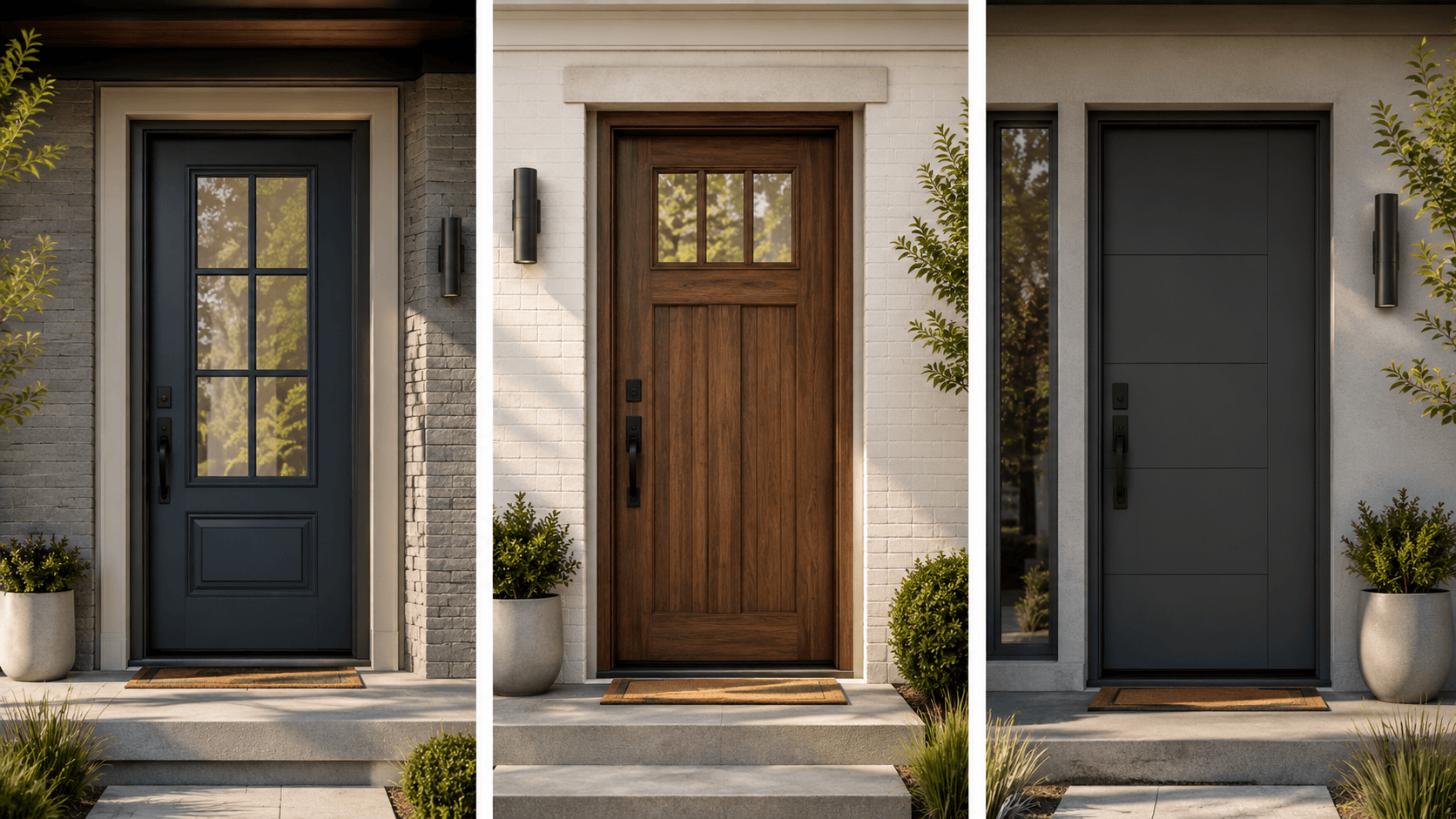
Fiberglass vs. Wood vs. Steel Entry Doors: Which Is Best?
Comparing fiberglass vs wood vs steel entry doors comes down to more than appearance or price. From a distance, they can even look surprisingly similar. Fiberglass can imitate wood grain, steel can be painted almost any color, and modern wood doors can be engineered and protected far better than older versions.
But underneath the finish, they behave very differently.
The best entry door is not simply the most expensive one or the material with the highest advertised performance. Climate, exposure to rain and sunlight, maintenance expectations, security, appearance and even the amount of glass in the door can matter just as much.
A protected front door under a deep porch has very different demands than a dark-colored door facing direct afternoon sun. A homeowner who wants a natural stained finish may make a different choice than someone who wants a durable painted door with very little maintenance.
Understanding those differences makes it much easier to narrow the options.
The Short Version
For many homes, fiberglass offers the best overall balance of durability, energy performance, appearance and maintenance.
Wood remains the premium choice when authentic material, custom design and architectural character matter most.
Steel can provide excellent strength and value, particularly when a painted finish and straightforward design are acceptable.
None of the three is automatically best for every opening.
The condition of the door frame, weather exposure, quality of construction and installation can have just as much impact on long-term performance as the material printed on the product label.
Fiberglass Entry Doors
Fiberglass doors have become popular because they can provide many of the qualities homeowners want from an exterior door without requiring the maintenance associated with natural wood.
Most fiberglass entry doors are not made from solid fiberglass. They typically use fiberglass exterior skins over an internal frame with an insulated core.
That construction allows manufacturers to create doors that are relatively stable, energy efficient and resistant to many of the moisture-related problems that can affect wood.
Fiberglass surfaces can be smooth and painted, or molded with wood-grain textures intended to resemble species such as oak, mahogany or fir.
Higher-quality products can look convincing from normal viewing distances, particularly when paired with detailed panels, quality hardware and a good stain or finish system.
Lower-cost fiberglass doors can look more synthetic, especially when the molded grain is repetitive or the finish does not closely resemble natural wood.
Where Fiberglass Performs Well
One of fiberglass’s biggest advantages is dimensional stability.
Exterior doors experience substantial temperature and humidity differences between the interior and exterior of a home. Materials expand, contract and react to moisture differently as those conditions change.
Fiberglass is generally less susceptible to swelling, shrinking and warping than natural wood.
That can make it particularly attractive in locations exposed to moisture or changing weather.
Maintenance is another advantage. A painted fiberglass door generally does not require the same level of ongoing refinishing as a stained wood door.
The insulated core commonly used inside fiberglass doors can also provide good thermal performance.
However, the actual energy performance of an entry system depends on more than the slab. Glass inserts, weatherstripping, the frame, threshold and installation all affect the complete assembly.
Where Fiberglass Has Limitations
Not every fiberglass door is built to the same standard.
The thickness and quality of the skins, internal reinforcement, core construction, edge materials and frame system can vary substantially between products.
Heavy hardware and large hinges need adequate reinforcement inside the door. This becomes particularly important with oversized doors, large glass inserts and multipoint locking systems.
Appearance can also be a deciding factor.
A premium fiberglass door can imitate wood extremely well, but homeowners who want the texture, variation and aging characteristics of actual timber may still prefer the real material.
Wood Entry Doors
There is a reason wood continues to be used on high-end homes even though newer materials require less maintenance.
It is difficult to fully reproduce the depth and natural variation of real wood.
Species, grain pattern, stain color and craftsmanship can make a wood entry door a major architectural feature rather than simply a functional opening.
Wood is also extremely flexible from a design standpoint. Custom sizes, oversized panels, carved details, unusual profiles and specialty configurations are all possible.
For traditional architecture, custom homes and entries where the door is intended to become a focal point, wood is often difficult to beat.
The Tradeoff Is Exposure and Maintenance
Wood reacts naturally to its environment.
Moisture can cause expansion and contraction. Strong sunlight can affect finishes and surface temperatures. Repeated wetting and drying can eventually damage an inadequately protected door.
That does not mean wood doors are poor exterior products.
A properly manufactured, finished and protected wood door can perform for decades.
But exposure matters.
A wood door installed beneath a substantial roof overhang may experience relatively mild conditions. The same door installed flush with an exterior wall and exposed to direct rain and intense afternoon sunlight faces a much harsher environment.
Finish maintenance becomes especially important with stained doors.
Clear finishes and stains generally need to be monitored and renewed as they weather. Ignoring deterioration can eventually expose the wood itself.
Painted wood provides more protection but also covers much of the natural appearance that causes many homeowners to choose wood in the first place.
Engineered and Clad Wood Options
Not every modern wood door is constructed from one solid piece of lumber.
Manufacturers may use engineered components, laminated construction, veneers and other methods to improve stability.
Some premium systems also combine wood on the interior with more weather-resistant materials on exterior surfaces.
These products can preserve much of the warmth of wood while reducing direct weather exposure.
That is why simply seeing the word “wood” in a brochure does not tell you everything about how the door is built.
Steel Entry Doors
Steel doors are sometimes thought of as basic or utilitarian, but good residential steel entry doors can offer an attractive combination of strength, security and cost.
Like fiberglass doors, most residential steel doors are not solid metal slabs.
They typically use relatively thin steel skins over an internal structure and insulated core.
The steel surface provides a strong exterior skin while the core helps improve thermal performance.
Most residential steel doors are painted rather than stained, although embossed patterns can imitate traditional panel designs.
Strength and Security
Steel has an obvious appeal where security is a priority.
But the security of an entry door should never be judged by the door skin alone.
A strong slab installed in a weak frame with short screws and a poorly supported strike plate can still be vulnerable.
The frame, hinges, lockset, strike reinforcement and anchors into the surrounding construction all contribute to the strength of the opening.
Multipoint locks can further distribute locking forces at several locations along the door edge rather than relying on one latch and deadbolt.
In other words, buying a steel door does not automatically create a secure entry system. The surrounding components still matter.
Dents and Corrosion
Steel has its own disadvantages.
Unlike fiberglass, a steel surface can dent when struck. Depending on the damage, repairing the surface without leaving a visible imperfection can be difficult.
The protective finish also matters.
If coating damage exposes bare steel and moisture remains present, corrosion can develop. This is particularly important around damaged edges, scratches and areas exposed to persistent moisture.
A properly finished steel door is not expected to simply rust under normal conditions, but damaged coatings should not be ignored.
Which Material Handles Weather Best?
For many homeowners, weather exposure should be one of the first considerations.
Fiberglass generally performs very well where moisture is a concern because the exterior skin does not behave like natural wood when it gets wet.
Steel also resists many forms of weathering when its protective finish remains intact, although scratches and coating damage need attention.
Wood can perform extremely well but benefits the most from architectural protection and regular maintenance.
Sun exposure is important too.
Dark-colored exterior doors can become extremely warm in direct sunlight regardless of the underlying material. High surface temperatures can affect finishes, seals, glazing and the door assembly itself.
Some manufacturers place restrictions on very dark finishes depending on the product, location or exposure, so warranty and finishing requirements are worth checking before choosing a color.
Energy Efficiency Depends on More Than Material
It is tempting to compare fiberglass, wood and steel entirely by insulation value, but the door material is only one part of the opening.
Many fiberglass and steel doors contain insulated foam cores that can provide strong thermal performance.
Solid wood can also provide useful insulating value, although its construction differs significantly.
Once decorative glass is introduced, however, the comparison changes.
A large glass insert may have a greater effect on overall thermal performance than the difference between two door materials.
The same is true of air leakage.
A well-insulated door with poorly adjusted weather stripping or a threshold that does not seal properly may perform worse in everyday use than a theoretically less efficient door that closes tightly.
When comparing products, look at the performance of the complete door assembly, not simply the insulation value of the slab.
Maintenance Can Be the Deciding Factor
Homeowners sometimes underestimate how much their willingness to maintain the door should influence the material choice.
If you want to install the door and largely forget about it, fiberglass deserves serious consideration.
Painted fiberglass surfaces still need normal cleaning and occasional finish maintenance, but the underlying material is generally forgiving.
Painted steel can also be relatively easy to maintain as long as scratches and coating damage are repaired before corrosion develops.
Wood requires more attention, particularly when maintaining a stained appearance.
That extra maintenance is not necessarily a negative. Many homeowners who choose premium wood doors consider refinishing part of owning a natural material.
The mistake is choosing wood for its appearance and then expecting it to behave like a low-maintenance synthetic product.
Appearance Is More Than the Door Slab
When shopping from catalogs or websites, it is easy to focus entirely on the door itself.
In a finished home, the entire entry composition matters.
Sidelights, transoms, trim, hardware, exterior cladding, threshold design and surrounding architecture can have as much visual impact as the slab material.
A relatively simple fiberglass door with well-proportioned sidelights and high-quality hardware can look more upscale than an expensive wood door placed in an awkward opening.
Conversely, a custom wood door may be exactly what a traditional or highly detailed facade needs.
The best material should support the architecture rather than fight it.
Fiberglass vs. Wood vs. Steel at a Glance
| Feature | Fiberglass | Wood | Steel |
|---|---|---|---|
| Maintenance | Low | Highest | Low to moderate |
| Moisture resistance | Very good | Depends on protection and finish | Good with intact coating |
| Wood-like appearance | Good to excellent | Authentic | Limited |
| Custom design options | Good | Excellent | Moderate |
| Dent resistance | Good | Good | Can dent |
| Thermal performance | Often very good | Varies by construction | Often very good |
| Painted finish | Excellent option | Available | Common |
| Stained appearance | Simulated | Excellent | Generally not used |
| Typical positioning | Broad range | Premium/custom | Value to midrange |
| Best fit | Low-maintenance residential entry | Architectural/custom entry | Durable painted entry |
These are general characteristics rather than guarantees.
A premium product in one material may outperform a poorly constructed product made from another.
What About Doors With Large Glass Inserts?
Glass can change the decision considerably.
Many entry doors now incorporate large decorative or full-height glass panels.
Once glazing becomes a major part of the door, its construction deserves the same attention as the frame material.
Look at whether the glass is insulated, whether Low-E coatings are available, what safety glazing is used and how the glass is retained within the door.
Privacy is another consideration.
A beautiful clear-glass entry door may bring daylight into the home but also expose the interior. Frosted, patterned, tinted and other privacy glazing options can change that relationship.
Large glass areas also add weight.
The hinges, internal door reinforcement and frame need to support that weight over years of operation.
This is particularly important for oversized entry doors.
Don’t Forget the Frame
Homeowners often spend most of their time comparing door slabs while paying relatively little attention to the frame.
That can be a mistake.
The jambs, threshold, weatherstripping, hinges and anchoring are all part of the installed opening.
Replacement projects may use a complete prehung door and frame assembly, or in some situations a new door may be fitted into an existing frame.
If the existing frame is damaged, out of square, deteriorated or poorly flashed, installing an expensive new slab will not correct those problems.
Water management around the opening matters as well.
Exterior doors are interruptions in the building envelope. The head, jambs and sill need to work with the surrounding wall system so rainwater is directed away from the interior.
This becomes even more important for doors exposed directly to weather.
Which Entry Door Material Is Best?
For the average homeowner looking for durability, good energy performance and relatively low maintenance, fiberglass is often the easiest material to recommend.
It works across a wide range of architectural styles, can imitate wood when desired and generally handles exterior exposure well.
But that does not make fiberglass the automatic winner.
Choose wood when authentic appearance, architectural character and customization are worth the additional maintenance and cost.
Choose steel when strength, a painted finish and value are high priorities.
And choose fiberglass when you want a strong balance between appearance, durability, efficiency and maintenance.
The final decision should also consider the specific manufacturer, product construction, warranty and installation conditions.
A Few Things to Check Before Ordering
Before placing an entry door order, make sure the decision goes beyond simply selecting a material and color.
Confirm the exact opening size and whether the project requires a complete frame replacement. Review the swing direction, threshold height, glass configuration, hardware preparation and exterior exposure.
If the door receives strong direct sunlight or rain, check whether the manufacturer has specific finish or overhang requirements.
For large or heavy doors, ask about hinge type and internal reinforcement.
If security is important, evaluate the lock, strike, jamb reinforcement and frame attachment as one system.
And if energy performance is a priority, compare the complete door rating rather than assuming one material is always superior.
Bottom Line
Fiberglass, wood and steel can all make excellent residential entry doors when the product is appropriate for the opening and installed correctly.
Fiberglass offers a particularly strong combination of durability, low maintenance and design flexibility, which is why it works well for many homes.
Wood remains difficult to match when natural beauty and custom architecture are the priority, but it asks more from the homeowner in return.
Steel provides strength and good value, especially for painted entry doors, although dents and damaged finishes require attention.
Rather than choosing based on material alone, consider how the door will actually live in your home: how much weather it receives, how often it will be used, how much maintenance you are willing to perform and how important the entry is to the overall architecture.
A well-chosen, properly installed door should still look good, operate smoothly and protect the opening years after the initial curb appeal has worn off.
Planning a Door Project?
Explore Builzee’s complete Doors guide for door types, materials, glass, security, large-opening systems, installation and buying guidance.