
How to Find a Roof Leak: Common Causes and Warning Signs
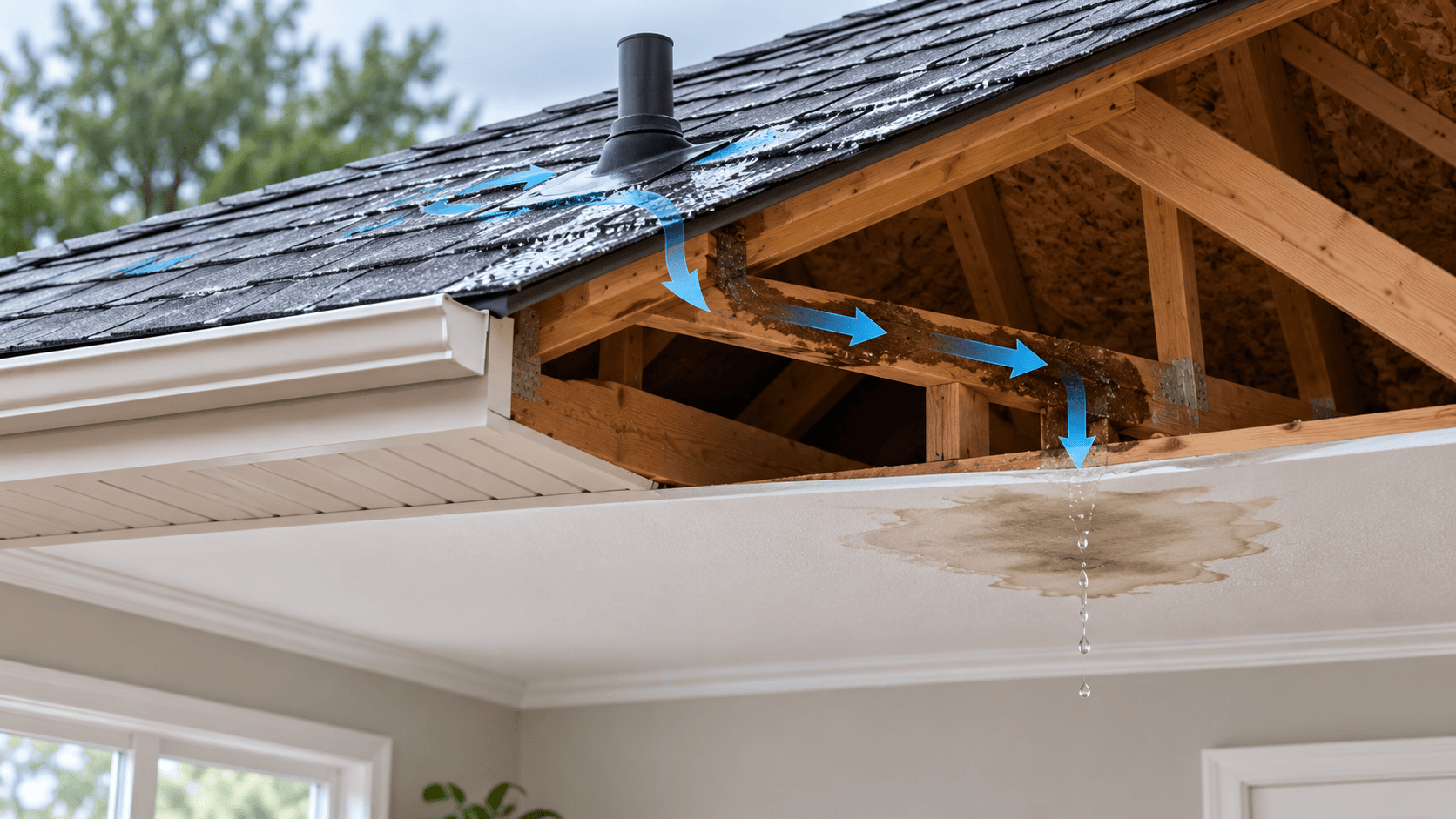
A water stain on the ceiling tells you there is a moisture problem. It does not necessarily tell you where the water entered the roof. Learning how to find a roof leak starts with tracing the path of the water rather than assuming the source is directly above the stain.
Roof leaks can be frustrating because water rarely follows a perfectly straight path. It can get beneath the roofing at a vent, chimney, valley or damaged shingle, travel along the roof deck or framing, and finally drip into the room several feet away.
That is why finding a roof leak is usually more about tracing the path of the water than looking directly above the stain.
Before assuming the entire roof needs work, start by figuring out where the moisture is coming from and whether the problem is actually related to the roof.
How to Find a Roof Leak From Inside the House
If water is already showing up inside, the attic is often the best place to begin.
When you can safely access the attic, look above and uphill from the interior stain. Bring a flashlight and inspect the underside of the roof decking, rafters and insulation.
You are looking for more than an obvious drip.
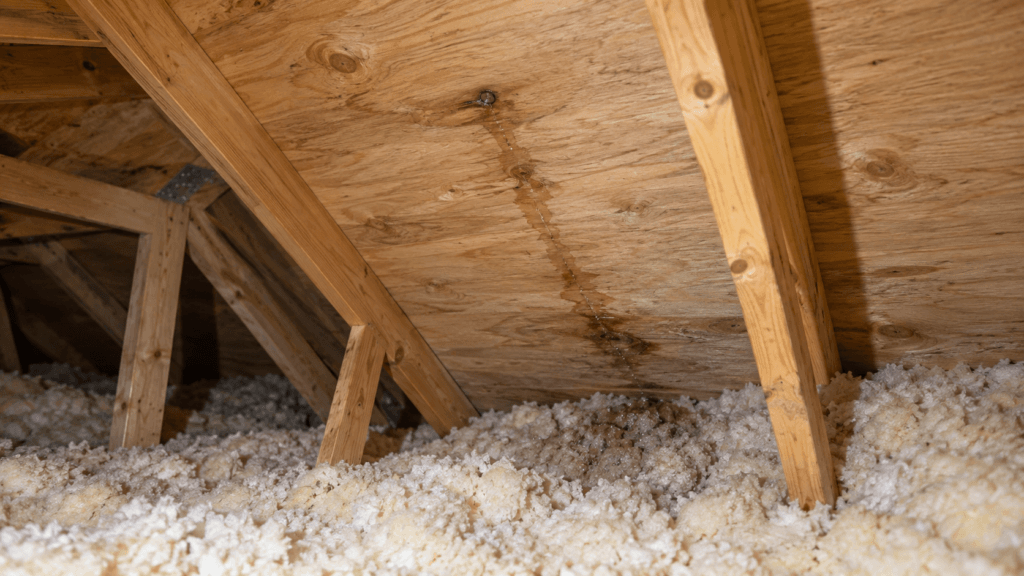
Darkened wood, rusty nail tips, damp insulation and water streaks along framing can all help trace moisture back toward the entry point.
If possible, inspect the attic while it is raining or shortly afterward. Active water is much easier to follow than a stain that has already dried.
Do not touch wet wiring, electrical boxes or fixtures. If water is near electrical equipment, deal with that hazard before continuing the inspection.
Why the Ceiling Stain May Be Misleading
Suppose water enters around a plumbing vent high on the roof.
Instead of dripping straight down, it may run along the underside of the sheathing until it reaches a rafter. From there, it can travel down the framing before finally dropping onto the insulation or ceiling drywall.
By the time you see the stain downstairs, the actual roof opening may be several feet away.
That is one reason replacing a shingle directly above a ceiling stain often does not solve the problem.
If you want a better understanding of the components you are looking at while tracing a leak, Builzee’s Roof Anatomy & Components guide explains the roof deck, valleys, flashing, penetrations, eaves and other common roof parts.
Make Sure It Is Actually a Roof Leak
Not every ceiling stain comes from rainwater entering through the roofing.
Before chasing shingles and flashing, consider when the moisture appears.
A stain that becomes wet only during or immediately after rain points strongly toward the roof or an exterior wall transition.
Moisture that appears regardless of the weather could be related to plumbing, HVAC equipment or condensation.
Bathrooms and kitchens can also create moisture problems when exhaust fans discharge into the attic instead of outdoors. Warm indoor air leaking through ceiling penetrations can condense against cold roof sheathing and produce stains that look surprisingly similar to a roof leak.
If the moisture appears mainly during cold weather or you are seeing widespread condensation rather than one concentrated water trail, take a look at our Roof Ventilation & Moisture guide before assuming the roofing itself has failed.
How to Trace a Roof Leak Through the Attic
Once you have found moisture inside the attic, work backward toward the roof.
- Find the highest visible evidence of water. Start at the ceiling stain and follow wet insulation, stained wood or water tracks uphill.
- Look at what is directly above that area. Plumbing vents, chimneys, skylights, valleys and roof-to-wall intersections deserve special attention.
- Check nearby fasteners and framing. Rusted nail tips and darkened rafters can reveal where water has been traveling.
- Compare the attic location with the exterior roof. Measure from a known feature such as a chimney, vent pipe or exterior wall if necessary.
- Document what you find. Photos taken from inside the attic can make it much easier to explain the problem to a roofer later.
You do not need to climb onto the roof to make this process useful.
In fact, for steep roofs, wet surfaces, tile roofs and other difficult conditions, staying off the roof is the safer approach. NRCA also advises homeowners without appropriate experience and safety equipment against walking on roofs during routine inspection and maintenance.
NRCA homeowner roofing resources
Common Places Roof Leaks Start
A roof can leak almost anywhere, but some areas deserve more attention than others.
Plumbing Vent Boots
Plumbing pipes pass through openings cut into the roof deck. A flashing assembly, often called a pipe boot, seals the roofing around the pipe.
On some boots, the rubber portion surrounding the pipe can crack or split long before the surrounding shingles wear out.
That creates a small opening that may only leak during certain rain conditions.
Look for cracked rubber, loose flashing, exposed fasteners or staining directly below the penetration in the attic.
A deteriorated pipe boot can often be repaired without replacing the entire roof if the surrounding roofing is still in good condition.
Chimney Flashing
A chimney creates several transitions where the roofing meets a vertical surface.
Properly detailed chimney flashing generally uses different pieces of metal to move water around the chimney and back onto the roof below.
Problems can develop when flashing becomes loose, corrodes, separates from masonry or has been repeatedly patched with roofing cement.
Large amounts of exposed sealant around a chimney can be a clue that previous repairs were treating the symptom rather than rebuilding the flashing detail correctly.
Roof-to-Wall Flashing
Whenever a sloped roof meets an exterior wall, water has to be redirected away from that intersection.
Step flashing is commonly woven into shingle courses along these areas. Depending on the wall construction, another layer may protect the flashing above.
If flashing is missing, improperly layered or damaged during siding work, water can enter behind the roofing and wall materials.
These leaks can be particularly confusing because moisture may show up inside a wall rather than directly on a ceiling.
Valleys
Roof valleys collect runoff from two roof planes and concentrate that water into a relatively narrow path.
That makes them one of the harder-working areas of a pitched roof.
Debris, damaged shingles, improper fastener placement or problems with the valley flashing or membrane underneath can allow water to move beneath the roofing.
When inspecting a valley from the ground, look for debris buildup, irregular shingle cuts, obvious damage or areas that appear different from the surrounding roof.
Missing, Lifted or Damaged Shingles
Individual shingles can be damaged by wind, impact, age or previous foot traffic.
One missing shingle does not automatically mean water is reaching the roof deck because asphalt roofs are built with overlapping courses and underlayment beneath the finished surface.
But damaged shingles expose the layers below to conditions they were not intended to handle indefinitely.
A localized damaged area on an otherwise healthy roof may be relatively straightforward to repair.
Widespread cracking, curling or brittle shingles point to a larger aging problem.
Skylights
A skylight creates a large opening in the roofing system and requires flashing on several sides.
Water entering around a skylight is not always caused by the skylight unit itself.
The problem could be flashing, roofing above the opening, debris that redirects water, condensation or deterioration of seals in the skylight assembly.
Before replacing the entire skylight, determine whether the water is actually entering through the glazing or through the surrounding roof detail.
Ridge, Hip and Roof Vents
Roof vents penetrate the roofing or sit along openings cut near the upper roof area.
Leaks can develop because of damaged flashing, loose fasteners, deteriorated seals or incorrect installation.
Ridge vents can also have problems if caps become loose or the system is exposed to unusual wind-driven rain.
The presence of a vent near an interior stain makes it worth checking, but proximity alone does not prove it is the source.
Rain Direction Can Give You a Clue
Pay attention to when the leak happens.
A leak that appears during every light rain may behave differently from one that only occurs during wind-driven storms.
If the roof stays dry during normal rain but leaks when wind pushes water from a particular direction, wall flashing, chimney details, vents or other vertical transitions become more suspicious.
A leak that continues dripping long after the rain stops may indicate water is collecting somewhere in the assembly before slowly making its way inside.
Keep a simple record of the weather when the leak occurs. Rain intensity, wind direction and how quickly the stain appears can give a roofing contractor useful information when diagnosing the problem.
Look for the Source, Not Just the Hole
It is tempting to find something that looks suspicious and cover it with sealant.
Sometimes that stops water temporarily.
The problem is that a good roofing detail usually does not rely on exposed caulk as its primary defense against water.
Shingles, underlayment and flashing are installed in layers so water continually moves downhill and back toward the exterior.
If water is getting behind those layers, spreading sealant across the surface may hide the opening without correcting the reason water reached it.
A lasting repair should restore that water-shedding sequence.
Builzee’s Roof Repair & Maintenance guide goes deeper into common flashing, shingle, decking and penetration repairs.
What Roof Leak Damage Looks Like Inside the Attic
Water does not always produce dramatic damage right away.
Early signs can be surprisingly subtle.
You may notice dark streaks on plywood, slightly darker framing, rust forming around nail tips or insulation that looks compressed in one area.
Continued moisture can eventually cause plywood or OSB to swell, delaminate or soften. Insulation can lose performance when repeatedly wet, and framing can develop more serious deterioration if the leak continues long enough.
That is why even a small ceiling stain is worth investigating.
The stain may be small because very little water has reached the drywall, not because the problem above it is necessarily small.
Do Not Forget Gutters and Drainage
Some leaks that seem like roofing failures begin with poor drainage.
Clogged gutters can overflow and keep water against fascia, roof edges or wall transitions. Debris collected in valleys can redirect runoff sideways beneath roofing materials.
Low-slope roof areas deserve even more attention because they rely heavily on clear drainage paths.
Check gutters, valleys, roof drains and downspouts when diagnosing a moisture problem, especially if the leak occurs near an exterior wall or roof edge.
Cleaning debris will not repair damaged flashing or deteriorated roofing, but it can eliminate one of the conditions contributing to the problem.
When a Roof Leak Can Usually Be Repaired
A roof leak does not automatically mean you need a new roof.
Localized problems are often repairable when the rest of the roof is still in good condition.
Examples include a failed pipe boot, a small section of damaged flashing, a few missing shingles, isolated storm damage or a limited area of deteriorated decking.
What matters is whether the materials surrounding the repair are still sound enough to work with.
That becomes more difficult as roofing ages.
Old asphalt shingles can become brittle enough that attempting to lift one shingle for a repair damages the shingles around it. Tile can become difficult to match. Older products may no longer be manufactured.
At that point, a seemingly small repair can become less practical.
When Repeated Leaks Point to a Bigger Problem
One repair is normal over the life of a roof.
A different leak every few months is not.
Multiple unrelated leak locations, widespread material deterioration, recurring flashing failures and substantial roof-deck damage can indicate that the problem is no longer localized.
Age also becomes relevant here.
A 7-year-old roof with a leaking vent boot should be approached very differently from a 25-year-old asphalt roof with brittle shingles, multiple previous patches and new leaks developing on different roof planes.
If repairs are becoming frequent, compare the remaining service life of the roof with the cost of continuing to patch it.
Our Roof Replacement & Cost guide explains the major factors that affect replacement scope and pricing.
What to Document Before the Repair
Take pictures before anything is covered up.
Photograph the ceiling stain, attic water path, damaged roofing and any deteriorated deck or flashing uncovered during the repair.
If a contractor discovers concealed damage after removing roofing materials, ask to see it before the area is rebuilt whenever practical.
This is especially useful when additional decking or framing repairs affect the original price.
Keep the final repair invoice with those photos and note what part of the roof was repaired.
Years later, that record can save a lot of guesswork if another problem develops nearby.
When to Call a Roofer
There is plenty a homeowner can observe safely from the ground or attic. That does not mean every leak should become a DIY roofing project.
Call a qualified roofer when the roof is steep, wet, high, fragile or difficult to access, or when tracing the leak requires removing roofing materials.
You should also get professional help when the source remains unclear, water is entering around a chimney or complex flashing condition, significant decking damage is visible, or a leak keeps returning after previous repairs.
The goal is not simply to make the dripping stop today.
The goal is to determine how the water got into the roofing system and rebuild that area so it sheds water correctly again.
Bottom Line
Finding a roof leak usually starts inside, not on top of the roof.
Follow water staining and damp materials uphill through the attic, then compare that location with vents, flashing, valleys, chimneys, skylights and damaged roofing on the exterior.
Do not assume the ceiling stain sits directly below the entry point, and do not assume every water stain is caused by the roofing.
Once you identify the likely source, the next question is whether the problem is localized or part of broader deterioration.
A failed vent boot or a few damaged shingles can often be repaired. Repeated leaks across an aging roof deserve a much wider look.
Most importantly, treat the leak itself as a clue. Fixing the path that allowed water inside is what turns a patch into an actual roof repair.
Planning a Roofing Project?
Explore Builzee’s Roofing Guides for practical help with roof types, ventilation, installation, repairs, maintenance, replacement and cost planning.