
ROOF REPLACEMENT & COST
Understand What Goes Into the Cost of a New Roof
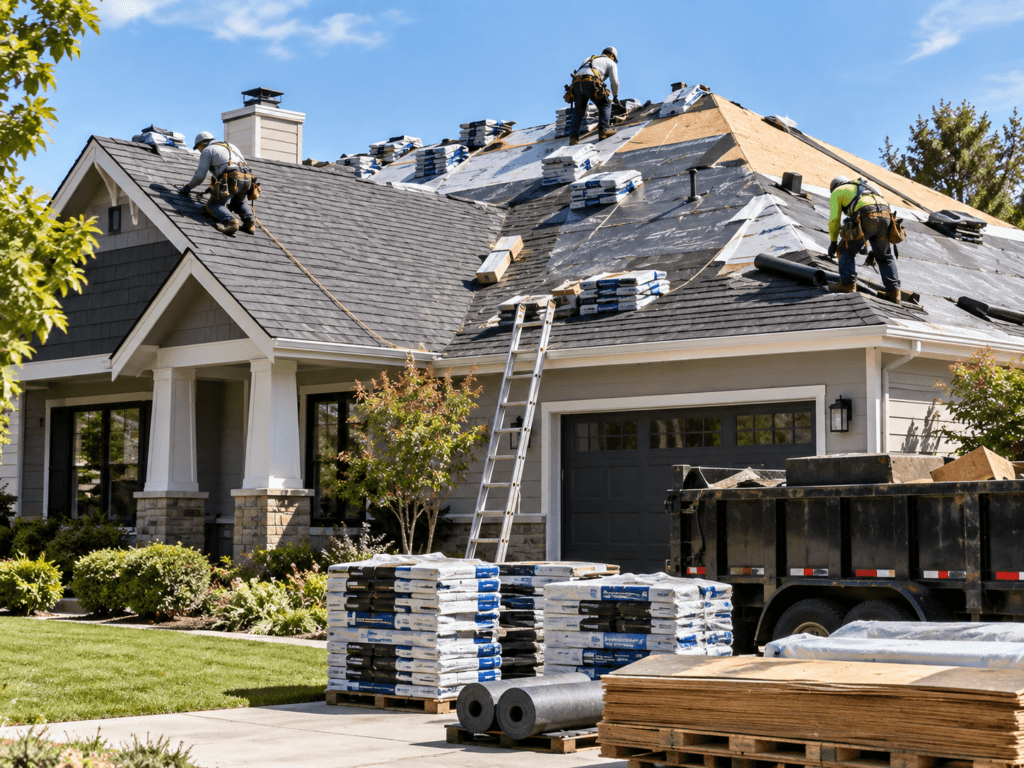
Roof replacement cost depends on much more than the roofing material itself. Roof size, pitch, complexity, tear-off, decking repairs, flashing, ventilation, labor and warranty requirements can all affect the final cost. This guide explains what drives the price and what to compare when reviewing roofing estimates.
WHEN REPLACEMENT MAKES SENSE
Know When a Full Roof Replacement Is Worth Considering
Roof replacement is usually driven by overall condition, recurring problems and the remaining service life of the existing system. A single leak does not automatically mean the entire roof needs to be replaced.
01 — WIDESPREAD MATERIAL WEAR
Replacement may make sense when deterioration is no longer limited to one repairable area.
WATCH FOR
- Widespread curling or cracking
- Heavy granule loss
- Numerous broken tiles
- Corrosion across large metal roof areas
- Multiple failing roof planes
- Materials that are brittle or difficult to repair
02 — REPEATED LEAKS & REPAIRS
A roof that needs frequent repairs in different locations may be reaching the point where replacement is more practical than continued patching.
WATCH FOR
- Leaks appearing in new areas
- Repeated flashing repairs
- Multiple failed pipe boots or penetrations
- Interior staining after previous repairs
- Repair costs accumulating over time
03 — AGE & SYSTEM CONDITION
Roof age matters, but it should be considered together with installation quality, climate, ventilation and maintenance history.
WATCH FOR
- Roof near the expected end of its service life
- Deteriorated underlayment
- Widespread deck damage
- Obsolete or unavailable roofing products
- Older installations with recurring performance issues
GOOD TO KNOW
The decision should be based on the condition of the whole roofing system, not age alone. A relatively young roof with poor installation may need major work early, while an older roof that remains dry and structurally sound may still have useful service life.
ROOF SIZE & QUANTITIES
Understand How Roof Size Affects Replacement Cost
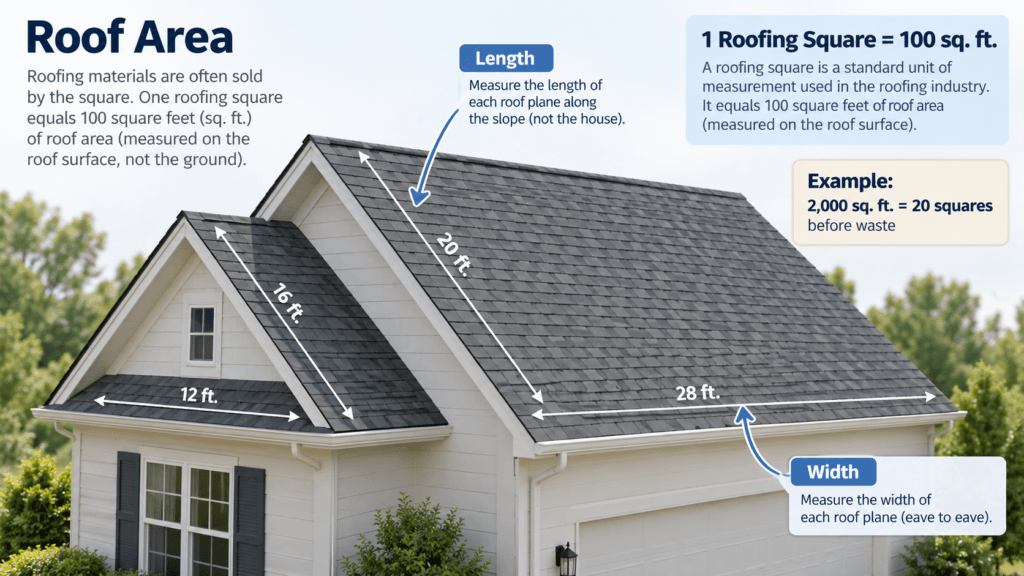
The larger the roof, the more roofing material, underlayment, flashing, labor and disposal the project requires. Contractors commonly measure roofing in squares, where one roofing square equals 100 square feet of roof area.
ROOF AREA
Roof area is not always the same as the home’s floor area. Roof pitch, overhangs, attached garages, porches, dormers and multiple roof sections can increase the total surface area.
CHECK FOR
- Main roof dimensions
- Garages and attached additions
- Porches and secondary roof areas
- Overhangs
- Roof pitch
- Dormers and complex intersections
ROOFING SQUARES & WASTE
Once the roof area is calculated, contractors convert that area into roofing squares and add material for cuts, valleys, hips, ridges and installation waste.
For example:
2,000 sq. ft. of roof area = 20 roofing squares
The actual amount ordered will usually be higher after waste is added.
CHECK FOR
- Total measured roof area
- Number of roofing squares
- Waste percentage
- Ridge and hip quantities
- Starter materials
- Underlayment and flashing quantities
GOOD TO KNOW
A simple gable roof may require less waste than a roof with many hips, valleys, dormers and small sections. Two homes with the same total roof area can therefore require different amounts of material and labor.
TRY THE CALCULATOR
Need to estimate your own roof? Use the Roofing Material Calculator to calculate roof surface area, roofing squares, waste and approximate material quantities from your roof dimensions and pitch.
ROOF PITCH & COMPLEXITY
Understand Why Roof Shape Affects Labor and Cost
Roof size is only part of the pricing equation. Steeper slopes, multiple roof planes and difficult transitions usually require more labor, more material cuts and additional safety measures.
01 — ROOF PITCH
Roof pitch describes how steep the roof is. Steeper roofs are generally slower and more difficult to work on than low- or moderate-slope roofs.
COST IMPACT
- More fall-protection setup
- Slower material handling
- More difficult access
- Increased labor time
- Specialized equipment on very steep roofs
02 — HIPS, VALLEYS & DORMERS
Each change in roof direction creates additional cutting, flashing and detailing. A simple gable roof can often be installed more efficiently than a similarly sized roof with multiple hips, valleys, dormers and intersecting sections.
COST IMPACT
- More material waste
- Additional ridge and hip caps
- More valley detailing
- Additional flashing
- Increased layout and installation time
03 — ACCESS & HEIGHT
The location and height of the roof also affect how easily crews can move materials, remove debris and work safely.
COST IMPACT
- Multi-story construction
- Limited driveway or yard access
- Tight neighboring properties
- Difficult material staging
- Landscaping or structures that require additional protection
- Longer carrying distances from delivery areas
GOOD TO KNOW
A complex roof can cost more to replace even when its measured area is smaller than a simple roof. Labor, safety requirements, flashing details and material waste can all increase as the roof geometry becomes more complicated.
ROOFING MATERIAL CHOICE
Material Selection Can Change the Entire Project Budget
Different roofing materials vary not only in purchase price, but also in labor, structural requirements, accessories, waste, and installation time. The least expensive material per square does not always produce the lowest total project cost.
01 — ASPHALT SHINGLES
Asphalt shingles are generally one of the more affordable and straightforward residential roofing options.
COST FACTORS
- Shingle grade and warranty
- Architectural vs. basic profiles
- Starter and ridge-cap materials
- Waste percentage
- Tear-off and disposal
- Local labor rates
02 — METAL ROOFING
Metal roofing usually carries a higher upfront cost because of the panel system, trim, flashing, and more specialized installation.
COST FACTORS
- Standing seam vs. exposed fastener
- Metal type and coating
- Custom panel lengths
- Clips, trim and flashing
- Roof complexity
- Installer experience
03 — TILE & SLATE
Tile and slate can significantly increase both material and labor cost. These systems may also require additional structural evaluation because of their weight.
COST FACTORS
- Material type and profile
- Structural support
- Specialized labor
- Breakage and waste
- Underlayment system
- Hip, ridge and flashing details
04 — LOW-SLOPE SYSTEMS
Flat and low-slope roofs typically use membrane systems with different labor and detailing requirements than steep-slope roofing.
COST FACTORS
- Membrane type
- Insulation or cover board
- Drainage details
- Parapets and perimeter flashing
- Roof penetrations
- Seam and attachment method
GOOD TO KNOW
Material cost should be compared as part of the complete installed system. Underlayment, flashing, trim, ventilation, structural work, accessories and labor can make two roofs with similar material prices end up with very different final costs.
TEAR-OFF & HIDDEN CONDITIONS
Existing Conditions Can Change the Final Cost
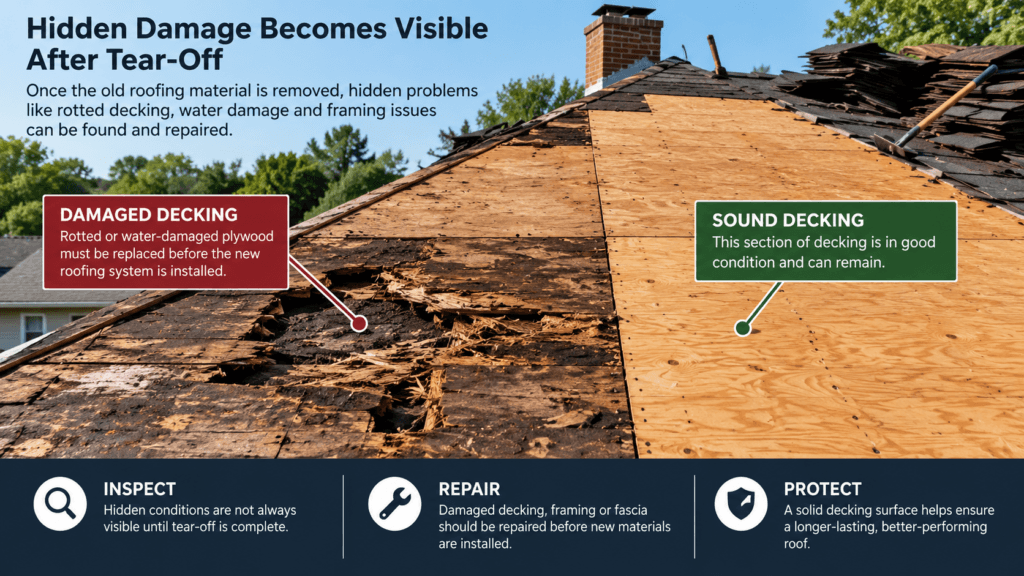
The existing roof has to come off before many hidden conditions can be fully evaluated. Tear-off, disposal and concealed damage can all add cost beyond the visible roofing material itself.
01 — TEAR-OFF
Removing the existing roof takes labor and creates debris that must be handled safely and efficiently.
COST FACTORS
- Number of existing roof layers
- Roofing material type
- Roof pitch and access
- Labor required for removal
- Protection of landscaping and exterior finishes
- Time needed to expose and clean the deck
02 — DISPOSAL
Old shingles, underlayment, flashing and damaged materials have to be hauled away and disposed of properly.
COST FACTORS
- Dumpster or trailer requirements
- Debris weight and volume
- Local disposal fees
- Difficult site access
- Additional cleanup or hauling
- Heavy materials such as tile or slate
03 — HIDDEN REPAIRS
Decking, framing, fascia and other concealed components may not be fully visible until the existing roof is removed.
COST FACTORS
- Rotted plywood or OSB
- Damaged plank decking
- Framing repairs
- Water-damaged fascia
- Failed flashing
- Wet insulation or other concealed moisture damage
GOOD TO KNOW
Ask how hidden repairs are priced before work begins. A good estimate should explain whether decking replacement is included, allowed for by quantity, or billed separately once damaged areas are exposed. I’d also recommend asking the contractor to document concealed damage with photos before covering it back up. That gives you a clear record of why the extra work was needed.
LABOR, ACCESS & LOCATION
Labor and Site Conditions Can Shift the Price Significantly
Even with the same roof size and material, installation cost can vary based on crew requirements, access, safety conditions and local labor rates.
01 — LABOR REQUIREMENTS
More complex roofing systems and difficult roof geometry usually require more time and more experienced installers.
COST FACTORS
- Crew size
- Installation difficulty
- Specialized roofing systems
- Steep or high roof areas
- Detailed flashing work
- Project duration
02 — SITE ACCESS
Material delivery, debris removal and safe crew access all affect how efficiently the job can be completed.
COST FACTORS
- Limited driveway access
- Tight side yards
- Multi-story homes
- Difficult ladder or lift access
- Long material-carry distances
- Protection needed for landscaping or adjacent structures
03 — REGIONAL PRICING
Roof replacement costs also vary by location because labor rates, permit fees, disposal costs and material availability are different from one market to another.
COST FACTORS
- Local wage rates
- Permit requirements
- Disposal fees
- Material freight and availability
- Climate-specific roofing requirements
- Local contractor demand
GOOD TO KNOW
A lower material price does not always mean a lower project price. Labor, access and regional conditions can sometimes have just as much impact on the final number as the roofing product itself.
PERMITS, WARRANTIES & SCOPE
Understand What the Roofing Price Actually Includes
Two estimates can look similar at first but cover very different scopes of work. Permits, warranty requirements, flashing, ventilation, cleanup and hidden-condition allowances should all be clearly defined before comparing prices.
01 — PERMITS & INSPECTIONS
Some roof replacement projects require permits and inspections depending on the location and scope of work.
CHECK FOR
- Whether permit fees are included
- Who is responsible for pulling the permit
- Required inspections
- Additional code-related upgrades
- Documentation provided at project completion
02 — WARRANTIES
Roofing projects may include separate warranties for materials and workmanship.
CHECK FOR
- Manufacturer material warranty
- Contractor workmanship warranty
- Registration requirements
- Exclusions and limitations
- Transferability to a future owner
- Maintenance requirements that could affect coverage
03 — INCLUDED SCOPE
The estimate should spell out what is included rather than relying on broad language like “complete roof replacement.”
CHECK FOR
- Tear-off and disposal
- Underlayment
- Flashing
- Ventilation components
- Starter and ridge materials
- Decking repair allowances
- Cleanup
- Final inspection
- Any excluded work
GOOD TO KNOW
A lower bid is not necessarily less expensive if important items are excluded and added later. The most useful comparison is between estimates with a similar scope, material system, warranty and allowance structure.
COMPARE ROOFING ESTIMATES
Compare the Scope, Not Just the Bottom-Line Price
Roofing bids can vary because contractors may be pricing different materials, allowances, flashing details, warranties or repair assumptions. Before choosing between proposals, make sure you are comparing similar work.
MATERIALS & SYSTEM
Confirm exactly what roofing system each contractor is proposing.
COMPARE
- Roofing manufacturer and product line
- Underlayment type
- Starter and ridge materials
- Flashing scope
- Ventilation components
- Manufacturer warranty level
- Any upgraded or optional materials
LABOR & PROJECT SCOPE
The installation scope can create just as much difference between bids as the roofing material itself.
COMPARE
- Tear-off and disposal
- Number of roof layers included
- Decking repair allowance
- Permit fees
- Property protection
- Cleanup and nail removal
- Workmanship warranty
- Exclusions and potential change-order items
GOOD TO KNOW
If one estimate is significantly lower than the others, look for differences in scope before assuming it is simply a better price. Missing flashing work, limited decking allowances, lower-grade materials or excluded permit and disposal costs can make a cheaper proposal more expensive later.
FINAL CHECK
Roof Replacement Cost Planning Checklist
Before approving a roof replacement, make sure the estimate clearly explains the scope, materials, allowances and potential extra costs.
□ Total roof area and roofing squares are identified
□ Waste factor is included
□ Roofing manufacturer and product line are listed
□ Underlayment type is specified
□ Flashing scope is clearly described
□ Tear-off and disposal are included
□ Permit responsibility and fees are identified
□ Decking repair pricing or allowances are explained
□ Ventilation work is included where required
□ Starter, ridge and accessory materials are included
□ Property protection and cleanup are part of the scope
□ Material and workmanship warranties are documented
□ Potential change-order items are identified in advance
□ Final payment requirements are clear
GOOD TO KNOW
A useful roofing estimate should make it easy to understand what could change the final price. Ask about unit prices or allowances for concealed work such as damaged decking so you know how additional costs will be handled before tear-off begins.
Bottom Line
Roof replacement cost is driven by more than the price of shingles, metal or tile. Roof size, pitch, complexity, tear-off, hidden repairs, flashing, ventilation, access, labor and warranties all contribute to the total project price.
That is why cost-per-square-foot comparisons can be misleading when the scopes are different. The better comparison is between complete roofing systems with similar materials, installation requirements, allowances and warranties.
Understanding those cost drivers makes it easier to compare bids, plan for possible hidden repairs and recognize when a lower estimate is leaving important work out.