
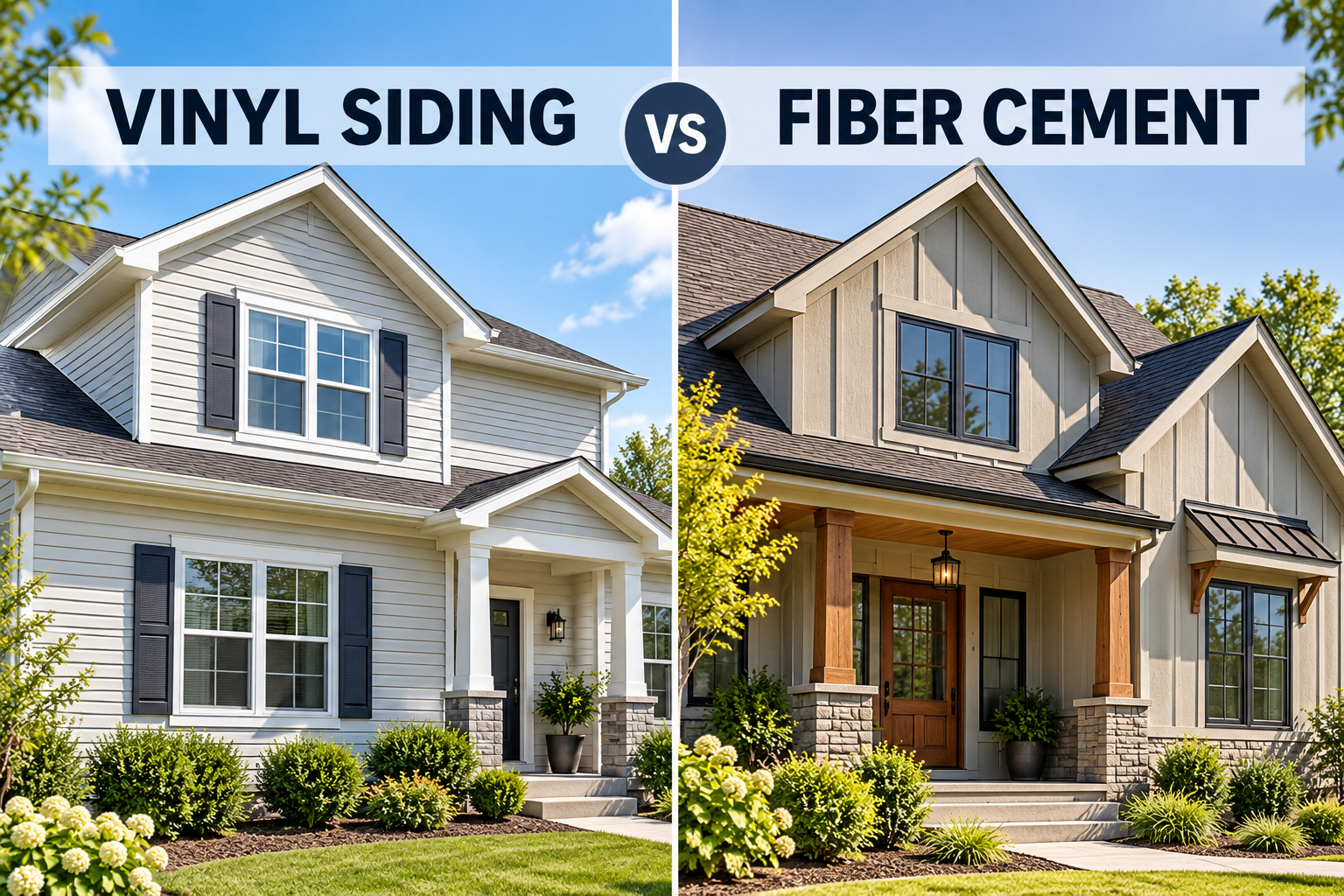
Vinyl Siding vs. Fiber Cement: Which Is Better for Your Home?
Vinyl siding vs. fiber cement is not simply a choice between cheap and premium cladding. They use different materials, fasteners and installation methods, and each has distinct tradeoffs in cost, maintenance, fire performance, appearance and repair.
The right comparison is the complete exterior wall: product, weather-resistive barrier, flashing, labor, trim and how the cladding will perform in your climate over time.
Lighter materials and simpler handling often result in lower installed cost.
Rigid, substantial profiles with deeper shadow lines and repainting flexibility.
Verify the specific product’s noncombustible classification and the whole wall assembly.
Vinyl Siding vs. Fiber Cement at a Glance
Vinyl siding is primarily PVC, normally formed into flexible interlocking panels with fastening slots that permit movement. Fiber cement is a heavier, rigid composite of cementitious ingredients, sand and cellulose fiber, sold in lap planks, panels, shingles and trim formats.
| Factor | Vinyl siding | Fiber cement |
|---|---|---|
| Initial installed cost | Usually lower | Usually higher |
| Handling / installation | Lightweight, flexible panels | Heavy, rigid pieces; more labor-intensive |
| Painting | Normally not required | Factory-finished or field-painted; can be recoated |
| Moisture performance | Material does not rot; flashing still required | Durability depends on proper clearances and details |
| Fire behavior | Can soften or melt with sufficient heat | Specified products may be classified noncombustible |
| Impact | May crack or puncture | Rigid but may chip or crack |
| Maintenance | Gentle cleaning, panel repairs | Cleaning, joint/finish inspection, eventual recoating |
| Profiles | Lap, Dutch lap, shakes, vertical, insulated panels | Lap, shingle, vertical, board-and-batten, panels |
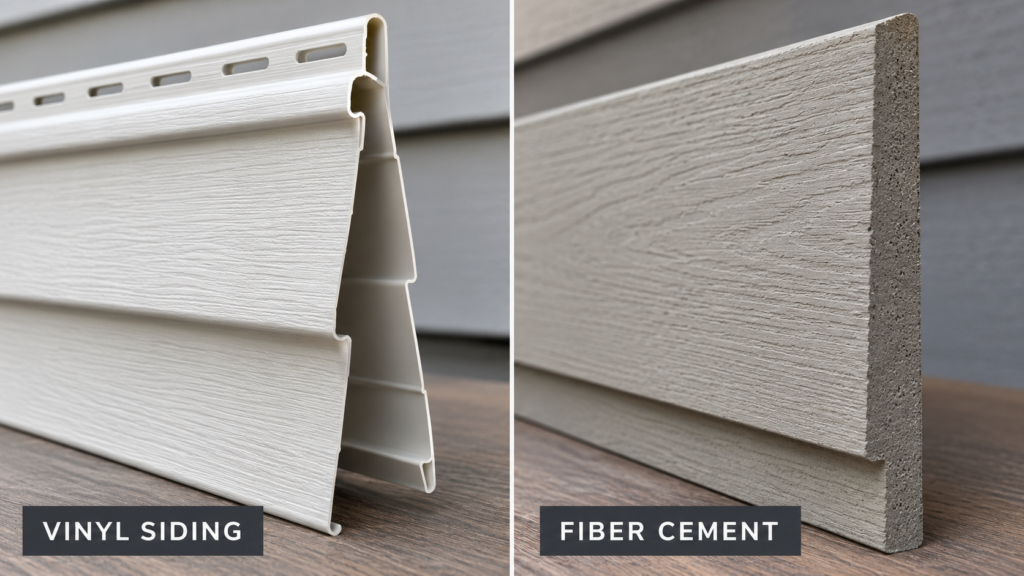
Do not select either product from a tiny swatch. Review finished buildings, trim transitions, colors and profiles, ideally in light conditions similar to your own home.
Vinyl Siding vs. Fiber Cement Cost
For broad 2026 national planning, Builzee’s existing article cites approximately $3–$12 per square foot installed for vinyl and $5–$15 per square foot installed for fiber cement. There is overlap: premium insulated vinyl can cost more than an entry-level fiber-cement product. Price also depends on demolition, trim and project complexity.
| Material | National installed range / siding sq ft | Example: 1,800 sq ft clad area |
|---|---|---|
| Vinyl | $3–$12 | $5,400–$21,600 |
| Fiber cement | $5–$15 | $9,000–$27,000 |
The cost example uses 1,800 square feet of actual exterior cladding, not a 1,800-square-foot house. Measure wall and gable elevations, subtract appropriate openings, add waste and price trims and wall-preparation scope separately.
Use the Builzee Siding Quantity Calculator to assemble wall and gable areas. It is a quantity tool, not a full installed-cost calculator; corner trim, WRB, flashing, removal and labor still require separate pricing. Angi’s material comparison offers another national benchmark.
Once cladding is removed, contractors may find sheathing decay, wet insulation, pest damage or flashing defects. Ask how concealed work will be documented and priced rather than accepting a number that assumes every wall is sound.
Moisture, Heat, Wind and Fire Performance
Neither vinyl nor fiber cement is the waterproof layer of an exterior wall. Rain can pass behind siding at laps, windows, doors, corners and other transitions. The assembly needs a compatible weather-resistive barrier, carefully integrated flashings, planned drainage and proper material clearances.
Primary weather-shedding surface
Handle water at openings and joints
Manage incidental water behind cladding
Keep the underlying assembly dry and sound
Vinyl in heat and wind
Vinyl expands and contracts, so fasteners must be positioned correctly without pinning panels tightly. Follow product-specific expansion gaps and wind-rated fastening schedules. Strong heat or reflected sunlight can deform vinyl.
Fiber cement in weather and fire
Fiber cement uses specific fastening, joint treatments and ground/roof clearances. Certain products, including designated James Hardie lines, meet ASTM E136 noncombustibility criteria. That does not make the whole house fireproof.
Fiber cement may provide a meaningful material advantage in fire-prone areas, but vents, eaves, roofs, windows, decks and surrounding vegetation remain part of the exposure. Compare actual manufacturer approvals and local building requirements, not a generic claim that either cladding is “fireproof.”
Cutting fiber cement can create respirable crystalline silica dust. Installers should follow manufacturer cutting and dust-control instructions and applicable worker-safety rules. Do not substitute generic wood-siding methods for fiber-cement installation.
Which Looks Better: Vinyl or Fiber Cement?
Appearance depends on panel geometry, depth of shadow lines, smooth versus textured finish, corners, window trim and installation quality. Fiber cement often delivers a substantial painted-wood appearance, while premium vinyl can be visually convincing from the street.
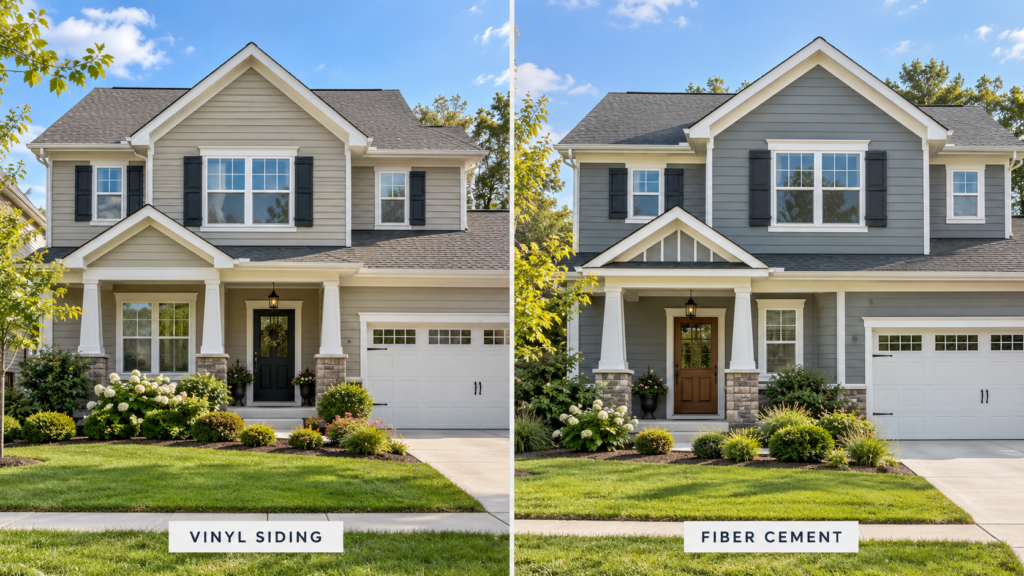
Both materials are offered in lap, vertical, shake and shingle-like profiles. Vinyl board-and-batten commonly uses manufactured vertical panels; fiber cement can use vertical panels with separate batten trim. See Builzee’s Board and Batten Siding guide for those design options.
When appearance favors fiber cement
If a traditional board profile, textured finish or future repainting is especially important, fiber cement may fit the design better. Its rigid shape can provide deeper consistent shadow lines.
When quality vinyl makes sense
If the budget is more limited and you prefer a low-maintenance finish, compare premium vinyl products, color retention, impact performance and matching trim accessories before dismissing the category.
Maintenance, Repairs and Long-Term Value
Vinyl rarely needs conventional repainting and generally requires gentle cleaning and occasional replacement of damaged or loose panels. It may fade or become brittle, and an exact match can be difficult when a color is discontinued.
Fiber cement is also relatively low maintenance, but paint, caulk, edge finish and exposed joints need periodic inspection. Factory finish can reduce initial maintenance, while primed products require a compatible field-painting system. Repainting is a benefit if you want new colors over time, but it is also a future expense.
| Condition | Vinyl approach | Fiber cement approach |
|---|---|---|
| Routine cleaning | Soft brush and garden hose per product directions | Gentle wash and approved brush per manufacturer |
| Localized impact damage | Unlock / replace affected panels as compatible | Remove and replace affected plank or panel |
| Color change | Only with approved paint and color system, or replace | Prepare and repaint under suitable conditions |
| Heat exposure | Check buckling, restricted movement and distortion | Monitor coatings, cracks and moisture details |
| Wind-driven rain | Inspect accessories, flashing and drainage | Inspect joints, clearances, flashing and drainage |
Do not assume advertised lifespan numbers are guarantees. Product quality, UV exposure, storm conditions, installation and maintenance determine how long a system performs. Coastlines add salt-related fastener concerns; hail areas call for specific tested impact performance. Neither siding material prevents pests from reaching framing through gaps in the assembly.
Hail, Coastal Air, Pests and Insulated Vinyl
Both siding materials can be suitable for many homes, but conditions outside the ordinary make product-specific details more important than the generic material name.
Hail and impact
Vinyl can crack or puncture in a severe impact, especially when cold, while rigid fiber cement may chip or break. Compare the actual product warranty and any documented impact testing if hail is a major local hazard. Neither material is damage-proof.
Coastal environments
Wind-driven rain, salt, high humidity and UV exposure increase demands on fasteners and trim. Verify corrosion-resistant fasteners, compatible flashing, wind ratings and manufacturer clearances for the specific coastal site.
Termites and insects
Neither vinyl nor fiber cement offers insects the same food source as wood siding. That does not protect hidden framing or sheathing from pests, which may still enter through open joints and penetrations.
Insulated vinyl
Some vinyl products include a rigid foam backing. It can add thickness and modest insulating value, but the energy performance of the whole wall still depends on its continuous insulation, air sealing and framing details.
If you want to change colors in the future, conventional refinishing is generally more straightforward with appropriately prepared fiber cement. Vinyl may be painted only with a product-compatible approved coating and color; a darker shade can create heat-related distortion. Review the exact manufacturer directions before repainting.
Fiber cement’s additional weight usually is manageable in typical compatible residential construction, but impacts handling, storage, cutting equipment, crew logistics and sometimes the condition of an older supporting assembly. Unusual structures warrant a qualified evaluation.
Which Siding Is Better for Your Priorities?
Lean toward vinyl
Compare quality, thickness, wind rating and trim system rather than selecting only by the lowest unit price.
Consider fiber cement
Depth, traditional plank character and repainting flexibility may justify higher installation and finish costs.
Verify noncombustible products
Fiber cement may be part of an improved exterior strategy, but look at the complete wall and home-hardening details.
Resale value is not a guaranteed win for either material. Buyers respond to the condition, color and design of the entire house. A well-installed vinyl exterior can outperform a poorly detailed premium fiber-cement job in real-world durability and curb appeal.
Vinyl Siding vs. Fiber Cement Contractor Checklist
To compare quotes properly, use the same measured cladding area, project conditions and finish expectations for both options.
Make sure contractors follow the chosen manufacturer’s installation instructions. For example, vinyl requires controlled movement, and fiber-cement systems have product-specific clearance and fastening requirements. An estimate that omits the WRB and window flashing cannot be compared fairly to a complete wall replacement proposal.
Choose the Cladding and the Wall Assembly Together
Vinyl usually wins on initial cost and low repainting requirements. Fiber cement often wins on rigid board appearance and offers noncombustible material options. Neither delivers durable performance without correct moisture management, installation details and sensible maintenance.
Further reading: Angi material comparison · James Hardie product information · Polymeric Exterior Products Association resources. Verify local code and product-specific installation requirements.

