
KITCHEN CABINETS & STORAGE
Choose Cabinets for How You Actually Use the Kitchen
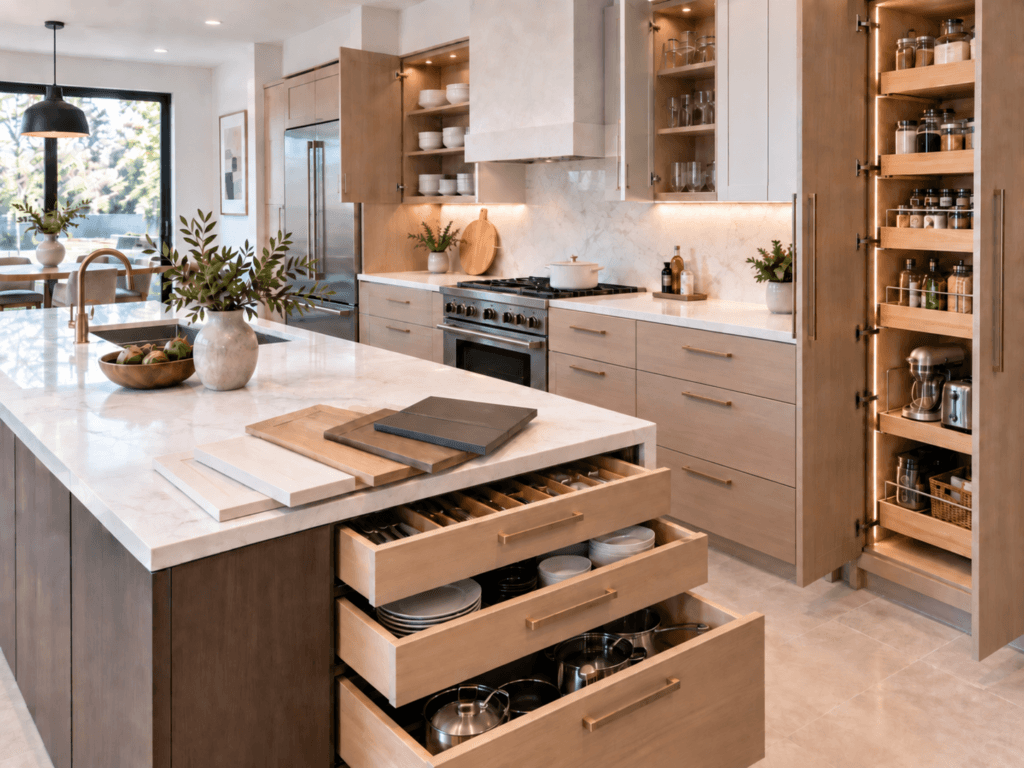
Kitchen cabinets and storage affect far more than appearance. Construction quality, storage layout, drawer design, pantry space and hardware all influence how well the kitchen works every day. Plan storage around what you own and how you use the room before focusing on finishes.
START WITH THE BASICS
Cabinets Are More Than Doors and Boxes
Kitchen cabinetry is one of the largest investments in a remodel and one of the hardest things to change later. Before choosing a door style or color, look at how the cabinets are built, how much usable storage they provide and whether the layout supports the way you cook and store everyday items.
A well-planned kitchen should make frequently used items easy to reach while giving larger or less-used items dedicated storage. Drawers, pullouts and pantry systems can often improve usability more than simply adding more cabinets.
HOW CABINETS ARE BUILT
Framed vs. Frameless Cabinets
Cabinet construction affects interior access, door style, installation and the overall look of the kitchen. The two main approaches used in residential cabinetry are framed and frameless construction.
FRAMED CABINETS
How are traditional framed cabinets built?
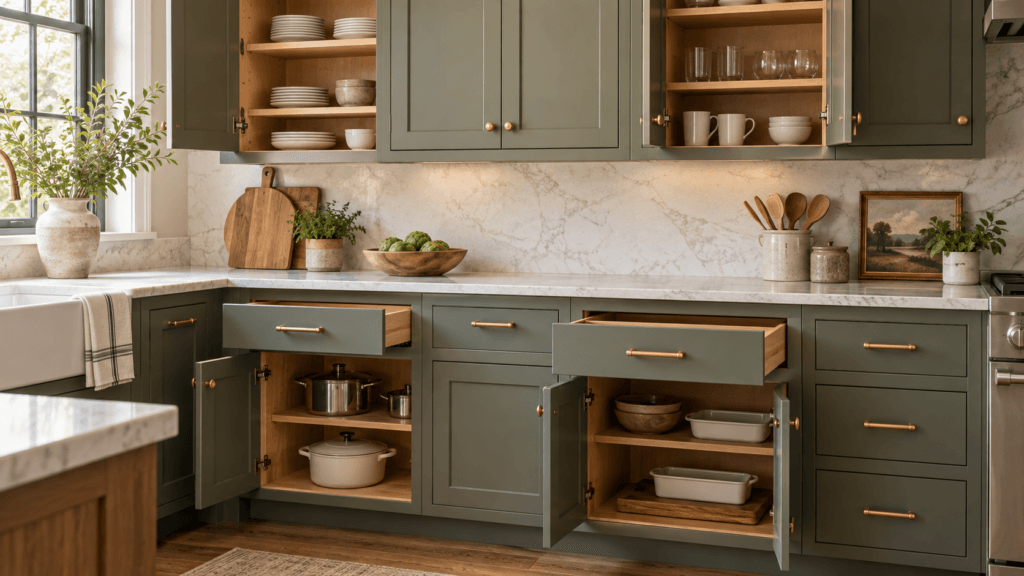
Framed cabinets have a face frame attached to the front of the cabinet box. The doors and drawers mount to or align with this frame, which adds rigidity and creates the more traditional construction commonly seen in many U.S. kitchens.
The face frame slightly reduces the usable opening, but framed cabinetry offers a wide range of door styles and overlay options and is familiar to most cabinet installers.
FRAMELESS CABINETS
What makes frameless cabinets different?
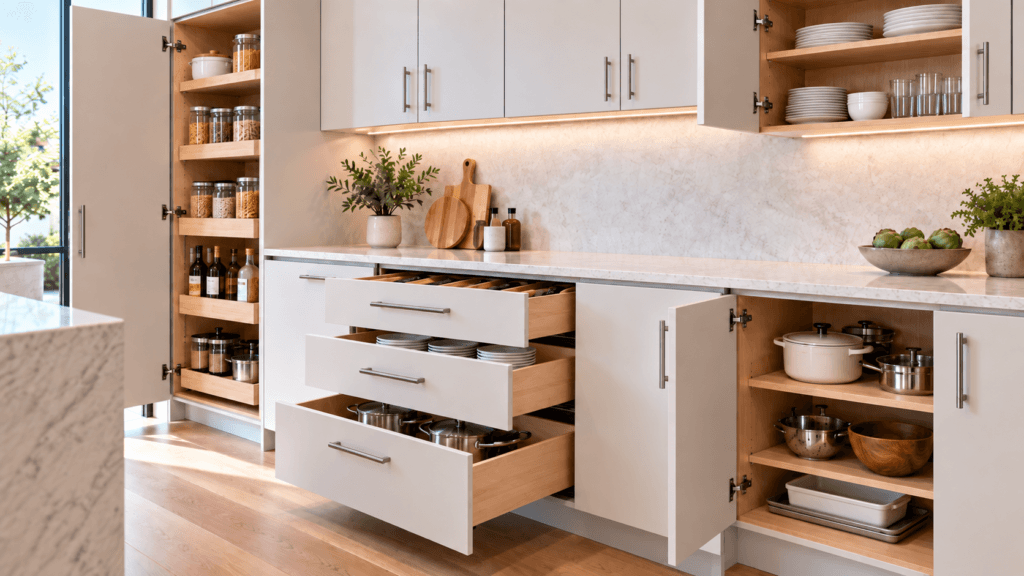
Frameless cabinets eliminate the front face frame, so the doors and drawers attach directly to the cabinet box. This creates wider interior access and a clean, streamlined appearance often associated with modern or European-style kitchens.
Because the cabinet boxes and hardware control alignment, accurate installation becomes especially important.
QUICK COMPARISON
Framed vs. Frameless Cabinets at a Glance
Both construction methods can produce high-quality cabinetry. The better choice depends on the look you want, available interior access, installation requirements and the cabinet manufacturer.
| Feature | Framed Cabinets | Frameless Cabinets |
|---|---|---|
| Front construction | Face frame attached to cabinet box | No face frame |
| Interior access | Opening is slightly reduced by frame | Wider access to cabinet interior |
| Door mounting | Hinges attach to face frame | Hinges attach directly to cabinet sides |
| Common appearance | Traditional to transitional | Modern to contemporary, but many styles are available |
| Door styles | Inset, partial overlay or full overlay | Most commonly full overlay |
| Drawer opening | Slightly narrower | Typically wider |
| Installation | Face frame helps with alignment | Box alignment must be very accurate |
| Common in | Many U.S. kitchens | European-style and modern cabinetry |
| Handles / pulls | Any style | Any style |
GOOD TO KNOW
Framed does not automatically mean traditional, and frameless does not mean handleless or ultra-modern. Door style, finish and hardware can dramatically change the appearance of either construction type.
CABINET QUALITY
What Makes a Quality Cabinet?
Cabinet quality is not determined by one material or feature. Look at how the box, drawers, hardware and finish are built and how those components work together over years of daily use.
CABINET BOX
What should you look for in the cabinet structure?
Check the material, thickness, joinery and overall rigidity of the cabinet box. Well-built boxes stay square, support shelves properly and provide a solid base for doors, drawers and countertops.
DRAWERS
Why does drawer construction matter?
Look for sturdy drawer boxes, secure joints and bottoms that resist sagging under weight. Full-extension drawers make it easier to reach items stored at the back.
HINGES & SLIDES
Which hardware features are worth paying for?
Quality hinges and drawer slides should operate smoothly, stay aligned and be adjustable. Soft-close hardware improves everyday use, while load capacity matters for heavy cookware and deep drawers.
FINISH & EDGES
How can you tell whether the finish will hold up?
Inspect the consistency of the finish, edge treatment and exposed surfaces. Durable coatings and well-sealed edges help cabinetry resist moisture, cleaning and everyday wear.
CABINET MATERIALS
What Are Kitchen Cabinets Actually Made From?
Kitchen cabinets are often built from a combination of materials rather than a single material throughout. Cabinet boxes, doors, drawer fronts and interior components may each use different products depending on cost, finish, strength and design.
01 — PLYWOOD
Where does plywood make sense in cabinetry?
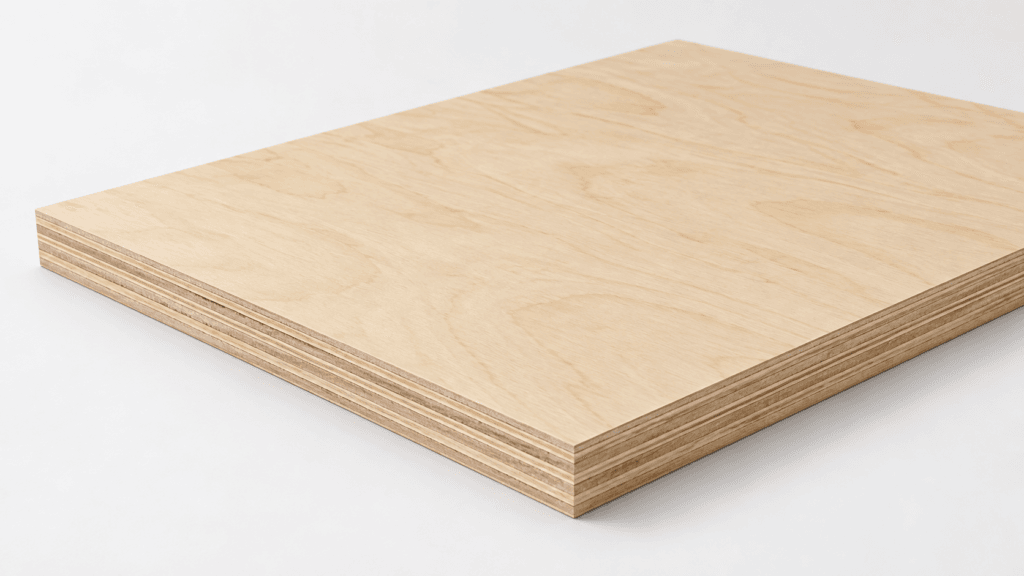
Plywood is commonly used for cabinet boxes, shelves and structural components. Its layered construction provides good strength and screw-holding ability while generally handling moisture better than many lower-density panel products.
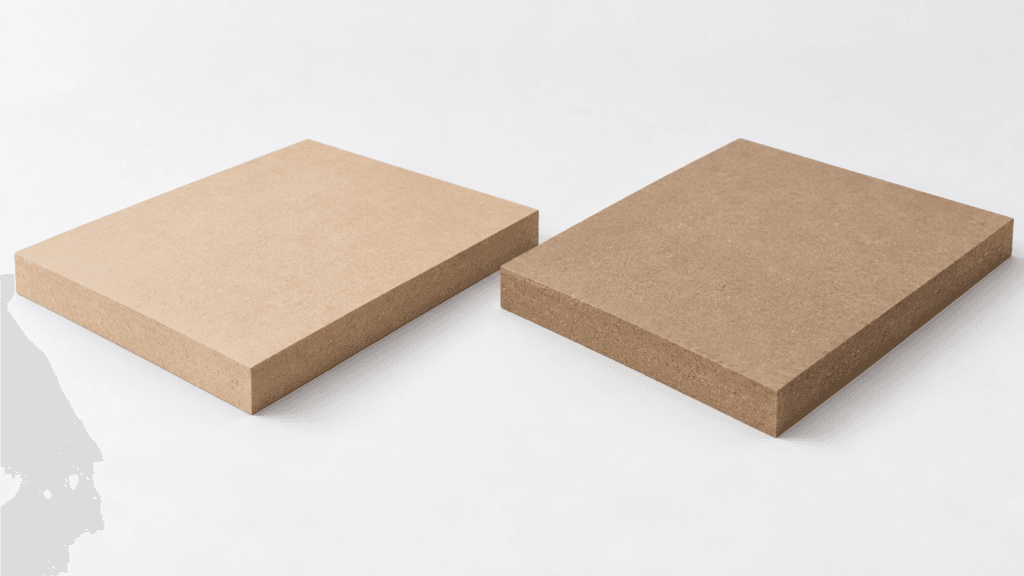
02 — MDF / HDF
Why is engineered fiberboard common on painted cabinets?
MDF and HDF provide a smooth, consistent surface that works particularly well for painted doors and detailed profiles. They resist the natural grain movement of solid wood, although exposed edges and damaged finishes should be protected from prolonged moisture.
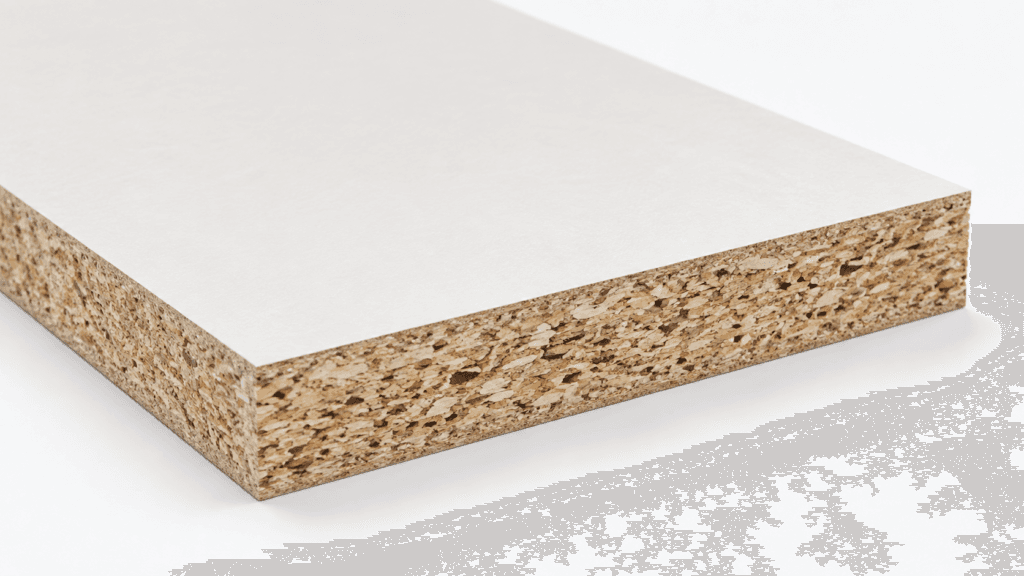
03 — PARTICLEBOARD
Does particleboard automatically mean low quality?
Not necessarily. Furniture-grade particleboard is widely used in cabinet boxes and panels, particularly in manufactured and frameless cabinetry. Quality varies considerably, so thickness, density, edge sealing and hardware attachment matter more than the name alone.
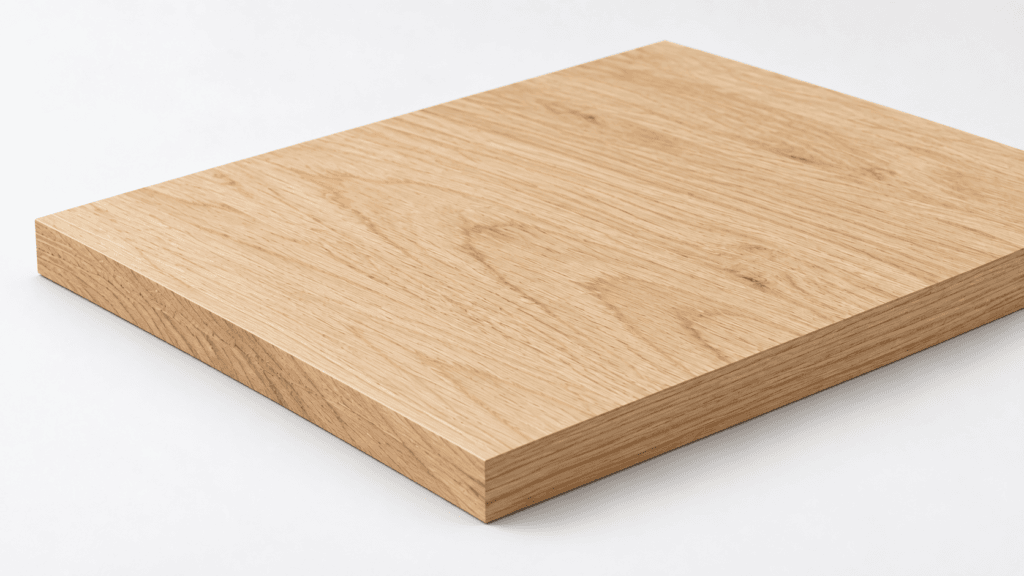
04 — SOLID WOOD
Where is solid wood typically used?
Solid wood is commonly used for cabinet doors, face frames, drawer fronts and decorative components rather than the entire cabinet box. It offers natural grain and character but can expand and contract as humidity changes.
GOOD TO KNOW
A cabinet advertised as “wood” does not necessarily mean every component is solid wood. High-quality cabinetry often combines plywood, engineered panels and solid wood in different parts of the cabinet based on how each material performs.
CABINET OPTIONS
Stock vs. Semi-Custom vs. Custom Cabinets
Cabinet categories are usually based on how much flexibility you get in sizing, construction, finishes and modifications. The best choice depends on budget, layout complexity and how specific your design requirements are.
STOCK CABINETS
When do stock cabinets make sense?
Stock cabinets are produced in standard sizes and a limited range of styles and finishes. They are usually the most affordable option and can work well when the kitchen layout fits common cabinet dimensions without many special modifications.
SEMI-CUSTOM CABINETS
What extra flexibility do semi-custom cabinets provide?
Semi-custom cabinets offer more sizes, finishes, door styles and factory modifications than stock cabinets. They can be a good middle ground when you want more design flexibility without the cost or lead time of fully custom cabinetry.
CUSTOM CABINETS
When is custom cabinetry worth considering?
Custom cabinets are built specifically for the project and can accommodate unusual dimensions, specialized storage, detailed finishes and unique design requirements. They offer the most flexibility but generally come with higher cost and longer production times.
GOOD TO KNOW
These categories are not strict quality rankings. A well-built stock cabinet can outperform a poorly built custom cabinet. Construction, hardware, finish quality and installation still matter.
STORAGE THAT WORKS
Plan Storage Around What You Actually Use
The most useful kitchen storage is planned around everyday items, not just the number of cabinets. Drawers, pullouts and dedicated storage zones can make the same amount of cabinet space much easier to use.
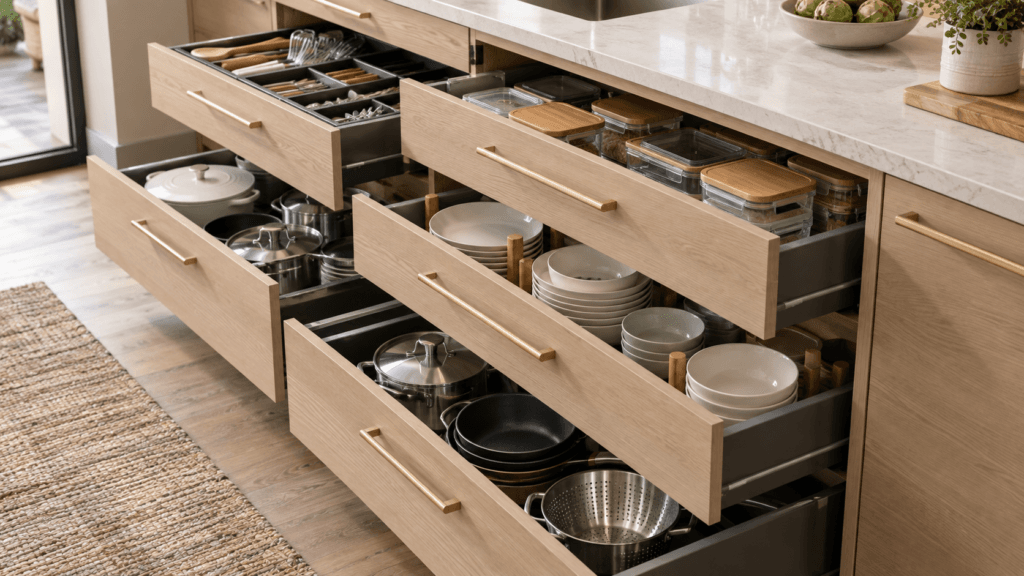
01 — DEEP DRAWERS
Why are deep drawers so useful in base cabinets?
Deep drawers provide full visibility and easier access to pots, pans, dishes and food storage containers without reaching into the back of a cabinet.
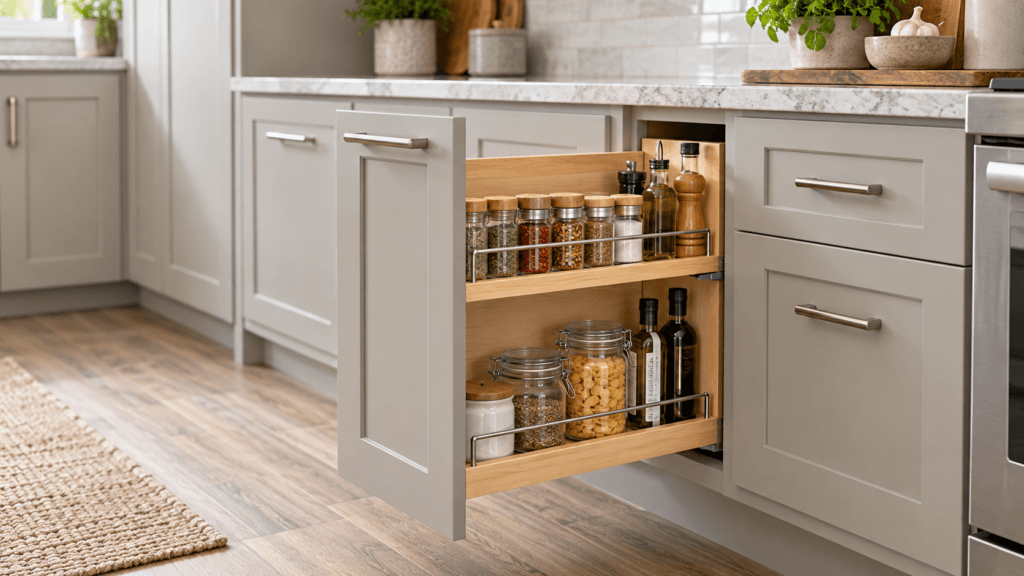
02 — PULL-OUT SHELVES
Can existing cabinet space be easier to reach?
Pull-out shelves bring stored items forward, making deep base cabinets and pantry cabinets easier to organize and use without crouching or reaching into the back.
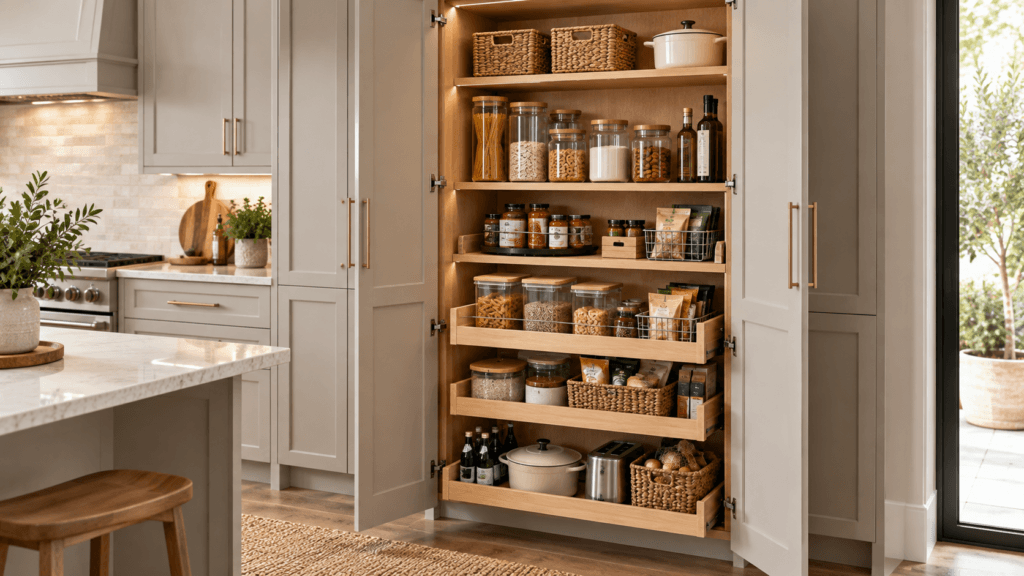
03 — TALL PANTRY STORAGE
How can you make better use of vertical space?
Tall pantry cabinets can organize dry goods, small appliances and bulk items in one dedicated area. Adjustable shelves and pullouts help keep deeper storage accessible.
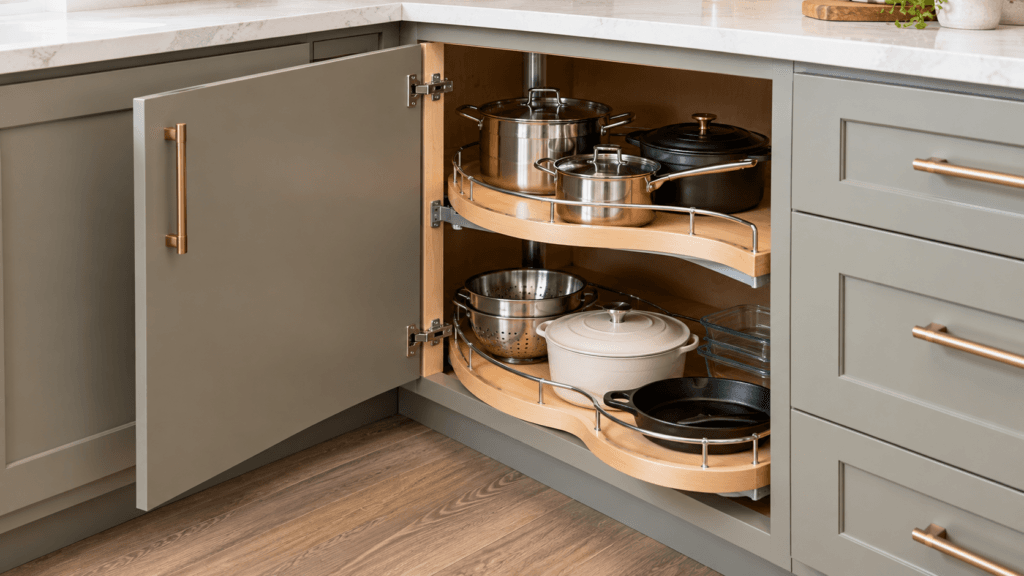
04 — CORNER CABINET SOLUTIONS
What can you do with difficult corner space?
Lazy Susans, pull-out trays and specialized corner hardware can improve access to areas that otherwise become deep, hard-to-reach storage.
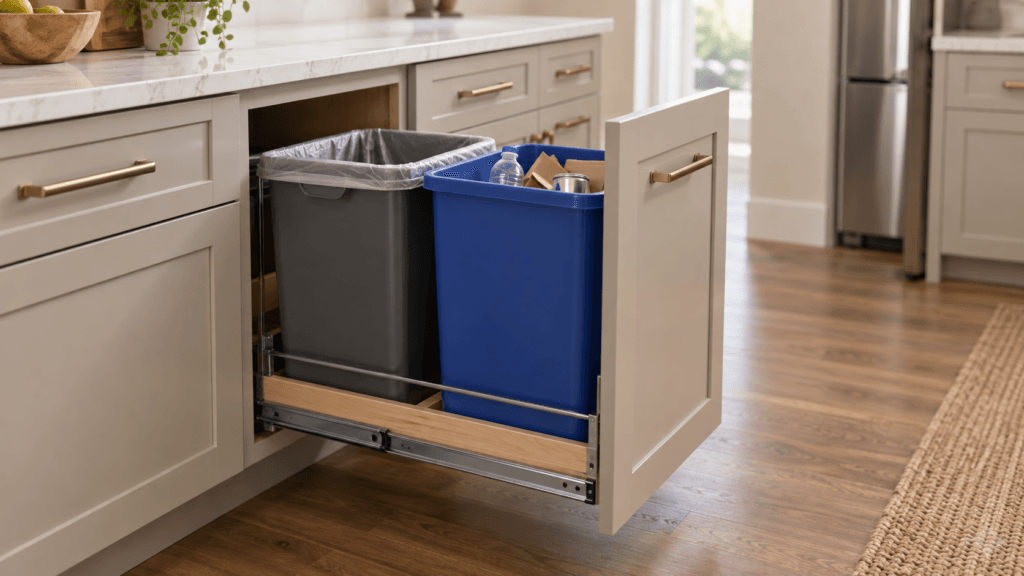
05 — TRASH & RECYCLING PULLOUTS
Where should trash and recycling be located?
Built-in pullouts keep bins hidden while placing them close to prep and cleanup areas. The location should allow the cabinet to open without blocking major walkways.
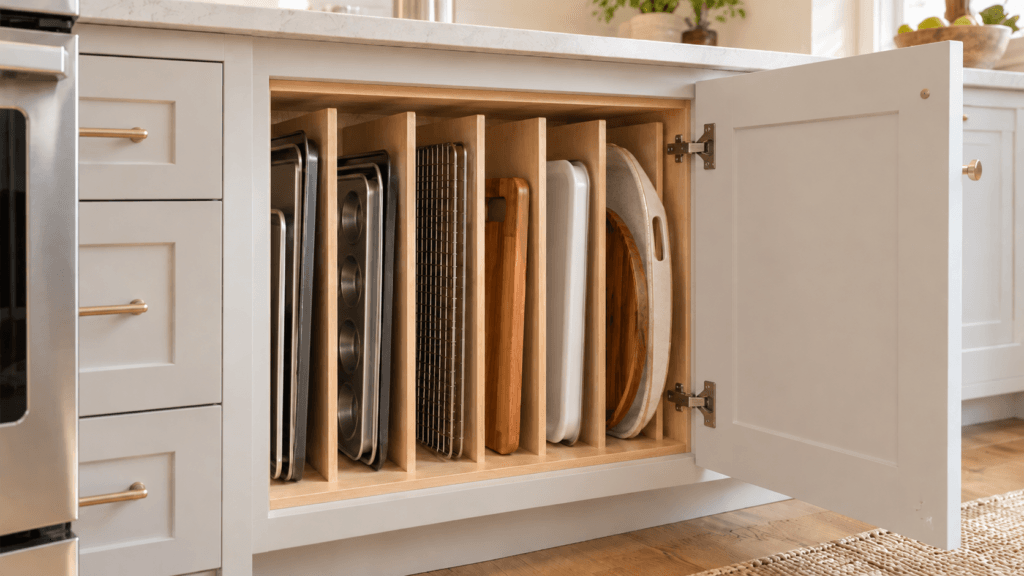
06 — TRAY & SHEET-PAN DIVIDERS
How should flat cookware be stored?
Vertical dividers keep baking sheets, cutting boards, trays and serving pieces upright so they are easier to see and remove without unstacking everything.
DRAWERS VS. DOORS
Where Do Drawers Make More Sense Than Cabinet Doors?
Base cabinets do not all have to use traditional doors and shelves. In many kitchens, wide drawers make everyday items easier to see and reach, while cabinet doors still make sense in certain locations.
DEEP DRAWERS
When are drawers the better choice?
Deep drawers work especially well for pots, pans, dishes, food containers and other frequently used items. Pulling the entire storage area toward you makes it easier to see what is inside without crouching or reaching into the back of a cabinet.
They are especially useful in wide base cabinets where traditional shelves can create deep, hard-to-reach storage.
CABINET DOORS
Where do doors and shelves still make sense?
Traditional cabinet doors remain useful under sinks, around plumbing, for certain specialty appliances and in locations where adjustable shelving provides more flexibility.
Doors can also be practical for unusually tall items or cabinet configurations where drawers would reduce usable interior height.
GOOD TO KNOW
There is no reason every base cabinet has to use the same storage type. A well-planned kitchen often combines drawers, doors, pullouts and specialty storage based on what will actually be stored in each location.
AVOID THESE
Common Cabinet & Storage Mistakes
Cabinet problems are often caused by planning decisions made before the cabinets are ordered. Check these issues early, while sizes, storage features and appliance locations can still be adjusted.
01 — TOO MANY DOORS, NOT ENOUGH DRAWERS
Relying heavily on traditional base cabinets can create deep storage that is difficult to see and reach. Use drawers where they improve access to cookware, dishes and everyday items.
02 — IGNORING CORNER ACCESS
Corner cabinets can waste a surprising amount of space if access is not planned. Consider lazy Susans, pull-out systems or other solutions before the cabinet layout is finalized.
03 — POOR PANTRY PLANNING
A pantry may provide plenty of volume but still be difficult to use if shelves are too deep or items become hidden. Match shelf depth and storage systems to what you actually keep there.
04 — ORDERING CABINETS BEFORE APPLIANCES
Refrigerators, ranges, wall ovens, microwaves and dishwashers all affect cabinet dimensions and clearances. Finalize appliance sizes before cabinets go into production.
05 — CHOOSING LOOKS OVER CONSTRUCTION
Door style and color are important, but cabinet boxes, drawer construction, hinges and slides determine how cabinetry performs over time. Compare what is behind the finish as well as what you see.
06 — FORGETTING TRASH & RECYCLING
Trash and recycling are used constantly but often planned late. Decide where bins will go early so they are convenient to prep and cleanup areas without blocking circulation.
BEFORE YOU ORDER
Cabinet & Storage Checklist
Before cabinets go into production, confirm the dimensions, appliance requirements, storage plan and finish selections. Cabinet changes become much more expensive once manufacturing begins.
□ Final kitchen measurements are confirmed
□ Appliance models and dimensions are finalized
□ Refrigerator, oven and dishwasher clearances are checked
□ Cabinet door and drawer swings do not conflict
□ Fillers and finished end panels are accounted for
□ Framed or frameless construction is confirmed
□ Cabinet box materials are understood
□ Door style and finish are selected
□ Drawer boxes, slides and hinges are specified
□ Deep drawers are planned where useful
□ Pantry storage is sized for actual needs
□ Corner cabinet access is resolved
□ Trash and recycling storage is planned
□ Tray, sheet-pan and specialty dividers are located
□ Sink-base plumbing and waste clearances are checked
□ Range hood and ventilation requirements are coordinated
□ Lighting and electrical locations are coordinated with cabinets
□ Countertop thickness and support requirements are confirmed
□ Hardware style and placement are selected
□ Delivery, installation and lead times are understood
Bottom Line
Kitchen cabinets should be chosen for more than appearance. Construction quality, usable storage, hardware, materials and layout all affect how the kitchen performs every day.
A good cabinet plan starts with what you need to store and how you use the room, then builds the cabinetry around those needs. The best-looking kitchen can still be frustrating if drawers are difficult to access, pantry storage is poorly planned or appliance clearances were overlooked.